Before You Listen
- Prerequisites: the basic neuron architecture from EDX-01 (axon, myelin, dorsal root ganglion (DRG) cell body); the instrumentation rules from EDX-02 (supramaximal stimulation, filter settings); the minimum limb temperature for a valid study, 32 °C at the hand and 31-32 °C at the foot, with conduction velocity slowing about 1.5-2.5 m/s and distal latency lengthening about 0.2 ms for every degree Celsius of cooling; the Erlanger-Gasser fiber-diameter classification; Wallerian degeneration timing (motor CMAP down about 50% by day 3-5, gone by about day 7 with the last detectable responses at day 9; sensory SNAP down about 50% by day 7 and unobtainable by day 11).
- Runtime: 43 minutes.
- Topic in one line: the five core nerve conduction study (NCS) parameters (latency, amplitude, conduction velocity, duration, area), the compound muscle action potential (CMAP) versus sensory nerve action potential (SNAP) distinction with the dorsal-root-ganglion-preservation rule that defines preganglionic versus postganglionic localization, the historical AAEM 1999 segment-specific amplitude OR area criteria for partial conduction block (Section 3), the antidromic-versus-orthodromic technique trade-off, the three classic anomalous innervations (Martin-Gruber anastomosis (MGA), Riche-Cannieu anastomosis (RCA), accessory deep peroneal nerve (accessory DPN)) and the paradoxical CMAP patterns they produce, the axonal-versus-demyelinating dichotomy (demyelinating pattern = distal latency >130% ULN or CV <75% LLN) with the uniform-versus-non-uniform rule (uniform slowing favors CMT1A; patchy slowing with block favors an acquired process, with exceptions), and the inching technique with the carpal-tunnel-syndrome (CTS) comparison studies.
Vignette. A 52-year-old right-handed accountant presents with three months of progressive, asymmetric distal weakness in both hands and a foot drop on the right. Reflexes are reduced. Motor NCS show a median CMAP at the wrist of 3.2 mV with a CMAP at the elbow of 6.8 mV, with a negative-peak duration of 7.2 ms at the wrist and 7.5 ms at the elbow; ulnar motor CMAP at the wrist is 8.6 mV, at the elbow 4.1 mV, with similar duration. Median sensory studies show a normal-amplitude SNAP. F-waves are prolonged. Sural and superficial fibular SNAPs are preserved.
Which AANEM consensus criterion is met for conduction block, what is the most likely electrodiagnostic diagnosis, why are the SNAPs spared, and what single anomalous innervation must be excluded before locking in the diagnosis?
(Answer at the end of this chapter)
Section 1: The Five Parameters and Why DML Cannot Yield a Velocity
Bottom line: the five NCS parameters (latency, amplitude, conduction velocity (CV), duration, area) each test a different physical aspect of the nerve; onset latency is the standard for motor and peak latency is the standard for sensory; the distal motor latency (DML) includes nerve conduction time plus neuromuscular junction (NMJ) delay (~0.5-1.0 ms) plus muscle fiber activation, so a true CV cannot be calculated from a single distal stimulation site.
Every NCS begins with a stimulus delivered to a peripheral nerve and a response captured at a distant electrode. Five core parameters are extracted from each tracing. Latency is the time interval from stimulus to response, in milliseconds (ms). Onset latency runs from the stimulus artifact to the initial deflection from baseline; it captures the fastest-conducting fibers and is the standard for motor studies. Peak latency runs from the stimulus artifact to the negative peak of the response; it is the standard for sensory studies because the SNAP is small (microvolts (microV)) and the takeoff from baseline is harder to call than the well-defined peak. The distal motor latency (DML) is the onset latency at the most distal standard stimulation site and folds three components into one number: distal nerve conduction time, NMJ transmission time (~0.5-1.0 ms of synaptic delay), and muscle fiber depolarization time. Because the DML includes NMJ transmission and muscle fiber activation in addition to nerve conduction time, a true CV cannot be calculated from a single distal stimulation site; CV calculation requires at least two stimulation points so that the shared non-neural components cancel out in the subtraction.
Amplitude reflects how many fibers contribute to the response. CMAP amplitude is measured baseline-to-negative-peak in millivolts (mV), with normal values 2-20 mV depending on the nerve-muscle pair. SNAP amplitude is measured baseline-to-peak or peak-to-peak in microV, with normal values 6-80 microV. The thousand-fold scale difference exists because the SNAP is a direct nerve recording while the CMAP is amplified by the NMJ-and-muscle generator. A reduced CMAP has four causes worth memorizing: axonal loss, conduction block, NMJ failure, and technical errors (submaximal stimulation, active electrode (E1) off the motor point). A reduced SNAP usually means sensory axonal loss or a postganglionic lesion, the diagnostic backbone of the next section. Age, temperature, recording technique and phase cancellation also lower it, so confirm the method before calling a small SNAP pathological.
Conduction velocity (CV) is the speed of action-potential propagation, calculated as CV (m/s) = Distance (mm) / (Proximal Latency − Distal Latency) (ms). The subtraction strips out the NMJ-and-muscle component. Normal motor CV is greater than or equal to 49-50 m/s in the upper extremity (UE) and greater than or equal to 40-44 m/s in the lower extremity (LE); the slower LE values reflect longer nerves, slightly cooler temperatures, and modest fiber-diameter differences. Treat these as typical adult ranges rather than universal cutoffs: every laboratory sets its own normal values, and the large normative task-force compilations differ by nerve, technique and demographic group. Conduction velocity is set by temperature, age, height and the segment measured, and in the leg height matters most. Sural, fibular and tibial velocities fall as height rises, strongly enough that a tall patient’s low-40s fibular velocity can be normal for them; median velocity does not track height, so the same allowance does not apply in the arm. Height lengthens distal latency in every nerve, the median included. The segment rate differs by limb as well: minimum F-wave latency rises about 0.2 ms per cm of height in the arm and 0.4 ms per cm in the leg, which is why an F-wave limit must be height-corrected and why a cutoff cannot simply be moved from one segment to another. They are also adult figures. Velocity is about half the adult value at birth, rises steeply through the first year to roughly three quarters to four fifths of adult, and reaches adult values by about age 3 to 5; it peaks in the fourth decade and then falls by roughly 1-2 m/s per decade, so a slow value at either end of life may be normal for age. CV reflects the fastest, largest myelinated fibers and is the parameter most sensitive to demyelinating pathology. Duration is measured from initial deflection to baseline crossing and reflects the range of conduction velocities (temporal dispersion) among contributing fibers. Area under the negative phase is the voltage–time integral (mV·ms for CMAP), not electrical charge. It is less susceptible than peak amplitude to temporal dispersion, which is why the conduction-block criteria give it its own threshold; dispersion severe enough to cause phase cancellation can still reduce area as well. Read amplitude, area and duration together inside whichever conduction-block framework you are using.
Normal Reference Values
The following reference values are the board answers. Read them as typical adult ranges tied to a named nerve and recording site: each laboratory establishes its own normal values, and the large normative task-force compilations differ from the taught figures partly because they standardize a different distal recording distance. Where a stem gives a value close to a limit, the nerve, the recording muscle and the distance matter as much as the number:
| Nerve & Study Type | Recording Site | Distal Latency | Amplitude | Conduction Velocity |
|---|---|---|---|---|
| Median Motor | Abductor pollicis brevis (APB), reference-value distance | ≤ 4.4 ms (onset); ≤ 4.2 ms at a standardized 8 cm | ≥ 4.0 mV | ≥ 49 m/s |
| Ulnar Motor | Abductor digiti minimi (ADM) | ≤ 3.3 ms (onset) | ≥ 6.0 mV | ≥ 49 m/s |
| Fibular Motor | Extensor digitorum brevis (EDB) | ≤ 6.5 ms (onset) | ≥ 2.0 mV | ≥ 44 m/s |
| Tibial Motor | Abductor hallucis (AH) | ≤ 5.8 ms (onset) | ≥ 4.0 mV | ≥ 41 m/s |
| Median Sensory | Digit 2 (14 cm distance) | ≤ 3.5 ms (peak) | ≥ 20 μV | — |
| Ulnar Sensory | Digit 5 (14 cm distance) | ≤ 3.1 ms (peak) | ≥ 17 μV | — |
| Radial Sensory | Anatomical snuffbox (10 cm) | ≤ 2.9 ms (peak) | ≥ 15 μV | — |
| Sural Sensory | Posterior lateral calf to ankle | ≤ 4.4 ms (peak) | ≥ 6 μV | — |
| Superficial Fibular | Lateral lower leg to foot dorsum | ≤ 4.4 ms (peak) | ≥ 6 μV | — |
A distal latency means nothing without its distance. Median motor recording from APB, the conventional upper limit is 4.4 ms in the reference-value set above and 4.2 ms at a standardized 8 cm wrist-to-recording distance, which is the convention the carpal-tunnel material in EDX-08 uses. Both are conventions over two segments, not a disagreement about physiology. Answer with the convention the question gives you; if it gives 8 cm, the limit is 4.2 ms. The same rule applies to temperature: warm the limb to at least 32 °C at the hand before any of these numbers mean anything.
The sensory rows are standardized at 14 cm (a 7 cm variant exists, and its latencies are roughly 1.4 ms shorter, so never mix the two). Know the traditional limits above as the exam answers, and know that the large normative series at that same 14 cm distance puts the mean peak latency at about 3.4 ms for both the median digit 2 and the ulnar digit 5 study, with an ulnar sensory amplitude lower limit near 10 µV. The taught 3.1 ms ulnar cutoff therefore sits below the normative mean, and it is not a 7 cm value either: the same normative chart puts the median palm 7 cm peak-latency upper limit at about 2.3 ms, so a 7 cm cutoff sits near 2 ms, not near 3. Use your laboratory’s limits clinically.
Normative task-force values differ by nerve, method and demographic group. Match the laboratory reference method; a fibular velocity in the low 40s does not by itself establish demyelination.
Match the reference method. Board answer: ulnar sensory amplitude lower limit ≥17 µV. The AANEM normative chart gives different method- and demographic-specific limits; do not substitute a study mean for a lower reference limit.
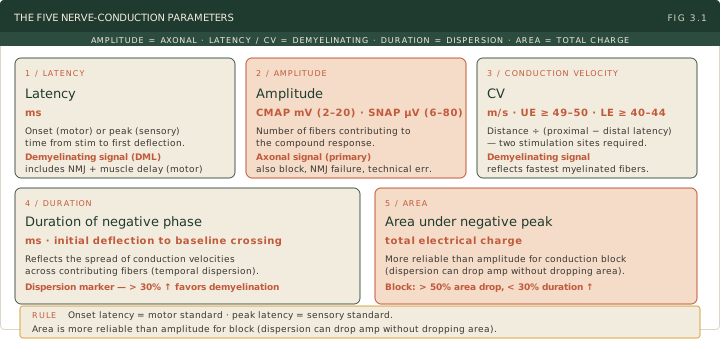
High Yield — The five NCS parameters
- Onset latency = standard for motor (fastest fibers).
- Peak latency = standard for sensory (more reproducible than the takeoff of a microvolt-level SNAP).
- DML = nerve conduction + ~0.5-1.0 ms NMJ + muscle activation; CV cannot be calculated from a single distal stimulation site.
- CMAP amplitude = mV (2-20 mV); reduced by axonal loss, conduction block, NMJ failure, technical error.
- SNAP amplitude = microV (typical teaching range 6-80 microV); reduced mainly by sensory axonal loss or a postganglionic lesion, with age, technique and phase cancellation as the confounders to exclude.
- CV (m/s) = distance / (proximal − distal latency); normal UE ≥49-50 m/s, LE ≥40-44 m/s.
- CV determinants = temperature, age, height and the segment measured. Height matters most in the leg: sural, fibular and tibial velocities fall as height rises, so a tall patient’s low-40s fibular velocity can be normal for them. Median velocity does not track height, so the same allowance does not apply in the arm; height does lengthen distal latency in every nerve, the median included. Minimum F-wave latency rises about 0.2 ms per cm of height in the arm and 0.4 ms per cm in the leg, which is why a cutoff cannot be moved from one segment to another (EDX-04).
- Duration = temporal dispersion marker.
- Area = voltage–time integral (mV·ms); less vulnerable than amplitude to dispersion, which is why block criteria give it a separate threshold. Not immune: phase cancellation reduces area too.
Mnemonic — “DML carries luggage; you can’t time it alone”
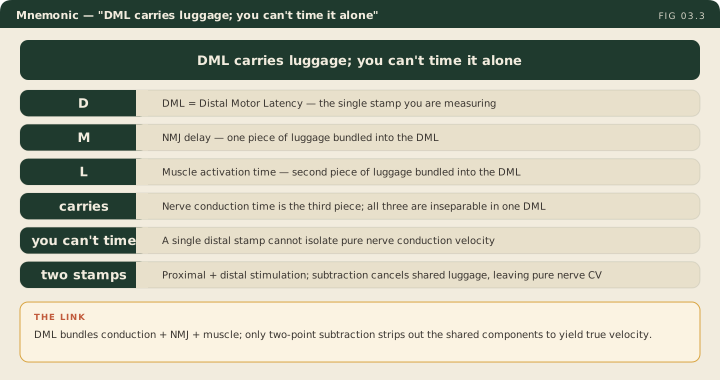
The DML carries three pieces of luggage at once: nerve conduction, NMJ delay, and muscle activation. You can’t separate them with a single stamp. Two stamps (a proximal and a distal stimulation site) let the shared luggage cancel out in the subtraction, so the difference is pure nerve conduction time, and only then can you compute a velocity.
Antidromic vs orthodromic recording — the trade-off
The choice between antidromic and orthodromic sensory recording trades signal size against contamination. Antidromic recording stimulates proximally and records distally, opposite to physiologic sensory conduction. Digital SNAPs are larger with this arrangement, because the recording electrodes lie close to the superficial digital nerves in a thin finger, not because receptors amplify anything. The cost is motor volume conduction: the proximal stimulus also activates motor fibers, and the muscle response can contaminate the trace. Orthodromic recording stimulates the digit and records proximally over the nerve trunk, in the physiologic afferent direction; the SNAP is smaller, but confining stimulation to the sensory digital nerve removes the motor contamination. Neither routine method tests unmyelinated small fibers. Practical defaults: antidromic for median and ulnar sensory studies in CTS evaluation, where the larger amplitude wins; antidromic for the sural as well, stimulating the calf and recording behind and below the lateral malleolus, though co-stimulation of neighbouring nerves still needs attention; orthodromic where motor co-stimulation over a mixed nerve would genuinely obscure the trace. Match each technique to its reference distances and laboratory norms.
Normal-value reference (adult)
| Nerve | DML cutoff | Min CMAP | CV cutoff | SNAP peak latency / amplitude |
|---|---|---|---|---|
| Median (motor) | ≤4.4 ms (reference-value distance); ≤4.2 ms at 8 cm | ≥4 mV | ≥49 m/s | — |
| Ulnar (motor) | ≤3.3 ms | ≥6 mV | ≥49 m/s | — |
| Tibial (motor) | ≤5.8 ms | ≥4 mV | ≥41 m/s | — |
| Fibular (motor) | ≤6.5 ms | ≥2 mV | ≥44 m/s | — |
| Median (sensory) | — | — | — | ≤3.5 ms / ≥20 µV (digit II antidromic) |
| Ulnar (sensory) | — | — | — | ≤3.1 ms / ≥17 µV (digit V antidromic) |
| Sural (sensory) | — | — | — | ≤4.4 ms / ≥6 µV |
These are the board reference values; each laboratory’s method-specific ranges govern its own reports. Sural amplitude declines with age, and absence becomes more frequent in advanced age. Age 60–70 alone does not make an absent response normal: verify technique and interpret the complete clinical and EDX pattern.
That massive difference exists because the SNAP is a direct recording of the nerve itself. You are just picking up the electrical depolarization of the axons passing right under the electrode. The CMAP, on the other hand, relies on the neuromuscular junction, the NMJ, and the muscle tissue acting as a massive biological amplifier.
— EDX-03 podcast, ~6:28