Before You Listen
- Prerequisites: the basic motor and sensory NCS framework from EDX-03 (CMAP, SNAP, distal motor latency, supramaximal stimulation, conduction block); the dorsal-root-ganglion (DRG) rule; the Erlanger-Gasser fiber classification (especially Group Ia muscle-spindle afferents, the largest and lowest-threshold sensory fibers); the cranial nerve five and seven (CN V and CN VII) anatomy; and the brainstem syndromes from CVA-01 (Wallenberg lateral medullary, lateral pontine).
- Runtime: 39 minutes.
- Topic in one line: the F-wave as a non-reflex motor backfire recorded using standard supramaximal stimulation, the H-reflex as the useful late-response adjunct for S1 radiculopathy, the A-wave as a stereotyped late motor response with several possible mechanisms, the blink-reflex five-pattern localization rule (R1 in the pons, R2 in the lateral medulla), the Bell-palsy direct facial nerve prognostic cutoffs, the phrenic nerve study (C3-4-5), the SSEP generators with 50%-amplitude / 10%-latency intraoperative alarm criteria, the RNS decrement-versus-increment dichotomy (myasthenia gravis (MG) postsynaptic with usually normal baseline CMAP, Lambert-Eaton myasthenic syndrome (LEMS) presynaptic with low baseline plus dramatic increment), single-fiber EMG (SFEMG) jitter, and autonomic testing.
Vignette. A 56-year-old man with a 30-pack-year smoking history presents with several weeks of progressive proximal lower-extremity weakness, dry mouth, and constipation. Reflexes are diminished but improve transiently after brief exercise. Electrodiagnostic testing reveals a baseline ulnar CMAP amplitude of 1.8 mV (low). Slow repetitive nerve stimulation at 3 Hz produces a 22% decrement from the first to the fourth response. After 10 seconds of maximal voluntary contraction of the abductor digiti minimi, immediate post-exercise stimulation produces a CMAP amplitude of 5.2 mV. F-wave latencies are normal. SFEMG shows markedly increased jitter with frequent blocking.
What is the most likely diagnosis, what is the percent increment after exercise (and is it diagnostic), what is the underlying antibody target and presynaptic mechanism, and what is the single most important next step in the workup?
(Answer at the end of this chapter)
Section 1: F-Waves and the H-Reflex — Two Late Responses That Are Not the Same
Bottom line: the F-wave is NOT a reflex but an antidromic motor backfire recorded using standard supramaximal stimulation, with variable latency and morphology because a different ~1-5% of anterior horn cells (AHCs) backfire each time; the H-reflex IS a true monosynaptic Group Ia reflex requiring submaximal stimulation, with constant latency and morphology, and usually disappears at supramaximal intensity through antidromic collision; the tibial H-reflex is the useful late-response adjunct for S1 radiculopathy.
The single most important board fact is that the F-wave is not a reflex. It has no afferent limb, no synapse, and no sensory component. Mechanism: a supramaximal stimulus to a motor nerve sends an action potential in two directions. Orthodromically, distally toward the muscle, producing the M-wave (CMAP). Antidromically, proximally back along the motor axon to the AHC body. When the antidromic impulse reaches the AHC, approximately 1-5% of motor neurons “backfire”: they re-excite and generate a new orthodromic action potential traveling back down the same motor axon to the muscle, producing the late F-wave. The letter F stands for “foot” because Magladery and McDougal first recorded it from foot muscles in 1950.
Because a different random 1-5% subset of AHCs backfires with each successive stimulus, the F-wave has variable latency and variable morphology. Standard F-wave studies use supramaximal stimulation for three reasons: all motor axons must be activated to maximize backfiring; supramaximal stimulation suppresses H-reflex contamination through antidromic collision; and reproducibility requires consistent activation of the motor neuron pool. Record 20 stimuli per nerve, the IFCN standard for minimal latency and persistence; count the stimuli delivered, not the F-waves obtained. Use nerve-specific reference values, adjusted for height and age, and know the adjustment rates: minimum F-wave latency rises about 0.2 ms per cm of height in the arm and 0.4 ms per cm in the leg, and about 0.03 ms per year of age in the arms and 0.1 ms per year in the legs. Height explains almost half the variability in minimum F-wave latency, which is why an F-wave limit must be height-corrected and why a cutoff cannot be moved from one segment to another. Key parameters: minimal F-wave latency (the most commonly used clinical parameter, reflecting the fastest motor fibers’ conduction from stimulation site to spinal cord and back, plus ~1 ms AHC turnaround); chronodispersion (max minus min latency); F-wave persistence (% of stimuli producing an F-wave, normal >50-80%); the F ratio = (F latency − M latency − 1) / (2 × M latency). Normal minimal F-wave latencies are approximately 25-32 ms for median and ulnar at the wrist and approximately 45-56 ms for tibial and fibular at the ankle. A side-to-side difference greater than 2 ms in the arms or 4 ms in the legs is abnormal, against nerve-specific laboratory reference values.
F-wave clinical applications center on assessing proximal motor segments inaccessible to routine NCS. In Guillain-Barre syndrome (GBS), F-wave abnormalities (prolonged latency, decreased persistence, or absent F-waves) may be the earliest electrodiagnostic finding because GBS frequently affects roots first; distal NCS can be normal in the first few days while F-waves are already abnormal. In chronic inflammatory demyelinating polyneuropathy (CIDP), prolonged latencies, increased chronodispersion, and decreased persistence suggest preferential proximal demyelination. In radiculopathy, F-wave sensitivity is only ~10-20% and F-waves cannot localize to a specific root because multiple roots contribute motor fibers to each peripheral nerve. In amyotrophic lateral sclerosis (ALS), the depleted motor neuron pool produces repeater F-waves (identical morphology on consecutive stimuli) because the same few neurons backfire repeatedly; repeaters are a nonspecific association of motor-unit loss, including ALS.
The H-reflex is fundamentally different. It is a true monosynaptic reflex, the electrical analog of the muscle stretch reflex (named for Paul Hoffmann, 1910). The arc has three parts: the afferent limb is Group Ia sensory fibers from muscle spindle primary endings (the largest, lowest-threshold sensory fibers); the central relay is a single synapse between Ia afferents and alpha motor neurons; the efferent limb is alpha motor neurons traveling via the ventral root to the muscle. Because the same motor neuron pool fires through the same arc each time, the H-reflex has constant latency and constant morphology. The standard clinical study is the tibial (soleus) H-reflex: stimulate the tibial nerve in the popliteal fossa with a long-duration stimulus (0.5-1.0 ms) to preferentially activate the large Ia afferents, record from the soleus midway between the popliteal crease and calcaneus. Normal latency is approximately 28-35 ms (height-dependent); side-to-side latency difference greater than 1.0-1.5 ms is abnormal; H/M ratio is approximately 0.5-0.7.
The H-reflex behavior with increasing stimulus intensity is a board favorite. At very low intensity, Ia afferents (lowest threshold) activate first; the H-reflex appears with no M-wave. As intensity rises to submaximal, more Ia fibers recruit, the H-reflex grows, and a small M-wave appears. At moderate intensity, the H-reflex reaches maximum amplitude. As intensity approaches supramaximal, the H-reflex amplitude decreases because the antidromic motor volley collides with and cancels the orthodromic H-reflex impulses returning from the cord. At supramaximal intensity the H-reflex usually disappears, the M-wave is maximal, and F-waves are sought; an H-reflex can persist in spasticity. Use submaximal stimulation for the H-reflex and supramaximal stimulation for standard F-wave recording. These are recording protocols, not thresholds below which a response cannot occur.
Clinical applications: the tibial H-reflex is the most useful late response for S1 radiculopathy, the electrical equivalent of the ankle jerk. An absent or prolonged unilateral tibial H-reflex supports S1 dysfunction, though it tests the whole arc and is not specific to the root; side-to-side comparison is more useful than absolute values; sensitivity is approximately 50% overall (up to 80% when acute). H-reflexes are prolonged or absent bilaterally in polyneuropathies (especially demyelinating); bilateral absence can be the earliest finding in GBS or diabetic polyneuropathy. Important caveat: H-reflexes may be absent bilaterally in normal individuals over age 60, so bilateral absence does not by itself clear a symptomatic patient. Technically reliable unilateral absence is significant at any age; investigate the whole reflex arc. The flexor carpi radialis (FCR) H-reflex tests the C6-C7 arc with reported sensitivity ~72% and specificity ~85% for cervical radiculopathy, but is not widely used due to technical difficulty.
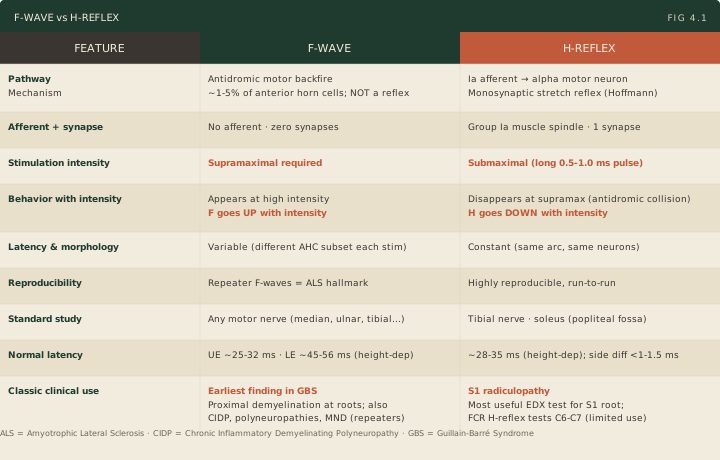
High Yield — F-wave and H-reflex
- F-wave is NOT a reflex: antidromic motor backfire from ~1-5% of AHCs; supramaximal stimulation; variable latency and morphology.
- H-reflex IS a reflex: monosynaptic Ia → alpha motor neuron arc; submaximal stimulation; constant latency and morphology.
- Standard F-wave recording uses supramaximal stimulation; the H-reflex usually disappears there (antidromic collision).
- Tibial (soleus) H-reflex is the most useful late response for S1 radiculopathy; side-to-side latency difference >1.0-1.5 ms is abnormal. It tests the whole arc, so it is not root-specific.
- F-wave reference values are height- and age-corrected: minimum F-wave latency rises about 0.2 ms per cm of height in the arm and 0.4 ms per cm in the leg, plus about 0.03 ms per year of age in the arms and 0.1 ms per year in the legs.
- F-wave abnormalities are often the earliest finding in GBS (proximal demyelination at roots).
- Repeater F-waves (identical morphology on consecutive stimuli) are a nonspecific association of motor-unit loss, including ALS.
- Bilateral H-reflex absence is common over age 60, but age alone does not clear a symptomatic patient; correlate with technique, the rest of the study and the examination.
Mnemonic — “F goes up; H goes down”
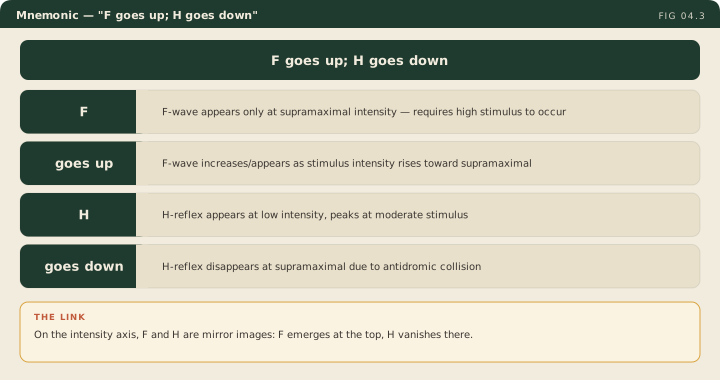
On the intensity axis the two responses move in opposite directions: the F-wave grows as intensity rises toward supramaximal, and the H-reflex appears at low intensity, peaks at moderate intensity, then falls away as antidromic motor collision increases. F goes up, H goes down. It is a recording heuristic rather than a law: F-waves can occur below supramaximal intensity, and H-reflexes can persist in spasticity.
As you increase the stimulator intensity more and more motor axons throw these antidromic volleys up the track Colliding with and wiping out the descending h reflex impulses.
— EDX-04 podcast, ~18:44
If you’re running an f-wave study and you see identical copy and paste late responses stimulus after stimulus It is a massive red flag. It indicates a depleted motor neuron pool and is a classic Diagnostic hallmark of motor neuron disease
— EDX-04 podcast, ~12:42
Current teaching clarification: This historical quotation overstates specificity. Frequent repeater F-waves can accompany motor-unit loss, including ALS, but do not diagnose ALS or distinguish it from other neurogenic disorders. Chroni et al., 2012.
But the f-wave cannot hide from a root lesion To complete its round trip that antidromic signal must travel through those inflamed demyelinated proximal roots Backfire and then travel through them a second time.
— EDX-04 podcast, ~9:20