Before You Listen
- Prerequisites: basic neurophysiology of the alpha motor neuron and motor unit; Wallerian degeneration; the principle that nerve conduction studies (NCS) and needle electromyography (EMG) together form the electrodiagnostic (EDX) examination; the concept that denervated muscle fibers develop membrane supersensitivity. EDX Episodes 1 through 4 covered NCS, F-waves, H-reflexes, repetitive nerve stimulation, and single-fiber EMG.
- Runtime: 24 minutes.
- Topic in one line: the four sequential phases of the needle examination (insertional activity, spontaneous activity at rest, motor unit action potential or MUAP morphology, recruitment), anchored by the auditory contrast of fat-frying-in-a-pan endplate spikes (initial negative deflection, normal) versus rain-on-a-tin-roof fibrillation potentials (initial positive deflection, metronomic regularity, pathological); the dive-bomber waxing-and-waning of myotonic discharges; the marching-soldiers myokymic discharges present in roughly 50 to 70% of radiation plexopathies; the Rule of Fives for recruitment; and the four integrated diagnostic patterns.
Vignette. A 55-year-old woman presents to the EDX laboratory with three weeks of progressive proximal arm and thigh weakness. She has difficulty rising from a chair and lifting her grandchildren. Her serum creatine kinase (CK) is markedly elevated. The needle EMG of the left deltoid shows increased insertional activity, 2+ fibrillation potentials and positive sharp waves (PSWs) at rest, short-duration low-amplitude polyphasic motor unit action potentials (MUAPs) on minimal effort, and a full interference pattern with low envelope amplitude at minimal voluntary effort.
Which of the four diagnostic patterns does this represent, why can fibrillation potentials occur in muscle disease, what single MUAP parameter is most reliable for distinguishing this from a chronic neurogenic disorder, and what diagnostic category and differential does the study support?
(Answer at the end of this chapter)
Section 1: Insertional Activity and the Resting Endplate Zone
Bottom line: the needle EMG is organized into four sequential phases (insertional activity, spontaneous activity, MUAP morphology, recruitment), and every muscle must be assessed through all four; insertional activity is the brief volley generated by needle movement through viable muscle, with increased activity indicating nonspecific membrane irritability and decreased activity indicating fibrosis or fatty replacement once needle placement is confirmed.
The needle EMG is the second pillar of the electrodiagnostic examination, complementing nerve conduction studies (NCS). NCS evaluate the peripheral nerve through conduction velocity, amplitude, and latency. The needle examination evaluates the muscle fiber, the neuromuscular junction (NMJ), and the motor unit as an integrated functional entity. A concentric or monopolar needle electrode is inserted directly into a muscle, and the examiner systematically evaluates electrical activity through four sequential phases: (1) insertional activity, (2) spontaneous activity at rest, (3) MUAP morphology during voluntary contraction, and (4) recruitment and interference pattern during graded effort. Every muscle must be assessed through all four phases.
Two electrode types are used. Concentric needle electrodes contain the active recording surface within a beveled cannula, with the cannula serving as the reference; they record from a smaller pickup territory. Monopolar needle electrodes have an insulated shaft and an exposed active tip, with a separate surface reference, and record from a larger territory. Monopolar recordings give larger amplitudes and, in paired recordings, longer durations; duration also depends on muscle and recording technique. Use reference values matched to the electrode, the muscle and the method, and never mix reference tables between electrode types.
Insertional activity is the brief burst of electrical activity generated when the needle electrode is moved through muscle tissue. The mechanical disruption of muscle fiber membranes produces a transient volley that lasts only as long as the needle is moving and ceases within a few hundred milliseconds (ms) after the needle stops. Normal insertional activity confirms that the needle is positioned within electrically viable muscle tissue.
Increased insertional activity is discharge prolonged beyond the brief response to needle movement. It indicates muscle membrane irritability and occurs with denervation, with the inflammatory myopathies (polymyositis, dermatomyositis, inclusion body myositis), with muscular dystrophy during active fiber degeneration, and with metabolic myopathies. It is nonspecific: it does not establish axonal injury on its own. In the first 1 to 2 weeks after nerve injury, increased insertional activity may be a muscle’s only abnormality. At 5 days after radicular symptom onset, increased insertional activity without fibrillations neither proves early denervation nor excludes radiculopathy. Read recruitment, the distribution of findings and the clinical picture, and repeat the study in 2 to 4 weeks when it is inconclusive and suspicion persists.
Decreased or absent insertional activity occurs when the needle encounters less excitable tissue. Common causes: fibrosis (muscle replaced by scar tissue), fatty replacement, severe longstanding denervation with fibrofatty replacement, acute rhabdomyolysis or severe compartment syndrome (early phase), and the trivial case of needle position outside muscle (subcutaneous fat, fascia, or tendon). A muscle with extensive fibrotic replacement is unlikely to recover useful function even if the nerve supply is restored.
After insertional activity is assessed, the examiner holds the needle still and listens for spontaneous activity. In normal muscle, outside the endplate zone, there should be electrical silence. Incomplete relaxation is one of the most common sources of artifact, because volitional motor unit firing may be misinterpreted as spontaneous activity.
The endplate zone is a normal source of electrical activity. Miniature endplate potentials (MEPPs, endplate noise) arise from spontaneous quantal release of acetylcholine vesicles at the NMJ. They are monophasic negative potentials of less than 100 microvolts (uV), firing irregularly and continuously at 20 to 40 hertz (Hz), producing a hissing sound classically described as a seashell held to the ear. Endplate spikes are generated when the needle irritates terminal nerve twigs in the endplate region. They range 100 to 500 uV, are biphasic or triphasic with an initial negative deflection, and fire irregularly with a sputtering pattern that sounds like fat frying in a pan. Frequency can reach 50 Hz, but firing is inconsistent. Both are normal findings at the motor endplate zone.
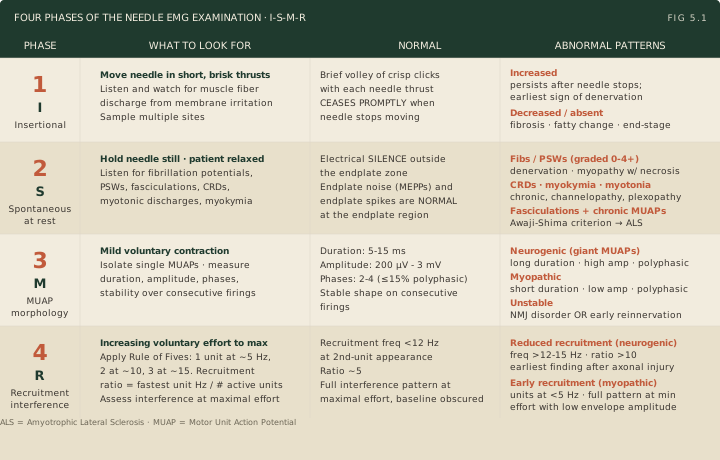
High Yield — Insertional activity and the four phases
- Four phases of needle EMG (in order): insertional activity, spontaneous activity at rest, MUAP morphology, recruitment / interference pattern.
- Normal insertional activity: brief volley with needle movement, ceases when needle stops.
- Increased insertional activity: prolonged response to needle movement; nonspecific membrane irritability in denervation, inflammatory myopathy or active dystrophy. May be the only abnormality in the first 1-2 weeks after nerve injury.
- Decreased insertional activity: fibrosis, fatty replacement, end-stage denervation, needle outside muscle. Important prognostic implications.
- Endplate noise (MEPPs): monophasic negative, less than 100 uV, irregular continuous firing at 20-40 Hz, “seashell” sound. NORMAL at endplate zone.
- Endplate spikes: biphasic/triphasic with initial negative deflection, 100-500 uV, irregular sputtering, “fat frying” sound. NORMAL.
- Concentric = smaller pickup territory; monopolar = larger territory and larger amplitudes. Duration also depends on muscle and technique. Match reference values to the electrode and muscle; never mix tables.
Mnemonic — “I-S-M-R” for the four phases
Insertional, Spontaneous, MUAP morphology, Recruitment. Every muscle, every time, in this order. If a board stem skips a phase, that is a clue to which finding is being tested.
The correct interpretation there is that denervation is in its very earliest phase. The timeline just hasn’t allowed fibrillations to emerge yet.
— EDX-05 podcast, ~7:48
Correction to the quoted teaching: insertional irritability on its own is nonspecific. Read recruitment, the distribution of findings and the clinical course before calling it early denervation.