Before You Listen
- Prerequisites: the four phases of needle electromyography (EMG) and the patterns of acute and chronic denervation from EDX-05; basic spinal nerve anatomy (root, dorsal root ganglion, ventral and dorsal primary rami, plexus formation); the H-reflex and F-wave physiology covered in EDX-04; and familiarity with the cervical and lumbosacral myotomes and dermatomes.
- Runtime: 1 hour 14 minutes.
- Topic in one line: the dorsal root ganglion (DRG) principle that keeps sensory nerve action potentials (SNAPs) normal in radiculopathy despite clinical sensory loss; the cervical (C5 to T1) and lumbosacral (L2 to S1) myotomes anchored on cross-nerve muscle pairs (deltoid + infraspinatus for C5, brachioradialis + pronator teres for C6, triceps + flexor carpi radialis for C7, first dorsal interosseous + flexor pollicis longus for C8, vastus medialis + tibialis anterior for L4, tibialis anterior + tibialis posterior for L5, medial gastrocnemius + gluteus maximus for S1); the evolution of EMG findings from reduced recruitment (days) through paraspinal fibrillations (7-10 days) to distal limb fibrillations (3-6 weeks); the soleus H-reflex as the S1 late response; the HI MADAM mnemonic; and the three-feature radiculopathy-versus-plexopathy table (SNAPs, paraspinals, distribution).
Vignette. A 45-year-old man presents with three weeks of progressive right foot drop. He reports lateral leg numbness and difficulty clearing his great toe when walking. Nerve conduction studies (NCS) show a normal right superficial fibular sensory nerve action potential (SNAP) and a normal sural SNAP. Needle EMG shows 2+ fibrillation potentials and positive sharp waves (PSWs) in the tibialis anterior (deep fibular nerve), peroneus longus (superficial fibular nerve), tibialis posterior (tibial nerve), and tensor fasciae latae (superior gluteal nerve). Lumbar paraspinals show 2+ fibrillations.
What is the diagnosis, why is the SNAP normal despite clinical sensory loss, which tibial-innervated muscle in this stem helps distinguish the diagnosis from a common fibular neuropathy at the fibular head, and what additional muscle would distinguish a sciatic neuropathy from a fibular neuropathy at the knee?
(Answer at the end of this chapter)
Section 1: The Dorsal Root Ganglion Principle
Bottom line: the dorsal root ganglion (DRG) sits in the intervertebral foramen outside the spinal canal; in radiculopathy the lesion is proximal to the DRG, so the peripheral sensory axon stays in continuity with its cell body, no Wallerian degeneration occurs, and the sensory nerve action potential (SNAP) is preserved despite clinical numbness. Normal SNAPs plus abnormal needle EMG in a myotomal distribution is the electrodiagnostic signature of radiculopathy. Read that signature with the examination and the rest of the study: a normal SNAP does not by itself prove a root lesion, and an abnormal one does not exclude it.
The dorsal root ganglion (DRG) principle is the central concept in the electrodiagnostic evaluation of radiculopathy. It explains why sensory nerve action potentials (SNAPs) remain normal in radiculopathy despite clinical sensory deficits.
The DRG is located in the intervertebral foramen, outside the spinal canal in most cervical and lumbar levels. It contains the cell bodies of primary sensory neurons. The peripheral process extends distally through the plexus and peripheral nerve to the sensory receptor; the central process extends proximally through the dorsal root into the spinal cord.
In a preganglionic radiculopathy, the nerve root is compressed or injured proximal to the DRG, within the spinal canal or at the foraminal entrance. Because the DRG cell body is intact and the peripheral sensory axon remains in continuity with it, that axon does not undergo Wallerian degeneration from the root lesion. It continues to conduct normally, and the SNAP is preserved.
The patient still has sensory symptoms (numbness, tingling, burning pain) in the dermatome of the affected root. These arise from dysfunction at the root level, disrupting sensory signal transmission into the spinal cord, but the peripheral sensory nerve is physiologically intact and the SNAP is preserved. The combination of normal SNAPs plus abnormal needle EMG in a myotomal distribution is the electrodiagnostic signature of radiculopathy. If the SNAP is abnormal in the territory of the clinical deficit, the lesion is at or distal to the DRG; the differential expands to plexopathy or peripheral neuropathy.
Several scenarios complicate this pattern. Concurrent peripheral neuropathy can reduce SNAPs independently. Direct DRG injury or foraminal/extraforaminal compression at or distal to the ganglion can also reduce a response in a root syndrome. An intraspinal L5 DRG can be exposed to an L4–L5 subarticular disc lesion; ganglion position also varies at S1. An abnormal SNAP therefore broadens the differential without excluding radiculopathy (Mondelli et al.; Ando et al.).
Five governing principles. First, radiculopathy cannot be diagnosed by NCS alone; needle EMG must be performed, and a clinical radiculopathy can still exist with a normal study. Second, the study must be timed appropriately, although the timing shifts yield rather than working as a clock. Third, a sufficient number of muscles must be examined: sample the suspected myotome through different peripheral nerves, compare adjacent roots, and include paraspinals. Fourth, the SNAP is preserved in preganglionic disease. Fifth, needle EMG evaluates motor-unit function, so pure sensory disease can give a normal study and motor conduction block can reduce recruitment without producing fibrillations. Needle-EMG sensitivity for cervical radiculopathy is 50 to 71 percent in the 1999 practice parameter; that parameter’s separate 65 to 85 percent figure is agreement with imaging, not sensitivity.
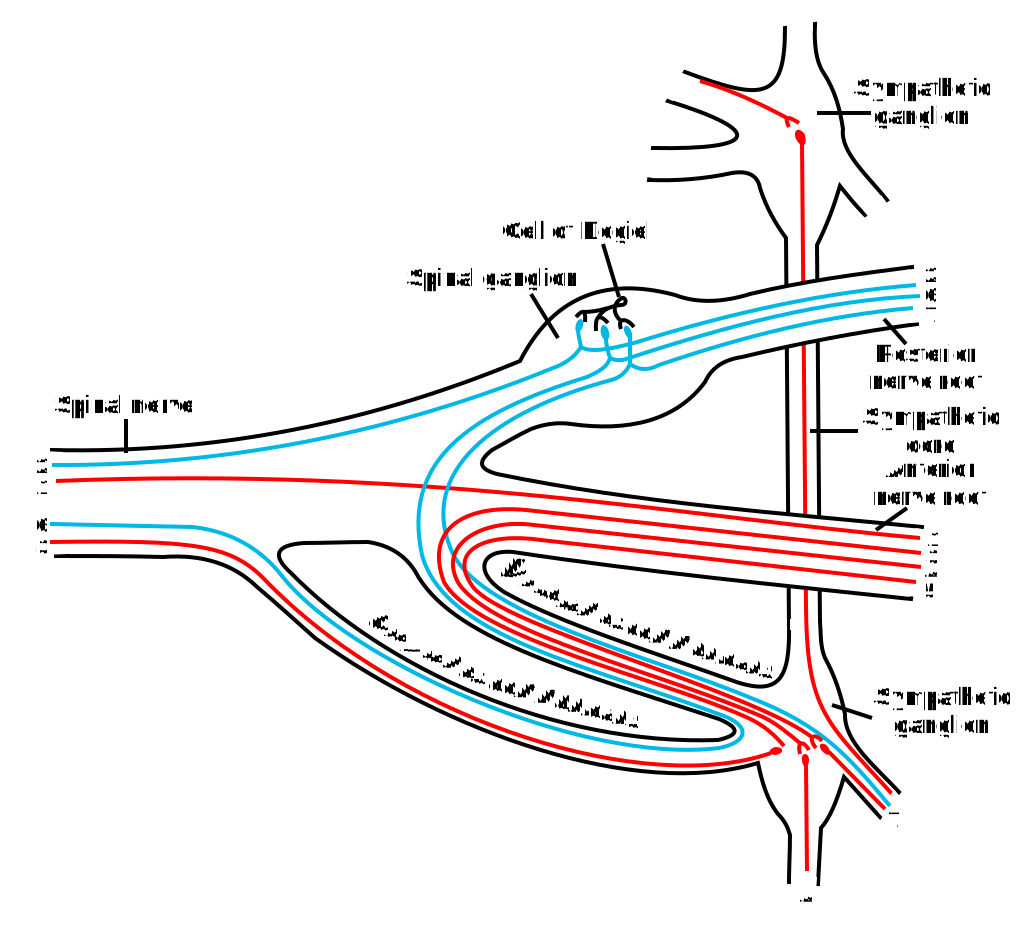
Source: Henry Vandyke Carter, “Gray’s Anatomy plate 799”, via Wikimedia Commons, Public Domain. https://commons.wikimedia.org/wiki/File:Gray799.svg
High Yield — DRG principle and the radiculopathy signature
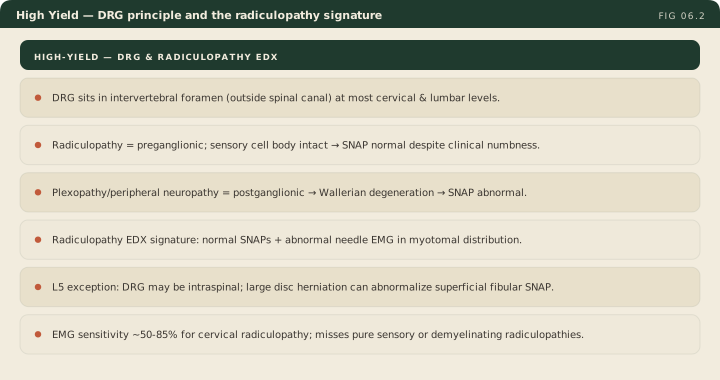
- DRG location: intervertebral foramen, outside spinal canal in most cervical and lumbar levels.
- Radiculopathy = preganglionic lesion (proximal to DRG). Sensory cell body intact, peripheral axon does not degenerate, SNAP normal despite clinical numbness.
- Plexopathy and peripheral neuropathy = postganglionic (distal to DRG). SNAP abnormal once the peripheral sensory axon degenerates; a preserved SNAP does not exclude a selective motor or demyelinating lesion.
- Radiculopathy electrodiagnostic signature: normal SNAPs + abnormal needle EMG in a myotomal distribution.
- SNAP exceptions: direct DRG injury, foraminal or extraforaminal entrapment at or distal to the ganglion, and coexisting neuropathy can all reduce a SNAP in a root syndrome.
- Needle-EMG sensitivity: 50 to 71 percent for cervical radiculopathy (1999 practice parameter). Pure sensory disease may be missed; motor conduction block may reduce recruitment without denervation.
Mnemonic — “Pre-ganglionic preserves the SNAP”
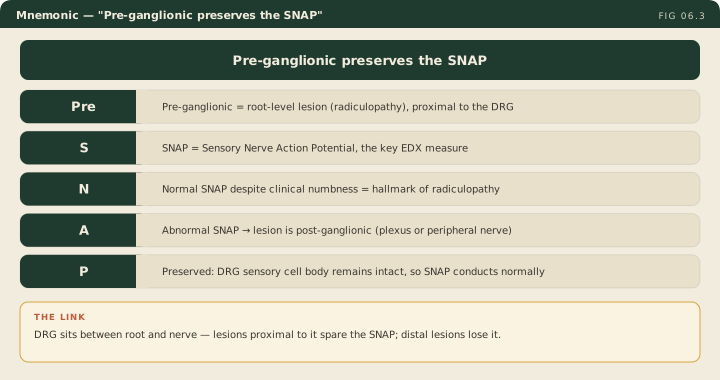
The DRG holds the sensory cell bodies. Preganglionic = root level (radiculopathy) = SNAP preserved, because the cell body and its distal axon stay intact. Postganglionic = plexus or peripheral nerve = SNAP lost once those axons degenerate. Read the SNAP alongside the motor distribution and the rest of the study rather than as a stand-alone answer rule.
Like if you pick up the phone in your house, which represents our peripheral nerve in this case, you still have a crystal clear dial tone. The physical phone and the wire leaving your house are working flawlessly. But the call doesn’t go through.
— EDX-06 podcast, ~5:54