Before You Listen
Before You Listen
- Prerequisites: brachial and lumbosacral neuroanatomy from medical school; the dorsal root ganglion (DRG) principle that sensory nerve action potentials (SNAPs) are preserved in preganglionic lesions; the basics of needle electromyography (EMG) including fibrillation potentials and positive sharp waves; the general distinction between axonal loss (Wallerian degeneration with reduced compound muscle action potential, CMAP, amplitude) and demyelination (focal slowing or conduction block); paraspinal muscle anatomy and the posterior primary ramus.
- Runtime: 25 minutes.
- Topic in one line: brachial plexus as Roots, Trunks, Divisions, Cords, Branches (Robert Taylor Drinks Cold Beer); the three features separating plexopathy from radiculopathy (abnormal SNAPs, normal paraspinals, trunk/cord distribution); the preganglionic root avulsion paradox of preserved SNAPs in an anesthetic limb; Erb-Duchenne upper trunk waiter’s tip and Klumpke lower trunk claw hand with Horner from T1 avulsion; true neurogenic thoracic outlet syndrome (TN-TOS) with its median-over-ulnar pattern and the medial antebrachial cutaneous (MABC) SNAP with a conventional ~95% sensitivity estimate that varies clinically; Parsonage-Turner’s patchy multifocal denervation crossing anatomical boundaries; myokymic discharges as the EMG finding to call radiation over tumor plexopathy; the lumbosacral plexus split into lumbar (L1-L4) and sacral (L4-S4); retroperitoneal hematoma in the anticoagulated patient; and the diabetic lumbosacral radiculoplexus neuropathy (DLRPN, “diabetic amyotrophy”) triad of pain, asymmetric proximal weakness, and weight loss. Memorize them cold.
Vignette. A 22-year-old man is brought to the trauma bay after a high-speed motorcycle crash. His right arm is flail and completely anesthetic from shoulder to fingertips. The right hemifacial sweat pattern is asymmetric and a partial ptosis is noted on the right. Three weeks later, electrodiagnostic testing reveals normal median, ulnar, and radial sensory responses on the affected right side with amplitudes that match the unaffected left. No motor responses are obtainable in any tested muscle. Needle EMG demonstrates dense fibrillation potentials in the cervical paraspinals at C5 through T1 levels and in the rhomboid major and serratus anterior, with no voluntary motor unit recruitment in any tested arm muscle. Magnetic resonance imaging (MRI) of the cervical spine shows pseudomeningoceles at C7, C8, and T1 with normal-appearing C5 and C6 root sleeves.
What does the paradox of normal SNAPs in a completely anesthetic, flail limb tell you about the level of injury, what does the involvement of the rhomboids and the serratus anterior tell you about which named root-level branches are damaged, what is the eponymous oculosympathetic finding and why does it raise concern for T1 avulsion, and how does this pattern inform further evaluation and reconstruction?
(Answer at the end of this chapter)
Section 1: Brachial Plexus Anatomy and the Three Distinctions From Radiculopathy
Bottom line: the brachial plexus is organized as Roots, Trunks, Divisions, Cords, and Branches (Robert Taylor Drinks Cold Beer); three useful localization clues are affected SNAPs, paraspinal sampling, and the distribution of weakness and denervation. Interpret them together with timing and clinical findings; none is an infallible exclusion rule.
The brachial plexus is the neural network formed by the ventral rami of C5 through T1 that supplies the upper limb. It is organized into five sequential levels (Robert Taylor Drinks Cold Beer): Roots, Trunks, Divisions, Cords, and Branches. The ventral rami traverse the interscalene interval in the lateral neck. Two clinically useful branches arise from the ventral rami before the trunks form. The dorsal scapular nerve (C5) supplies the rhomboid major, rhomboid minor, and levator scapulae. The long thoracic nerve (C5, C6, C7) supplies the serratus anterior. Denervation of these muscles suggests injury proximal to the trunks or separate dorsal scapular/long thoracic nerve involvement; it does not by itself prove radiculopathy or avulsion.
The five roots converge into three trunks: upper (C5+C6), middle (C7 alone), and lower (C8+T1). The suprascapular nerve (C5, C6) arises from the upper trunk to supply the supraspinatus and infraspinatus and is a useful upper-trunk localizer. The nerve to subclavius also arises from the upper trunk. Each trunk then splits into anterior (flexor) and posterior (extensor) divisions. No named peripheral nerves arise at the division level, which is why isolated divisional localization is the hardest of all on EDX testing.
The three cords are named for their position around the axillary artery. The lateral cord (anterior divisions of upper and middle trunks; C5-C7) gives rise to the musculocutaneous nerve and the lateral contribution to the median nerve. The medial cord (anterior division of lower trunk; C8-T1) gives rise to the medial antebrachial cutaneous nerve (MABC), the ulnar nerve, and the medial contribution to the median nerve. The posterior cord (posterior divisions of all three trunks; C5-T1) gives rise to the axillary and radial nerves. The median nerve is unique because it draws contributions from both lateral cord (prominent C6-C7 supply to pronator teres and flexor carpi radialis) and medial cord (C8-T1 supply to thenar muscles and important forearm flexors, including AIN muscles). A pure lateral cord lesion produces partial median dysfunction with intact thenar function; a pure medial cord lesion produces partial median dysfunction with intact pronator teres.
Clinical Pearl — The three distinctions that separate plexopathy from radiculopathy
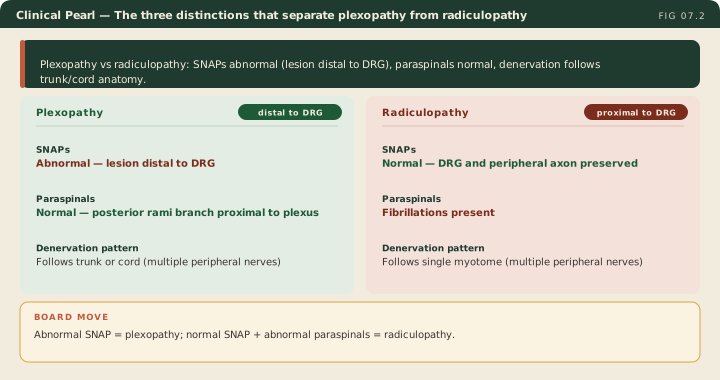
A vignette gives you the same root-level weakness (for example, deltoid plus biceps plus brachioradialis) and asks you to localize between an upper trunk plexopathy and a C5-C6 radiculopathy. Three findings make the call. First, SNAPs are abnormal in plexopathy because the lesion is distal to the dorsal root ganglion (DRG); they are normal in radiculopathy because the DRG and its peripheral axon are preserved. This single feature is the most powerful discriminator. Second, paraspinal muscles are normal in plexopathy because the posterior primary rami branch from the spinal nerve proximal to the plexus; they show fibrillations in radiculopathy. Third, the distribution of denervation in plexopathy follows trunk or cord anatomy (multiple peripheral nerves sharing one plexus element), while radiculopathy follows a single myotome served by multiple peripheral nerves. Memorize these three together and the localization writes itself.
The pattern of abnormal SNAPs maps the lesion within the plexus. The lateral antebrachial cutaneous (LABC) SNAP tests fibers through the upper trunk and lateral cord. The median digit-1 (thumb) SNAP tests C6 (upper trunk, lateral cord). The median digit-3 (middle finger) SNAP tests C7 (middle trunk, lateral cord). The ulnar digit-5 SNAP tests C8 (lower trunk, medial cord). The MABC SNAP tests C8-T1 (medial cord) and is the most sensitive study for lower trunk and medial cord lesions. The radial sensory SNAP at the snuffbox tests posterior cord fibers. The combination of these SNAPs with needle EMG of muscles that share trunk or cord territory builds the precise anatomical map.
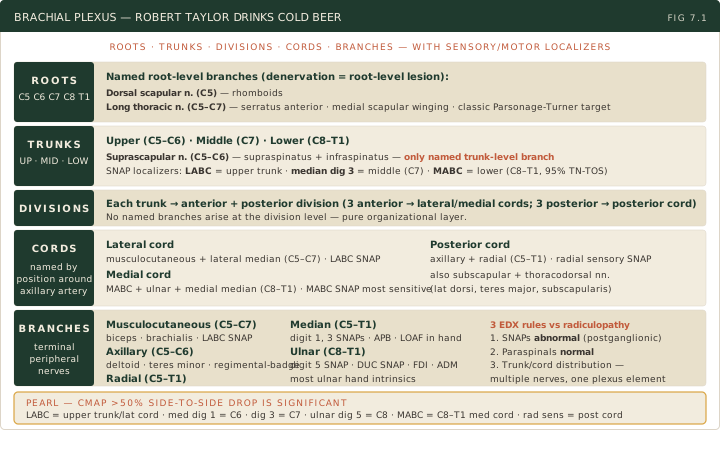
High Yield — Brachial plexus anatomy and plexopathy versus radiculopathy
These are typical patterns, not mandatory findings; normal paraspinal sampling does not exclude root disease.
- Mnemonic: Robert Taylor Drinks Cold Beer = Roots, Trunks, Divisions, Cords, Branches.
- Root-level branches (proximal to plexus): dorsal scapular (C5, rhomboids), long thoracic (C5-C7, serratus anterior). Denervation suggests proximal injury or a separate lesion of these nerves.
- Trunks: upper (C5-C6), middle (C7), lower (C8-T1). Suprascapular (C5-C6, supraspinatus + infraspinatus) is a useful upper-trunk branch; the nerve to subclavius also arises there.
- Cords (named by position around axillary artery): lateral (musculocutaneous + lateral median), medial (MABC + ulnar + medial median), posterior (axillary + radial).
- Three distinctions plexopathy vs radiculopathy: (1) SNAPs abnormal in plexopathy, normal in radiculopathy (DRG principle); (2) paraspinals spared in isolated plexopathy; normal sampling does not exclude radiculopathy; (3) distribution follows trunk/cord (multiple nerves sharing a plexus element) vs single myotome.
- Localizing SNAPs: LABC = upper trunk/lateral cord; median digit 1 = C6/upper trunk; median digit 3 = C7/middle trunk; ulnar digit 5 = C8/lower trunk; MABC = C8-T1/medial cord (most sensitive lower trunk/medial cord SNAP); radial sensory = posterior cord.
- CMAP side-to-side reduction >50% vs the unaffected limb is significant.
Since those nerves leave before the first trunk even exists, absolutely no lesion inside the plexus itself can denervate those muscles.
— EDX-07 podcast, ~3:44
Denervation of the rhomboids or serratus anterior places the lesion at or proximal to the root, but it does not by itself establish a root avulsion. The dorsal scapular (C5) and long thoracic (C5-C7) nerves branch before the trunks form, so no lesion confined to the plexus can reach these muscles. A discrete dorsal scapular or long thoracic mononeuropathy produces the same denervation with the roots intact, so read these muscles alongside the SNAPs, the paraspinals, the rest of the needle examination and the imaging before calling an avulsion.