Before You Listen
Set the stage
- Prerequisites: comfort with the basic NCS pattern (compound muscle action potential / CMAP and sensory nerve action potential / SNAP); the needle electromyography (EMG) findings of denervation (fibrillation potentials, positive sharp waves, fasciculation potentials) and chronic reinnervation (large-amplitude, long-duration, polyphasic motor unit action potentials with reduced recruitment); recognition that motor neuron disease (MND) selectively destroys motor neurons while sparing sensory neurons; familiarity with the four body regions (bulbar, cervical, thoracic, lumbosacral) used in ALS diagnostic criteria.
- Runtime: 54 minutes.
- Topic in one line: the MND spectrum, the evolution of amyotrophic lateral sclerosis (ALS) diagnostic criteria from El Escorial to Awaji-Shima to Gold Coast, normal SNAPs as the ALS pattern, the split hand sign, spinal muscular atrophy (SMA) and its four disease-modifying therapies, Kennedy disease (spinal and bulbar muscular atrophy / SBMA) with its reduced or absent SNAPs, primary lateral sclerosis (PLS) vs progressive muscular atrophy (PMA), ALS treatments (riluzole, edaravone, tofersen, Relyvrio withdrawal), respiratory thresholds for noninvasive ventilation (NIV), the ALSFRS-R, and post-polio syndrome with the March of Dimes (2000 consensus) diagnostic criteria.
Vignette. A 42-year-old man presents with eighteen months of slowly progressive proximal weakness, prominent perioral fasciculations producing a chin-quivering appearance, dysphagia, dysarthria, and prominent muscle cramps. He has gynecomastia and reports decreased libido. Family history reveals a maternal uncle who developed similar symptoms in his fifties and lived another two decades. On exam he has proximal greater than distal weakness, brisk fasciculations in the tongue and limbs, hyporeflexia, and notably preserved muscle bulk in the calves with absent ankle reflexes. Strength has progressed only modestly over the past year. Laboratory studies show creatine kinase (CK) elevated at 1,200 U/L. Standard NCS show reduced CMAP amplitudes in the upper and lower limbs with normal conduction velocities, and reduced SNAP amplitudes diffusely (sural absent, median sensory amplitude 8 microV). Needle EMG shows chronic neurogenic motor unit changes with relatively few fibrillation potentials.
What is the most likely diagnosis, which EDX feature separates it from ALS here, what is the genetic basis, what physical findings beyond the neuromuscular exam point to the diagnosis, and what is the expected disease course compared with classic ALS?
(Answer at the end of this chapter)
Section 1: The MND Spectrum and the Cardinal Rule (Normal SNAPs in ALS)
Bottom line: motor neuron diseases destroy motor neurons and spare sensory neurons, so the ALS nerve conduction pattern is reduced motor responses with normal sensory nerve action potentials (SNAPs). Abnormal SNAPs redirect the differential to Kennedy disease, cervical myelopathy with neuropathy, or polyradiculopathy, although minor sensory abnormalities alone do not exclude ALS. MMN also spares the SNAPs: definite motor conduction block outside entrapment sites supports it, and absent block does not exclude it.
Motor neuron diseases (MNDs) encompass progressive neurodegenerative disorders characterized by selective loss of upper motor neurons (UMNs), lower motor neurons (LMNs), or both. ALS is the prototypical MND, defined by the combination of UMN and LMN degeneration across multiple body regions. The broader spectrum includes primary lateral sclerosis (PLS, pure UMN); progressive muscular atrophy (PMA, pure LMN, likely an ALS variant); spinal muscular atrophy (SMA, hereditary LMN from SMN1 deletion); Kennedy disease (SBMA, X-linked LMN with sensory involvement); and post-polio syndrome.
The electrodiagnostic evaluation confirms widespread LMN involvement, investigates alternative diagnoses, and quantifies extent of disease. One fundamental principle governs the entire evaluation: motor neuron diseases affect motor neurons while sparing sensory neurons. The EDX finding the board tests most consistently is NORMAL sensory nerve action potentials (SNAPs). Abnormal SNAPs in a patient with suspected ALS redirect the workup to Kennedy disease (sensory neuronopathy component), multifocal motor neuropathy with conduction block (MMN; sensory studies normal but motor conduction block at non-entrapment sites), cervical myelopathy with superimposed polyneuropathy, and chronic inflammatory demyelinating polyradiculoneuropathy (CIDP). Normal SNAPs are the ALS pattern rather than an absolute entry requirement: in a prospective study of 35 ALS patients and 35 matched controls, six ALS participants had minor sural amplitude or velocity abnormalities. Check technical factors and a coexisting neuropathy before abandoning the diagnosis, and give substantial abnormalities a full sensory neuropathy or neuronopathy workup. Sensory study.
The motor NCS in ALS reflects pure motor neuron loss without primary myelin involvement. CMAP amplitudes are reduced (reflecting LMN loss and atrophy) but vary by stage and region. Conduction velocities are normal or only mildly reduced because surviving axons retain their myelin sheaths; mild slowing can occur from loss of the largest, fastest-conducting motor axons. Marked slowing into the demyelinating range is not an ALS finding and points to an alternative or additional process. Distal motor latencies are normal or mildly prolonged. Definite motor conduction block and marked temporal dispersion are not ALS findings either. Block outside entrapment sites supports MMN; failure to demonstrate block does not exclude MMN, because a longitudinal series of 33 patients (20 with detected block, 13 without) found a similar clinical course and similar IVIg responses in both groups. Longitudinal MMN study. F-wave persistence is reduced, and repeater F-waves (identical morphology on consecutive stimulations) mark a depleted motor neuron pool; the finding is nonspecific and does not count surviving anterior horn cells.
The needle EMG is the cornerstone. The hallmark is coexistence of active denervation AND chronic reinnervation in the same muscle. Active denervation is documented by fibrillation potentials, positive sharp waves, and fasciculation potentials (which under Awaji carry equivalent weight when accompanied by chronic neurogenic changes). Chronic reinnervation produces motor unit action potentials (MUAPs) with increased duration (surviving motor neurons sprout to reinnervate denervated fibers), increased amplitude (sometimes giant MUAPs >10-20 mV), increased polyphasia, reduced recruitment, and unstable morphology on successive firings. Both must coexist in the same muscle. Chronic changes alone point to a remote stable process such as old polio; acute denervation alone points to a different acute process. The combination across multiple body regions documents ongoing, progressive motor neuron loss. Documented clinical progression and exclusion of alternatives are what attribute that loss to ALS.
The four body regions are bulbar (tongue/genioglossus, masseter, orbicularis oris, mentalis), cervical (deltoid, biceps, triceps, first dorsal interosseous (FDI), abductor pollicis brevis (APB)), thoracic (paraspinal muscles at T6-T10), and lumbosacral (vastus lateralis, tibialis anterior, gastrocnemius, extensor digitorum brevis (EDB)). Thoracic paraspinal EMG is particularly valuable because the thoracic region is rarely affected by other common conditions (radiculopathy, entrapment neuropathy), so denervation there provides an additional independent body region that can upgrade diagnostic certainty. When a patient with suspected ALS has only cervical and lumbosacral abnormalities, thoracic paraspinal examination supplies the third region needed for the older revised El Escorial clinically definite classification. Gold Coast does not require three or four abnormal regions.
The AANEM model policy describes the typical study for suspected motor neuronopathy as up to 4 motor NCS and 2 sensory NCS plus needle EMG of up to 4 extremities (or 3 limbs plus bulbar muscles). These are utilization estimates, not diagnostic minimums and not caps. Sample according to the clinical findings and to the regional definitions in the diagnostic criteria.
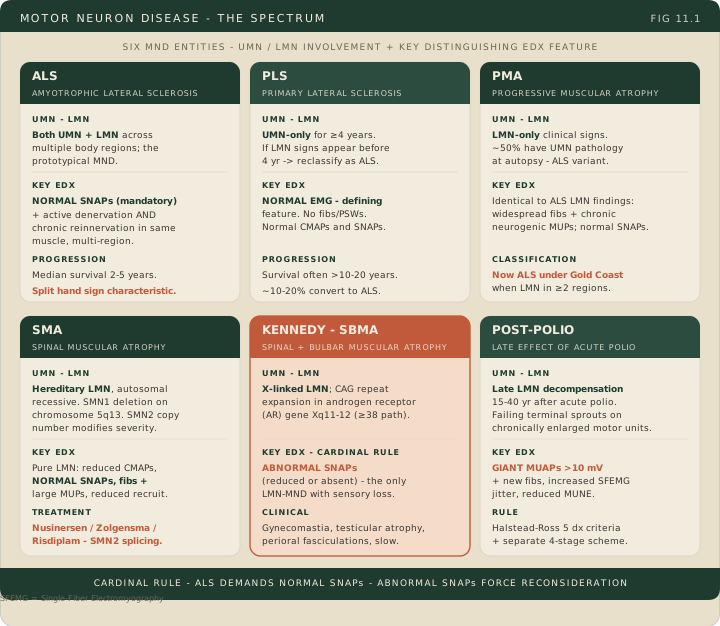
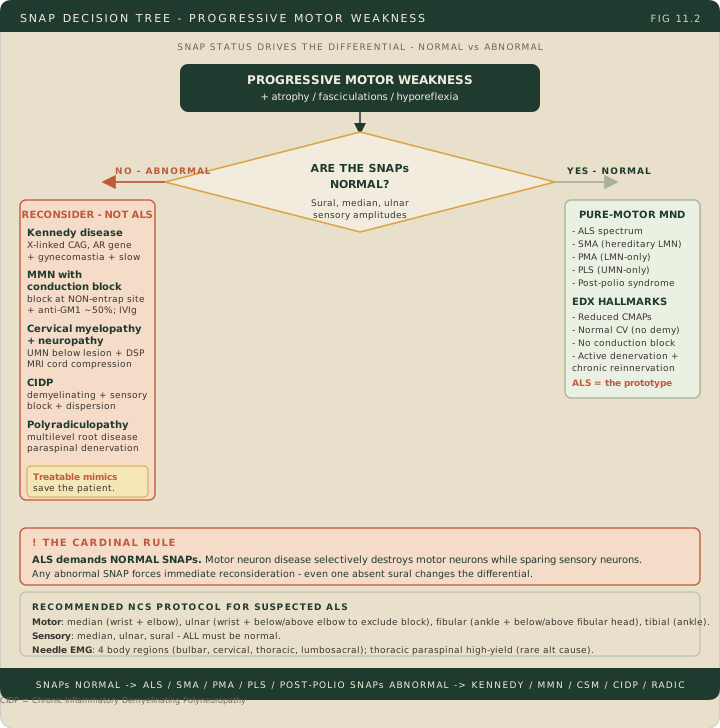
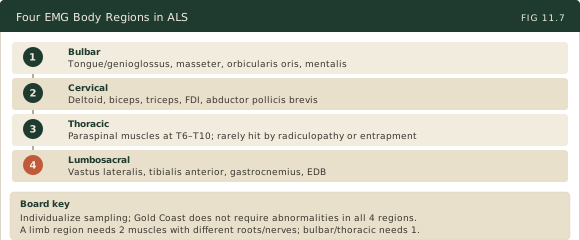
High Yield — MND spectrum and the cardinal SNAP rule
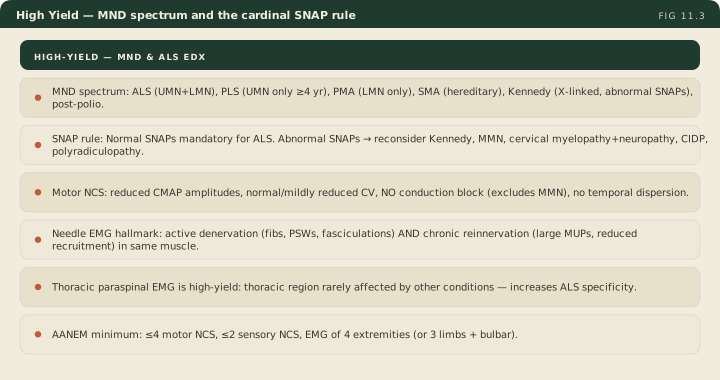
- MND spectrum: ALS (UMN + LMN), PLS (UMN syndrome; probable 2-4 years, definite ≥4 years), PMA (LMN only), SMA (hereditary), Kennedy disease (X-linked, abnormal SNAPs), post-polio syndrome.
- NORMAL SNAPs are the ALS pattern. Abnormal SNAPs → reconsider Kennedy, cervical myelopathy + neuropathy, CIDP, polyradiculopathy; minor abnormalities alone do not exclude ALS. MMN and radiculopathy also spare the SNAPs.
- Motor NCS: reduced CMAP amplitudes; normal or mildly reduced CV, never into the demyelinating range. Definite block outside entrapment sites supports MMN; absent block does not exclude it.
- Needle EMG hallmark: BOTH active denervation (fibs, PSWs, fasciculations) AND chronic reinnervation (large MUPs, reduced recruitment) in the same muscle.
- Four body regions: bulbar, cervical, thoracic, lumbosacral. Thoracic paraspinal EMG is high-yield because the thoracic region is rarely affected by other conditions.
- AANEM utilization guidance: up to 4 motor NCS, up to 2 sensory NCS, EMG of up to 4 extremities (or 3 limbs + bulbar), individualized. Not a diagnostic minimum.
Because the motor neuron pool itself is so severely depleted, you might only have one or two viable anterior horn cells left connecting to that particular muscle. So when you stimulate the nerve 10 times, that exact same solitary motor neuron is the only one capable of backfiring.
— EDX-11 podcast, ~7:37
You saw sensory nerves that simply refused to get sick. I mean, if you see completely normal sensory nerve action potentials or SNAPs, well, the diagnosis stays strictly on the motor neuron disease side of the fence.
— EDX-11 podcast, ~0:33