Before You Listen
Before You Listen
- Prerequisites: the basic motor unit (alpha motor neuron, axon, neuromuscular junctions, innervated muscle fibers); components of a motor unit action potential (MUAP = motor unit action potential) and its measurement (duration, amplitude, polyphasia); the principle that compound muscle action potential (CMAP) amplitude reflects total mass of activated muscle fibers; fibrillation potential and positive sharp wave morphology; the difference between sensory nerve action potential (SNAP) and CMAP recordings; a working sense of recruitment.
- Runtime: 57 minutes.
- Topic in one line: the cardinal short-duration low-amplitude polyphasic MUAP with early recruitment that defines myopathy on needle electromyography (EMG); normal sensory nerve conduction studies (NCS) in pure myopathy and the motor exceptions, prolonged CMAP duration in critical illness myopathy (CIM) foremost; myotonic discharges in DM1, DM2, myotonia congenita, paramyotonia congenita, hyperkalemic periodic paralysis, and Pompe paraspinals; the muscular dystrophies anchored by Duchenne/Becker (Xp21 dystrophin) and the DM1-vs-DM2 distinction; the five-subtype inflammatory myopathy classification and the mixed myopathic-neurogenic pattern of inclusion body myositis (IBM); the metabolic pearls of electrical silence in McArdle and paraspinal myotonic discharges in Pompe; the chronic steroid-myopathy pattern (normal creatine kinase [CK], no fibrillation potentials, near-normal EMG); the CIM-vs-critical-illness-polyneuropathy (CIP) distinction.
Vignette. A 68-year-old man develops profound weakness and fails extubation after 14 days in the intensive care unit for septic shock complicated by acute respiratory distress syndrome. He received high-dose intravenous methylprednisolone for 5 days and a 72-hour vecuronium infusion early in the course. Sensation is preserved. Tendon reflexes are reduced symmetrically. Motor compound muscle action potential (CMAP) amplitudes are reduced to about 30% of normal in both peroneal and ulnar territories, and each CMAP is markedly prolonged in duration, visibly stretched out across the screen. Sensory nerve action potential (SNAP) amplitudes and conduction velocities are entirely normal. Direct muscle stimulation, performed because the patient cannot cooperate with needle EMG, produces a small low-amplitude muscle response.
What is the electrodiagnostic diagnosis, what does prolonged CMAP duration in two nerves establish and what does it not, what does the normal SNAP argue against, and how does the direct-muscle-stimulation response separate this disorder from its closest mimic?
(Answer at the end of this chapter)
Section 1: The Cardinal Myopathic EMG Pattern and Why NCS Are Normal
Bottom line: in myopathy each motor unit loses muscle fibers but the alpha motor neuron, axon, and neuromuscular junction are intact, so motor unit action potentials become short in duration, low in amplitude, and polyphasic, and the nervous system compensates with early recruitment. Short duration is the most useful of the three, read against muscle-, age- and technique-matched reference values. Sensory responses are normal in pure myopathy, and motor responses are usually normal because compound muscle action potential amplitude reflects total muscle bulk, with a short list of exceptions.
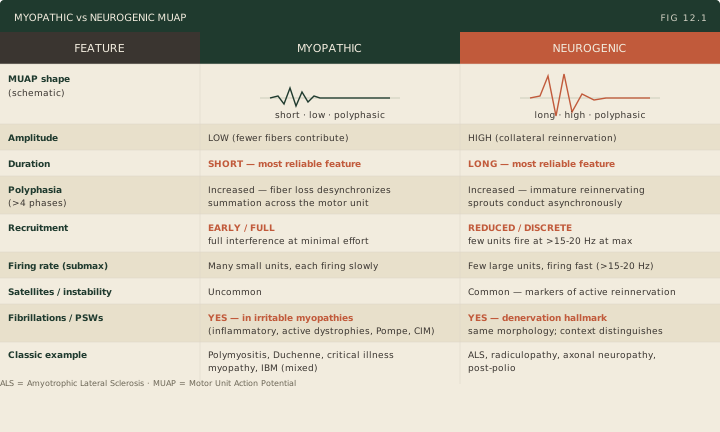
The cardinal principle of myopathic electromyography lives in the muscle fiber itself. The alpha motor neuron, axon, and neuromuscular junction are intact; necrosis, atrophy, vacuolar degeneration, or membrane dysfunction reduces the number of functioning fibers within each motor unit. When fibers drop out, the motor unit action potential (MUAP) becomes smaller in amplitude (fewer fibers contributing) and shorter in duration (less spatial and temporal spread). Short duration is the most useful myopathic MUAP feature, judged against muscle-, age- and technique-matched reference values. Duration is measured from the initial deflection to the final return to baseline. Low amplitude follows from the same biology but is more variable because amplitude depends on electrode position and on muscle fiber hypertrophy, which can paradoxically raise amplitude in some dystrophies. Increased polyphasia (more than 4 phases) is common in myopathy but non-specific: roughly 12 to 15% of MUAPs in normal muscle are polyphasic, the exact proportion varying with the muscle and the needle technique, and polyphasia accompanies neurogenic reinnervation. Increased turns add specificity when combined with short duration and low amplitude.
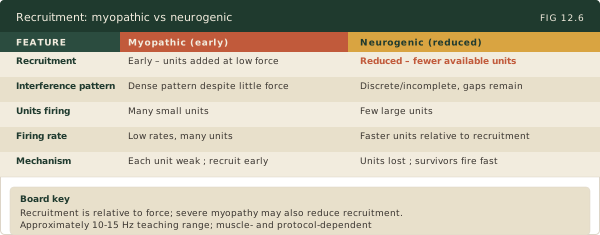
The recruitment pattern is the second pillar. Each myopathic motor unit generates less force, so the nervous system activates additional units at a lower force threshold. The result is early recruitment: a full interference pattern fills the EMG screen at minimal effort, with many small units firing at low individual rates. The contrast with neurogenic disease is sharp: when units have been lost (denervation), the few survivors fire faster before another unit joins, producing reduced recruitment with large, long-duration units built by chronic reinnervation. A single motor unit fires at approximately 10 to 15 hertz before a second is recruited, the exact limit varying by muscle and protocol. Read recruitment as units relative to the force generated, not from firing rate alone, and remember that severe or end-stage myopathy can itself reduce recruitment.
Nerve conduction studies are usually normal in myopathy, and that fact is itself informative, although normal studies never make the diagnosis on their own. Sensory nerve action potentials (SNAPs) are normal in pure myopathy because sensory nerves and dorsal root ganglia are unaffected. An abnormal SNAP means a neuropathic or combined disorder, or a technical problem, and redirects the workup. Motor NCS are typically normal because compound muscle action potential (CMAP) amplitude reflects the total number of functioning muscle fibers within the recording-electrode pickup area; in most myopathies, fiber loss is diffuse and partial early in the course and overall muscle bulk is preserved. Exceptions: critical illness myopathy produces prolonged CMAP duration from muscle-membrane dysfunction (Section 5). Severe distal and end-stage myopathies can reduce CMAP amplitudes globally. Myotonic dystrophy may produce diffusely low CMAPs from combined myopathy and membrane abnormality. The near-100% specificity often quoted for prolonged duration in more than one nerve was measured for critical illness neuromyopathy (CINM) against other-cause controls, not for isolated CIM versus CIP.
The American Association of Neuromuscular and Electrodiagnostic Medicine (AANEM) describes a typical study for suspected myopathy: needle EMG of two limbs including clinically involved proximal muscles, two motor and two sensory NCS, and up to two repetitive nerve stimulation (RNS) studies when a neuromuscular junction (NMJ) disorder is the alternative. Those counts are the AANEM recommended approach and cover roughly 90% of cases; tailor the extent to the presentation. Proximal sampling matters because most myopathies preferentially damage proximal limb girdles (deltoid, biceps, iliopsoas, vastus lateralis); distal-only sampling risks a false-negative study.
High Yield — Cardinal myopathic pattern and NCS rules
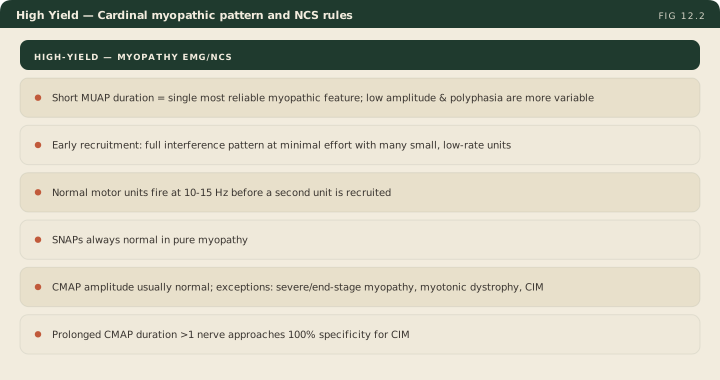
- Short duration is the most useful MUAP feature of myopathy, read against muscle/age/technique reference values. Low amplitude and increased polyphasia accompany it but are more variable.
- Early recruitment: full interference pattern at minimal effort with many small units firing at low rates, i.e. many units relative to the force generated. Neurogenic unit loss gives reduced recruitment with large, long-duration units. Firing rate alone is not diagnostic, and severe or end-stage myopathy can also reduce recruitment.
- A motor unit fires at 10-15 Hz before a second unit is recruited (muscle- and protocol-dependent).
- SNAPs are normal in pure myopathy.
- CMAP amplitude usually normal; exceptions = severe distal/end-stage myopathy, myotonic dystrophy, and CIM.
- Prolonged CMAP duration signals a myopathic component in ICU weakness. The near-100% specificity in >1 nerve was reported for CINM against other-disease controls, not for pure CIM versus CIP.
- AANEM typical study: EMG of 2 limbs (including involved proximal muscles), 2 motor + 2 sensory NCS, up to 2 RNS if an NMJ disorder is suspected. Tailor the study; these counts are not an inflexible minimum.
Board Trap — Increased polyphasia is NOT specific for myopathy
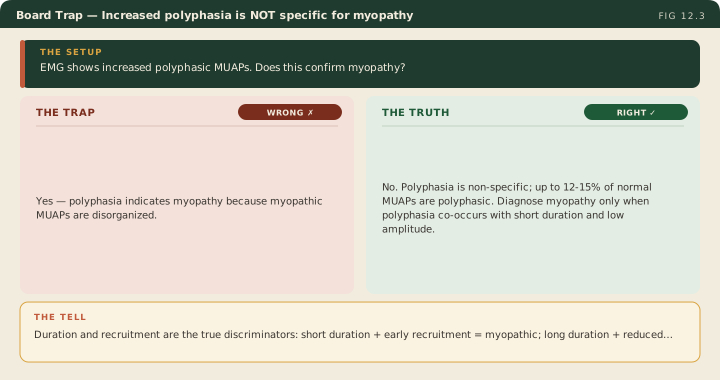
A vignette describes increased polyphasia and asks whether the pattern is myopathic. Polyphasia alone is non-specific: roughly 12-15% of MUAPs in normal muscle are polyphasic, the proportion varying with muscle and needle technique, and reinnervation in neurogenic disease produces polyphasia readily. The discriminators are duration (short = myopathic, long = neurogenic) and recruitment relative to force (early = myopathic, reduced = neurogenic). Pick polyphasia as the answer only when it co-occurs with short duration and low amplitude.
As fibers die, surviving individual muscle fibers undergo compensatory hypertrophy. They become physically larger to carry the load, and a larger fiber generates a larger local voltage. So you might actually see a high amplitude signal in a profoundly myopathic muscle.
— EDX-12 podcast, ~5:09