Before You Listen
Preparation
- Prerequisites: the basic motor unit (alpha motor neuron, axon, neuromuscular junctions, all innervated muscle fibers); compound muscle action potential (CMAP) recording with surface electrodes after supramaximal nerve stimulation; sensory nerve action potential (SNAP) recording; the difference between presynaptic and postsynaptic locations at a chemical synapse; standard needle EMG terminology (insertional activity, motor unit action potentials, recruitment).
- Runtime: 44 minutes.
- Topic in one line: quantal transmission and its safety margin; protocol-specific repetitive stimulation and jitter testing; recognition of MG, LEMS, botulism and inherited myasthenic syndromes; and treatment guided by the clinical pattern, disease subtype and urgent respiratory or cardiac risks.
Vignette. A 63-year-old man with a 40-pack-year smoking history presents with progressive proximal lower extremity weakness over 3 months, dry mouth, constipation, and erectile dysfunction. His tendon reflexes are diminished at rest. After he performs 10 seconds of vigorous voluntary contraction of his calf, the previously absent ankle reflex returns transiently. Motor nerve conduction studies of the abductor digiti minimi show a baseline compound muscle action potential (CMAP) amplitude of 1.8 millivolts (laboratory normal greater than 5). After 10 seconds of maximum voluntary abduction of the fifth digit, the CMAP amplitude rises to 5.6 millivolts. Sensory nerve action potentials are normal. Slow-rate repetitive nerve stimulation at 3 hertz of the same nerve shows a 22% decrement.
What is the diagnosis, what antibody supports the pathophysiology, what is the percentage post-exercise increment in this patient (and what increment is the classic LEMS criterion), what cancer must be aggressively screened for, and what is the first-line symptomatic treatment?
(Answer at the end of this chapter)
Section 1: Neuromuscular Junction Physiology, Safety Factor, and Vesicle Pools
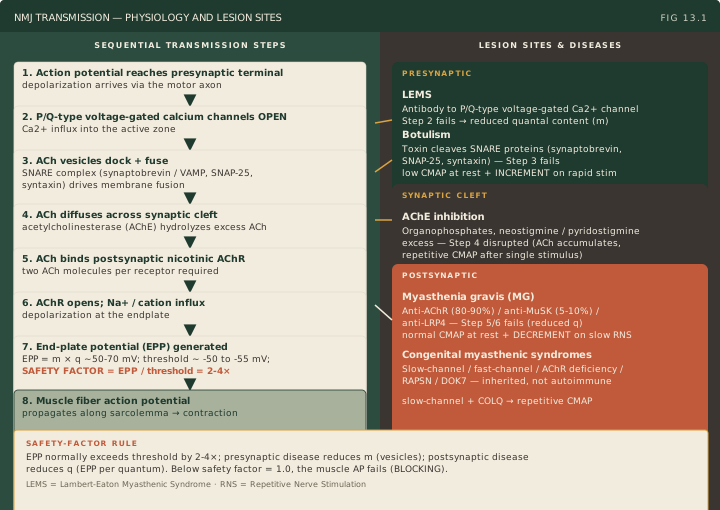
Bottom line: an action potential opens P/Q-type voltage-gated calcium channels at the presynaptic terminal, calcium triggers SNARE-mediated vesicle fusion, acetylcholine (ACh) binds nicotinic ACh receptors (AChR) on the muscle fiber, and the conventional safety factor is about 3 to 5 (quanta released relative to the minimum needed to trigger a muscle action potential); presynaptic disorders reduce quantal content (m, vesicles released per impulse), postsynaptic disorders reduce quantal response (q, EPP per quantum), and when the safety factor falls below 1.0 the muscle fiber action potential fails (blocking).
The neuromuscular junction (NMJ) is the chemical synapse between the motor nerve terminal and the muscle fiber. When an action potential reaches the presynaptic terminal, it opens P/Q-type voltage-gated calcium channels (VGCCs) — the targets of Lambert-Eaton myasthenic syndrome (LEMS) autoantibodies. Calcium influx triggers fusion of acetylcholine (ACh)-containing vesicles with the presynaptic membrane through SNARE proteins (synaptobrevin/VAMP, SNAP-25, syntaxin), the proteins cleaved by botulinum toxin. ACh is released as quanta (each vesicle = one quantum, approximately 5,000 to 10,000 ACh molecules) and binds nicotinic ACh receptors (AChR) on the postsynaptic membrane (the myasthenia gravis [MG] target). AChR opens to allow sodium influx, generating an endplate potential (EPP). If the EPP exceeds threshold, a muscle fiber action potential follows. Acetylcholinesterase in the cleft hydrolyzes ACh and terminates transmission.
Two physiologic quantities define the system. Quantal content (m) is the number of quanta released per impulse (normally 50 to 300). Quantal response (q) is the EPP per quantum (the miniature endplate potential, MEPP, normally 0.5 to 1.0 millivolts). In a simplified quantal model, EPP ≈ m × q. The conventional safety factor is about 3 to 5: released quanta relative to the minimum required to trigger a muscle action potential. It is not calculated by dividing EPP amplitude by a signed membrane voltage. Presynaptic disorders (LEMS, botulism) reduce m. Postsynaptic disorders (MG) reduce q. When the safety factor falls below 1.0, the muscle fiber action potential fails: blocking.
The presynaptic terminal maintains three vesicle pools. The readily releasable pool (RRP) (~1,000 vesicles docked at active zones) is depleted first during repetitive stimulation. The recycling pool replenishes the RRP. The reserve pool is mobilized during prolonged activity. During slow-rate RNS at 2 to 3 hertz, replenishment cannot keep pace, and by the fourth or fifth stimulus the RRP reaches its nadir. In a healthy NMJ, this physiological decline produces no failure (safety factor adequate). In a diseased NMJ, the further decline pushes additional junctions below threshold and produces the measurable decrement.
High Yield — NMJ physiology
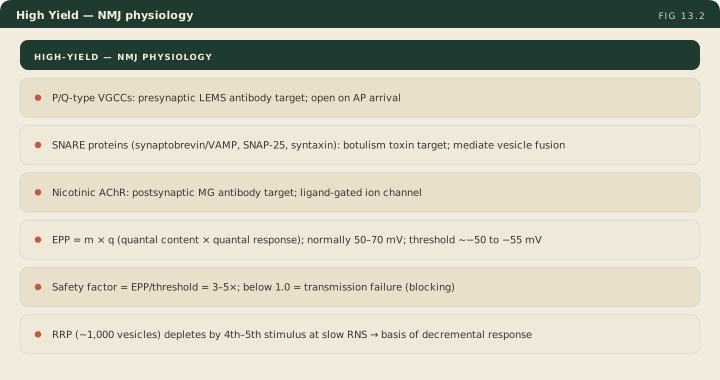
- P/Q-type VGCCs = LEMS antibody target; open at presynaptic terminal upon action potential arrival.
- SNARE proteins (synaptobrevin/VAMP, SNAP-25, syntaxin) = botulism toxin target; mediate vesicle fusion.
- Nicotinic AChR = MG antibody target; postsynaptic ligand-gated ion channel.
- Quantal content (m) = vesicles per impulse (50 to 300); reduced in presynaptic disease.
- Quantal response (q) = EPP per quantum (MEPP, 0.5 to 1.0 mV); reduced in postsynaptic disease.
- EPP ≈ m × q is a simplified quantal model; raw signed membrane voltages do not define the safety factor.
- Safety factor ≈ 3 to 5: released quanta / minimum quanta needed for an action potential. Below 1.0 = blocking (transmission failure at that junction).
- RRP (~1,000 vesicles) depletes by the 4th-5th stimulus at slow-rate RNS — the physiological basis of the decremental response.
Mnemonic — m for “many vesicles”, q for “quantum punch”
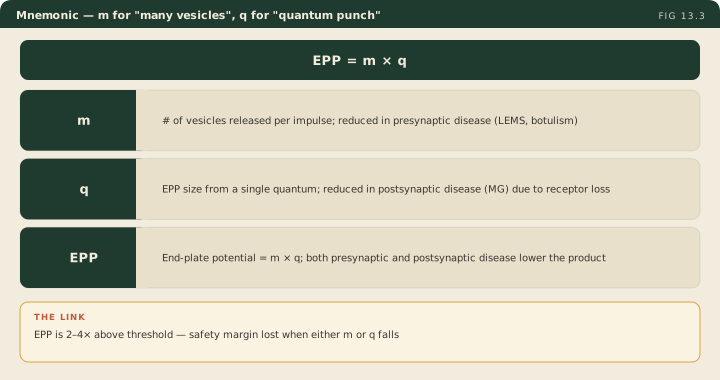
m is the count: how many vesicles release per impulse. Reduced in presynaptic disease (LEMS, botulism) where the calcium-driven release machinery fails. q is the punch: how big the EPP a single quantum produces. Reduced in postsynaptic disease (MG) where receptor loss makes each quantum less effective. EPP = m × q. Both classes lower the product, but boards distinguish them by which factor is the culprit.
In botulism, the snare proteins are physically destroyed by the toxin. Even though exercise brings massive amounts of calcium into the terminal, the physical machinery required to zip the vesicles to the membrane is gone, so excess calcium cannot fully rescue the release.
— EDX-13 podcast, ~35:55
There are three distinct vesicle pools. First is the readily releasable pool, which contained about 1,000 docked vesicles sitting right at the active zones.
— EDX-13 podcast, ~8:52