Before You Listen
Episode Setup
- Topic in one line: the four-phase American Association of Cardiovascular and Pulmonary Rehabilitation (AACVPR) framework, the AACVPR 2012 risk tiers, exercise prescription with the Karvonen heart rate reserve formula and the Borg rating of perceived exertion (RPE), post-sternotomy recovery, what HF-ACTION did and did not show in heart failure with reduced ejection fraction, and the denervated physiology of the transplanted heart.
- Prerequisites: basic cardiac anatomy and physiology, the ejection fraction concept, the New York Heart Association (NYHA) functional classification, normal autonomic control of heart rate, and the metabolic equivalent of task (MET) framework as a measure of activity intensity.
- Runtime: 45 minutes.
Vignette. A 62-year-old man enters outpatient rehabilitation 3 weeks after an inferior STEMI treated with PCI. He is clinically stable with LVEF 35 percent. On his current metoprolol succinate 50 mg daily, resting HR is 58 bpm and measured peak HR is 110 bpm. His symptom-limited treadmill test ends at 4 METs for fatigue; 1 mm horizontal ST depression first appears at 110 bpm. He asks about his risk, a target at 50 percent HRR, monitoring and return to freight loading.
What is his AACVPR risk category, what target heart rate does 50 percent of his measured heart rate reserve give, how do his ischemic threshold and clinical status constrain that target, what monitoring does he need, and what one finding would have required deferring the exercise test?
(Answer at the end of this chapter)
Section 1: The Four Phases of Cardiac Rehabilitation
Bottom line: cardiac rehabilitation runs through four phases. Phase I is inpatient, starting 24 to 48 hours after an uncomplicated event at 1 to 2 METs under the traditional delta heart rate (HR) +20, delta systolic blood pressure (SBP) +20 progression rule. Phase II is supervised outpatient, 12 to 36 sessions over 6 to 12 weeks, 2 to 3 times per week, classically on continuous electrocardiographic (ECG) monitoring. Phase III is late outpatient over 3 to 6 months with intermittent or no ECG. Phase IV is lifelong self-directed maintenance with continuing clinical follow-up. In the Anderson 2016 coronary-disease review, exercise-based rehabilitation cut cardiovascular mortality by 26 percent in relative terms (RR 0.74) and reduced admissions, with no significant all-cause mortality reduction.
The cardiac rehabilitation continuum begins in the hospital bed and ends with the patient exercising independently for the rest of their life. Each phase has a defined setting, intensity, monitoring level, duration and primary goal, and a vignette is usually asking which phase it describes.
Phase I is the inpatient phase, after MI, CABG, valve surgery, PCI or a heart-failure admission. Mobilization begins 24 to 48 hours after the event in uncomplicated recovery, once the patient is clinically stable. Activity starts at 1 to 2 METs: eating, bedside bathing and short ambulation. Continuous telemetry monitors rhythm. The goals are early mobilization to prevent venous thromboembolism and deconditioning, patient and family education, and discharge planning; walking about 200 feet on level ground and climbing a short flight of stairs is the conventional discharge benchmark when home access requires it. The traditional post-MI progression rule allows a rise of no more than 20 bpm in heart rate and 20 mmHg in systolic pressure above rest during a single activity session. Both the 1 to 2 MET start and the 200-foot goal are starting examples rather than fixed ceilings, and the actual home environment sets the real discharge target; progression follows symptoms, heart rate, blood pressure, rhythm and functional need. The delta HR +20 / delta SBP +20 limits are a conservative inpatient teaching convention, not the diagnostic-test absolute-stop criteria below. New ischemic symptoms, poor perfusion, a significant rhythm change or an unexpected pressure fall stop the session and prompt reassessment.
Phase II is outpatient supervised cardiac rehabilitation, the most heavily tested phase. It begins 1 to 3 weeks after discharge, as soon as the patient is medically ready. The standard course is 12 to 36 sessions over 6 to 12 weeks, 2 to 3 sessions per week. Each session combines warm-up, aerobic exercise, resistance training, cool-down and risk-factor education. Continuous ECG monitoring during exercise is the classic feature, and it matters most early and in high-risk patients; its duration follows risk and the observed response rather than a fixed rule, and selected stable low- or moderate-risk patients who cannot attend a center can use structured home-based or hybrid programs instead. Exercise prescription is individualized from the exercise test result, the AACVPR risk tier and the Karvonen formula. In the Anderson 2016 pooled review, exercise-based rehabilitation reduced cardiovascular mortality (RR 0.74, 95 percent CI 0.64 to 0.86) and hospital admissions (RR 0.82, 0.70 to 0.96), with no significant effect on total mortality, myocardial infarction or revascularization. The older teaching of a 20 to 25 percent all-cause mortality benefit from Phase II does not survive that review.
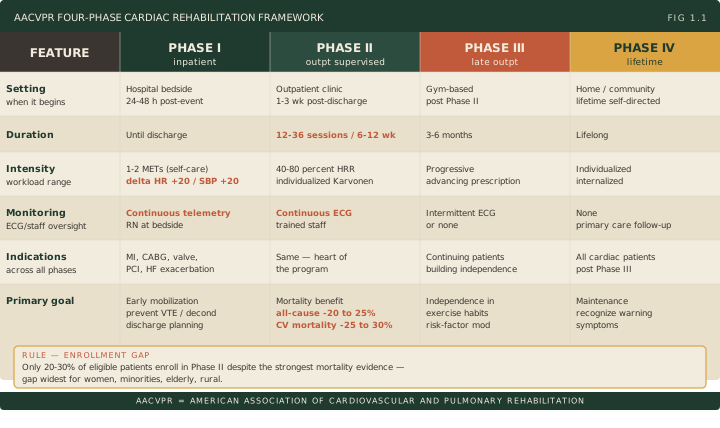
Phase III is the late outpatient or maintenance-transition phase. It runs 3 to 6 months in a gym-based setting with intermittent or no ECG monitoring, as safety is demonstrated. The goals shift toward independent exercise habits, advancement of the prescription and continued risk-factor modification. Patients who still need close supervision stay in supervised care longer.
Phase IV is lifetime maintenance: self-directed independent exercise with no session monitoring. The patient has internalized the prescription, recognizes warning symptoms and continues long-term risk-factor management with primary care and cardiology. Independent exercise is not the end of clinical care.
A stable patient 6 weeks after MI exercising with ECG monitoring in a supervised outpatient facility is in Phase II. A patient on telemetry walking the hospital hallway 2 days after CABG is in Phase I. Self-directed walking 8 months after the event is Phase IV. Setting and monitoring intensity together identify the phase; neither elapsed time nor the presence of a monitor decides it alone.
The continuum is underused. Eligible patients are referred and enrolled far less often than the evidence supports, and the gap is widest for women, racial and ethnic minorities, the elderly and rural populations.
High Yield — Rehabilitation phases
- Phase I: inpatient, 24-48 h after an uncomplicated event, 1-2 METs, continuous telemetry, traditional delta HR +20 / delta SBP +20 progression rule.
- Phase II: outpatient supervised, 1-3 wk after discharge, 12-36 sessions over 6-12 wk, 2-3x/week, classically continuous ECG monitoring; monitoring duration follows risk, and home-based or hybrid delivery suits selected stable low/moderate-risk patients.
- Phase III: late outpatient, intermittent or no ECG, 3-6 months, gym-based, building independence.
- Phase IV: lifetime self-directed exercise, no session monitoring, continuing clinical follow-up.
- Mortality benefit: Anderson 2016 found cardiovascular mortality RR 0.74 (26 percent relative reduction), admissions RR 0.82, and no significant all-cause mortality reduction.
- Enrollment gap: cardiac rehabilitation is underused by eligible patients, and the gap is widest for women, racial and ethnic minorities, the elderly and rural populations.
Mnemonic — “I-Bed, II-Belt, III-Gym, IV-Forever”
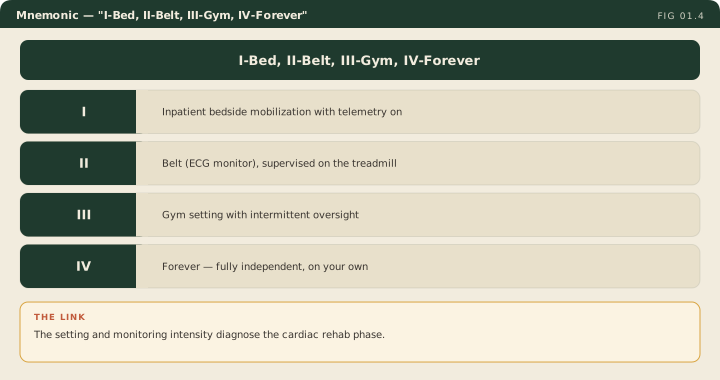
Inpatient = Bedside mobilization, telemetry on. II = Belt of the ECG monitor, supervised on the treadmill. III = Gym with intermittent oversight. IV = Forever, exercising on your own. Setting and monitoring intensity diagnose the phase.
If the systolic blood pressure drops by more than 10 millimeters of mercury instead, it means the left ventricle is so weak or so ischemic that it simply cannot increase cardiac output to meet even the mildest exertion. The pump is acutely failing.
— MEDREH-01 podcast, ~8:04
A fall in systolic pressure during exercise is a signal to stop and reassess, not a diagnosis of acute pump failure. Repeat the measurement and read the fall against symptoms, the ECG, medications and volume status. A workload-associated fall greater than 10 mmHg with other ischemic evidence is an absolute termination criterion. An isolated fall that persists below baseline, without ischemic evidence, is a relative one.