Before You Listen
Episode Setup
- Topic in one line: the obstructive versus restrictive versus mixed pulmonary function test (PFT) framework and the diffusing capacity of the lung for carbon monoxide (DLCO) interpretation that informs the differential diagnosis, flow-volume loop pattern recognition, the Global Initiative for Chronic Obstructive Lung Disease (GOLD) airflow grading of chronic obstructive pulmonary disease (COPD), separate functional assessment and the BODE index, breathing techniques (pursed-lip expiratory back-pressure, diaphragmatic, inspiratory muscle training), chronic resting versus exertional oxygen indications, oxygen delivery devices, and acute oxygen-induced hypercapnia, ventilator weaning by the rapid shallow breathing index (RSBI), tracheostomy tube anatomy with the Passy-Muir speaking valve and the cuff-deflation safety rule, decannulation, noninvasive ventilation, airway clearance technique with the cough-versus-huff distinction, and four disease-specific pulmonary rehabilitation paradigms (neuromuscular disease, cystic fibrosis, interstitial lung disease, and asthma exercise-induced bronchoconstriction).
- Prerequisites: basic respiratory mechanics, the alveolar-capillary unit, the oxygen-hemoglobin dissociation curve, normal arterial blood gas (ABG) interpretation, the autonomic and somatic innervation of the diaphragm and accessory respiratory muscles, and basic mechanical ventilation vocabulary (positive end-expiratory pressure (PEEP), fraction of inspired oxygen (FiO2), tidal volume).
- Runtime: 46 minutes.
Vignette. A 68-year-old man with a 50-pack-year smoking history and chronic exertional dyspnea has post-bronchodilator spirometry showing FEV1 1.05 L (38 percent predicted), FVC 2.40 L (62 percent predicted), and FEV1/FVC ratio 0.44. DLCO is 38 percent of predicted. Resting SaO2 is 92 percent on room air. Six-minute walk test stops at 240 m with desaturation to 86 percent. He is referred to outpatient pulmonary rehabilitation. He asks whether his FEV1 will improve, whether he qualifies for ambulatory oxygen, and what the program will accomplish.
What is his GOLD stage, what specific findings indicate emphysema-predominant rather than chronic-bronchitis-predominant disease, what oxygen prescription does he qualify for, and what realistic outcomes should he expect from the program?
(Answer at the end of this chapter)
Section 1: PFT Pattern Recognition — Obstructive, Restrictive, Mixed, and DLCO
Bottom line: pulmonary function tests classify into three patterns by the FEV1/FVC ratio and the total lung capacity (TLC). Obstruction is a reduced ratio (below the lower limit of normal, LLN; GOLD uses post-bronchodilator FEV1/FVC less than 0.70 specifically for COPD diagnosis in the appropriate clinical context) with reduced FEV1 and a normal or increased TLC from hyperinflation; restriction is a reduced TLC (measured below its LLN) with a normal or increased ratio; mixed disease combines a reduced ratio with a reduced TLC. Spirometry alone cannot diagnose restriction (TLC measurement is required). The diffusing capacity of the lung for carbon monoxide (DLCO) is decreased in emphysema, pulmonary fibrosis, pulmonary vascular disease and anemia, preserved in chronic bronchitis and preserved or increased in asthma, and increased in pulmonary hemorrhage and polycythemia, so a normal DLCO in obstruction points to chronic bronchitis or asthma while a reduced DLCO points to emphysema; DLCO supports rather than uniquely establishes a diagnosis. Bronchodilator responsiveness: ERS/ATS 2022 defines it as a change in FEV1 or FVC greater than 10 percent of that measurement’s predicted value; the older ATS/ERS rule was an FEV1 increase of both greater than 12 percent and greater than 200 mL from baseline. Responsiveness alone does not distinguish asthma from COPD.
The three pulmonary function patterns are obstructive, restrictive, and mixed.
Obstructive patterns reflect airflow limitation, defined physiologically by FEV1/FVC below the lower limit of normal (fifth percentile) using an appropriate reference equation. FEV1 can remain within its reference range despite a reduced ratio. Restriction is confirmed by a measured TLC below the LLN, never by a low FVC alone, because FVC also falls with air trapping and with poor effort. TLC may be normal or increased; a reduced TLC indicates a mixed impairment. COPD, asthma and bronchiectasis all produce obstruction, and the lumen narrows for a different reason in each: in asthma from the outside in, by smooth-muscle constriction and mucosal inflammation; in chronic bronchitis from the inside out, by excessive mucus and chronic inflammation; and in emphysema by loss of parenchymal elastic recoil, so the small airways lose their structural tethering and collapse prematurely under positive intrathoracic pressure during forced exhalation. In the appropriate clinical context, GOLD 2026 retains a post-bronchodilator ratio <0.70 for COPD diagnosis. Keep that disease-specific criterion separate from general physiologic interpretation.
Restrictive impairment requires measured TLC below its LLN, rather than a universal 80-percent-predicted cutoff. FEV1/FVC is often preserved or increased; if the ratio is also below LLN, classify a mixed impairment. Causes fall into three buckets. Intrinsic lung disease scars and stiffens the parenchyma itself (idiopathic pulmonary fibrosis and the other interstitial lung diseases). Chest-wall disorders trap healthy lung inside a rigid cage (severe kyphoscoliosis, ankylosing spondylitis). Neuromuscular disease leaves the parenchyma and chest wall intact but the respiratory muscles cannot generate the negative pressure needed to inflate the system (amyotrophic lateral sclerosis, Guillain-Barre syndrome, high cervical spinal cord injury). A low FVC alone cannot establish its cause or confirm restriction.
Mixed impairment requires both FEV1/FVC and TLC below their respective LLNs. A low ratio plus a low FVC is insufficient because obstruction with air trapping can reduce FVC without reducing TLC.
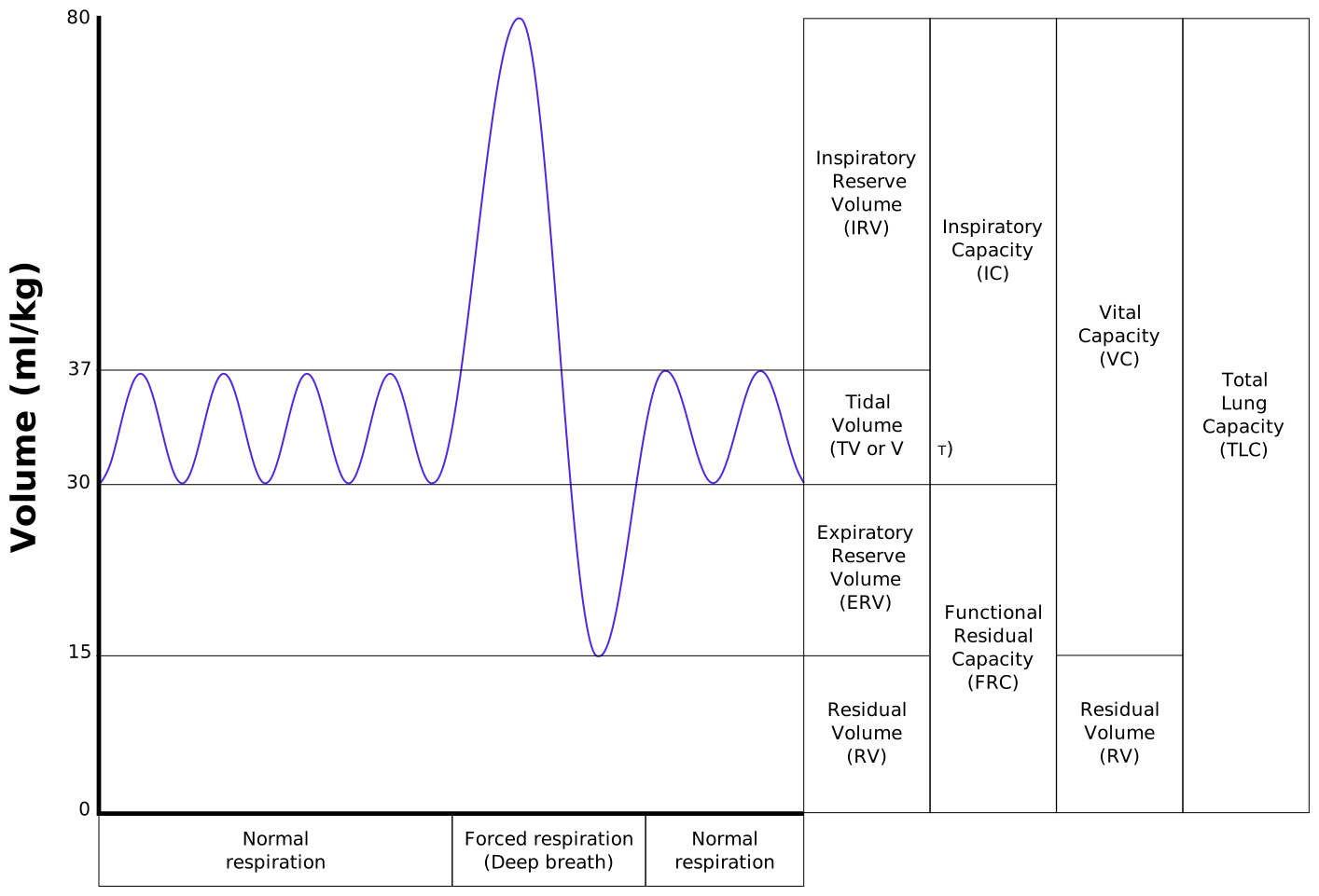
Spirometry alone cannot confirm restriction. It does not measure TLC or residual volume. Measure lung volumes when needed to distinguish restriction, mixed impairment and air trapping. The trap is that severe hyperinflation in advanced obstruction depresses the FVC: residual volume is so large that the patient cannot draw much additional air on top of it, and the spirometry printout mimics a small container. Given spirometry alone, the report can say only “consistent with restriction”; confirm with full lung volumes by body plethysmography or washout. Gas-dilution or washout methods can underestimate trapped gas in severe obstruction, so consider the measurement method when interpreting results. ERS/ATS 2022 provides the general interpretive framework.
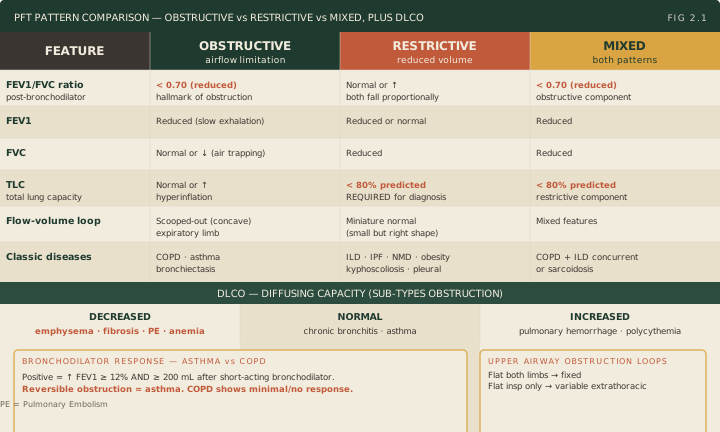
Bronchodilator responsiveness characterizes a change in lung function, but does not by itself distinguish asthma from COPD. Under ERS/ATS 2022, a significant response is a change in FEV1 or FVC greater than 10 percent of that measurement’s predicted value: (post − pre) / predicted ×100. This is not percent change from baseline. COPD can show responsiveness, and asthma may show no significant response on a particular test.
Historical versus current criteria: The older ATS/ERS rule is an increase in FEV1 or FVC of at least 12 percent AND at least 200 mL from baseline. ERS/ATS 2022 replaced it with a change greater than 10 percent of that measurement’s predicted value. Read the denominator in the stem: percent of baseline is the older rule, percent of predicted is the 2022 rule.
DLCO measures carbon-monoxide transfer from alveolar gas to blood. Carbon monoxide is the tracer because its affinity for hemoglobin is roughly 200 times that of oxygen, so very little of it stays dissolved in plasma to back-pressure the transfer. Interpretation depends on membrane transfer, pulmonary capillary blood volume, hemoglobin and measured lung volume, not membrane properties alone. Low DLCO can occur with emphysema (alveolar wall destruction collapses the cluster-of-grapes architecture into floppy inefficient sacs), interstitial disease (collagen deposition thickens the membrane), pulmonary vascular disease (an intact membrane with no blood flow past it to pick up the gas) or anemia (too little hemoglobin to bind the tracer). In obstruction, a low value points to emphysema, but does not uniquely distinguish it from every alternative. DLCO is preserved in chronic bronchitis and preserved or high in asthma. Hemorrhage and increased hemoglobin raise it. Neuromuscular weakness produces volume-related changes, so DLCO is not reliably normal there.
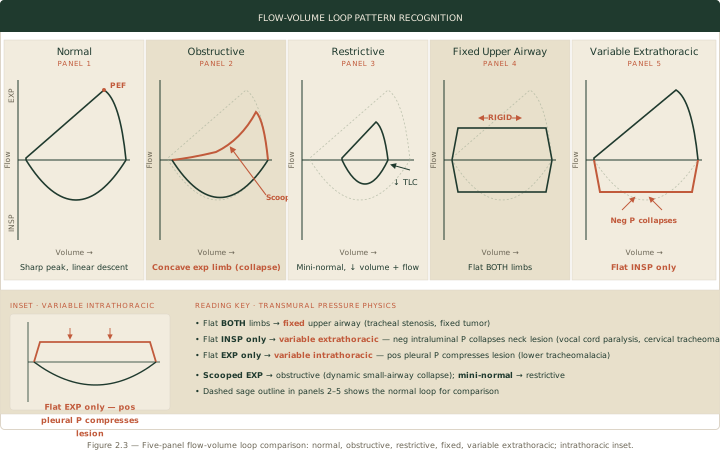
Flow-volume loops display flow against volume. The normal loop has a rapid rise to peak expiratory flow followed by a near-linear decline back to zero, with a smooth semicircular inspiratory limb below the axis. The obstructive pattern shows a scooped-out (concave) expiratory limb that reflects dynamic airway collapse: as the patient bears down to exhale, positive intrathoracic pressure squeezes the floppy small airways closed before all the air can escape, dropping flow precipitously. A restrictive loop keeps the normal architecture but is narrowed on the volume axis; peak expiratory flow need not fall and may be preserved or increased where elastic recoil is high. The upper-airway patterns are reasoned through transmural pressure direction. Fixed upper airway obstruction (tracheal stenosis from prolonged intubation, fixed tumor) flattens both limbs into a boxy plateau because a rigid hole limits flow equally in both directions. Variable extrathoracic obstruction (vocal-fold paralysis, cervical tracheomalacia) flattens the inspiratory limb only: negative intraluminal pressure during inspiration sucks the floppy neck lesion closed, while positive pressure during expiration blows it open. Vocal-fold paralysis, including bilateral paralysis, produces variable extrathoracic obstruction. Read fixed versus variable from the shape of the loop, then correlate it with laryngoscopy; laterality alone does not settle the pattern. Variable intrathoracic obstruction (lower tracheomalacia) flattens the expiratory limb only because highly positive pleural pressure during forced exhalation compresses the lesion, while negative pleural pressure during inspiration pulls outward and props it open.
High Yield — PFT pattern recognition
- Obstructive physiology: FEV1/FVC <LLN (GOLD uses post-bronchodilator <0.70 for COPD diagnosis with compatible clinical context), reduced FEV1, normal or increased TLC (hyperinflation).
- Restriction: measured TLC <LLN; spirometry alone cannot confirm it.
- Mixed: both FEV1/FVC and TLC <LLN; low FVC alone is insufficient.
- DLCO: multiple determinants; low with emphysema, ILD, pulmonary vascular disease or anemia; preserved or high in asthma. Interpret with hemoglobin and lung volumes.
- ERS/ATS 2022 bronchodilator response: change in FEV1 or FVC >10 percent of its predicted value; not a standalone asthma/COPD discriminator.
- Loops: concave expiration means obstruction; restriction reduces volume but not necessarily peak flow. Fixed lesions flatten both limbs; variable extrathoracic lesions flatten the inspiratory limb, variable intrathoracic lesions the expiratory limb.
Mnemonic — “RATIO restricts your diagnosis, TLC seals it”
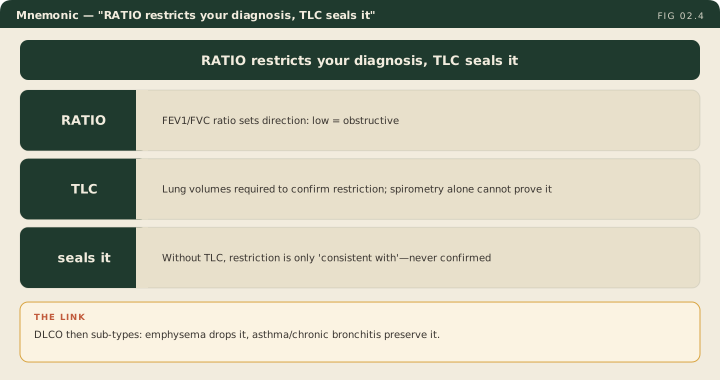
A low FEV1/FVC ratio establishes physiologic obstruction using LLN. TLC is needed to confirm restriction; a reduced FVC alone cannot do so. When a vignette hands you spirometry only and asks whether the patient is restricted, the answer is “consistent with restriction, needs lung volumes.” DLCO then sub-types: it is low in emphysema and preserved in chronic bronchitis and asthma, though it contributes to the differential rather than naming a disease by itself.
So in emphysema, that beautiful high surface area cluster of grapes architecture of the alveoli collapses into large, floppy, inefficient sacks. You lose massive amounts of membrane surface area, so the DLCO drops.
— MEDREH-02 podcast, ~10:57
Spirometry only measures what the patient can actively blow out of their mouth. It literally cannot measure the residual volume left in the lungs after a maximal exhalation.
— MEDREH-02 podcast, ~6:51