Before You Listen
Episode Setup
- Topic in one line: burn depth assessed from appearance, blanching and sensation; adult Rule of Nines and age-adjusted Lund–Browder TBSA; classic Parkland calculations and current resuscitation context; Jackson zones; topical drug effects; airway and toxic-gas assessment; surface-specific positioning; graft protection and scar management; electrical and chemical injury; HO surveillance; nutrition; and current ABA consultation/transfer guidance.
- Prerequisites: skin layers, acid-base physiology, co-oximetry, and positioning that lengthens the injured skin surface while protecting wounds, tendons and joints.
- Runtime:42 minutes.
Vignette. A 35-year-old man weighing 70 kg presents to the emergency department 90 minutes after a house fire with deep partial-thickness and full-thickness burns covering both arms (anterior and posterior), the anterior trunk, and the anterior surfaces of both entire lower extremities. He has singed nasal hairs, carbonaceous sputum, and a hoarse voice. Pulse oximetry reads 98 percent on room air. Co-oximetry shows a carboxyhemoglobin level of 32 percent. He is alert. Burn depth is full-thickness on the dorsa of both hands. The remainder of the burns are deep partial-thickness.
What is his estimated TBSA by the Rule of Nines, what is his Parkland formula fluid resuscitation in the first 24 hours and how is it timed, what does the pulse oximetry reading actually mean and what is the next intervention, what is the anti-deformity position for his hands, and where does he most commonly develop heterotopic ossification compared to a traumatic brain injury patient?
(Answer at the end of this chapter)
Section 1: Burn Depth, Total Body Surface Area, and the Parkland Formula
Key points: superficial epidermal burns are excluded from resuscitation TBSA. Superficial partial-thickness burns are usually moist, blistered and painful; deeper injury often has reduced sensation and delayed healing. Dry, leathery, nonblanching and insensate tissue suggests full thickness, but pain alone cannot classify a burn. Adult Rule of Nines uses head/neck 9%, each arm 9%, each trunk surface 18%, each whole lower extremity 18%, and perineum 1%. Use an age-adjusted Lund–Browder chart for greater detail, especially in children. Classic Parkland is 4 mL × kg × % TBSA LR over 24 h, half allocated to the first 8 h from injury and half over 16 h. It is a starting estimate: account for fluids already given and titrate to urine output and overall perfusion.
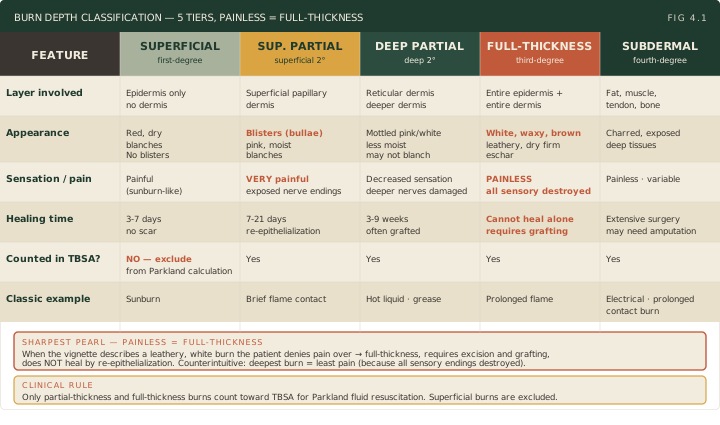
Burn depth determines prognosis, healing time, and the need for surgery.
A superficial burn (first-degree, e.g., sunburn) involves only the epidermis. Skin is red, dry, painful, and blanches. No blisters. Healing in 3-7 days without scarring. Superficial burns are NOT counted in the TBSA calculation for fluid resuscitation.
A superficial partial-thickness burn (superficial second-degree) extends into the superficial papillary dermis. Hallmark: blisters (bullae). Wound base is pink, moist, and very painful because sensory endings are exposed and intact. Heals in 7-21 days by re-epithelialization from surviving skin appendages.
A deep partial-thickness burn extends into the reticular dermis. Sensation is often reduced; the wound can be mottled pink/white, relatively dry and poorly blanching. Healing commonly takes longer than three weeks, with substantial scarring risk and frequent need for grafting. Reassess evolving depth rather than relying on a fixed healing deadline.
A full-thickness burn destroys the epidermis and entire dermis, including dermal appendages and sensory endings. Dry, leathery, white/brown/charred, nonblanching tissue with absent sensation supports this diagnosis. Pain alone is not diagnostic: mixed-depth and adjacent wounds may still hurt. The destroyed surface cannot regenerate from dermal appendages; small defects may close from the margins, but substantial full-thickness wounds usually need excision and grafting.
A subdermal burn (fourth-degree) extends into fat, muscle, tendon, or bone, typically from prolonged exposure, electrical injury, or high-temperature contact. Requires extensive surgical management and may require amputation.
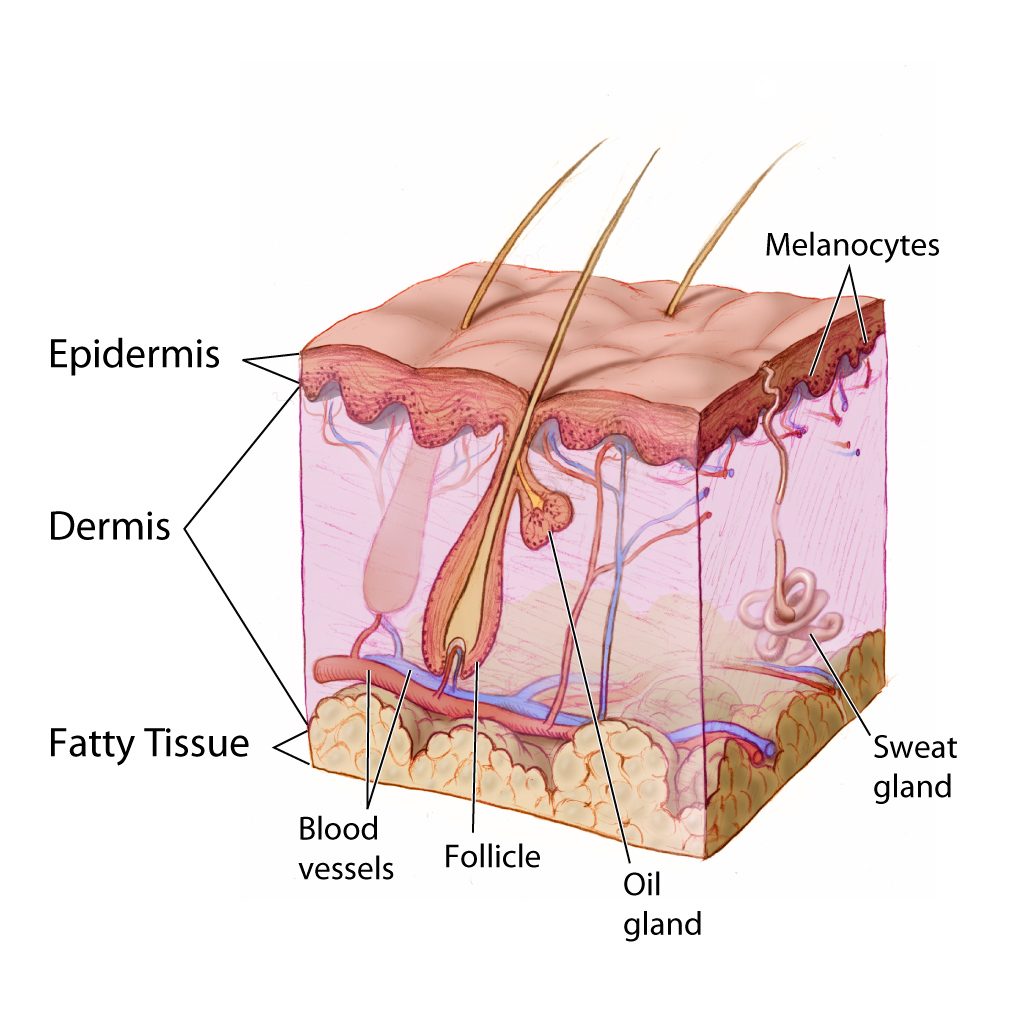
Source: Don Bliss / National Cancer Institute, “Anatomy The Skin - NCI Visuals Online”, via Wikimedia Commons, Public Domain. https://commons.wikimedia.org/wiki/File:Anatomy_The_Skin_-_NCI_Visuals_Online.jpg
Total body surface area (TBSA) estimation guides fluid resuscitation, transfer criteria, and prognosis. Only partial-thickness and full-thickness burns are counted.
The Rule of Nines in adults: head and neck 9 percent, each upper extremity 9 percent, anterior trunk 18 percent, posterior trunk 18 percent, each lower extremity 18 percent, perineum 1 percent. Total 100 percent.
In children, the head occupies a larger and the lower extremities a smaller fraction of body surface than in adults, because the cranium grows toward adult size long before the legs do. The modified pediatric Rule of Nines carries that shift: in an infant the head and neck are 18 percent and each lower extremity is 14 percent, with the remaining regions as in the adult chart; the figures are rounded, so the infant chart sums to 101 percent, which is one reason a detailed assessment uses Lund–Browder instead. The Lund–Browder chart is a separate tool that adjusts every region across the whole age range and is preferred for detailed assessment. Keep the two apart: the 18 and 14 percent infant figures belong to the modified Rule of Nines, not to Lund–Browder. Pediatric rehabilitation is discussed in PEDS-11.
The palmar surface method uses the patient’s palm with fingers as ~1 percent of TBSA, useful for small or scattered burns.
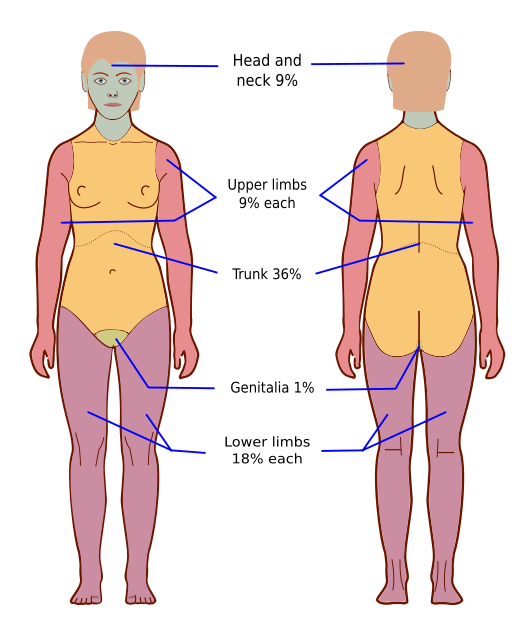
Source: Jmarchn, Wikimedia Commons, CC BY-SA 3.0. https://commons.wikimedia.org/wiki/File:Wallace_rule_of_nines-en.svg
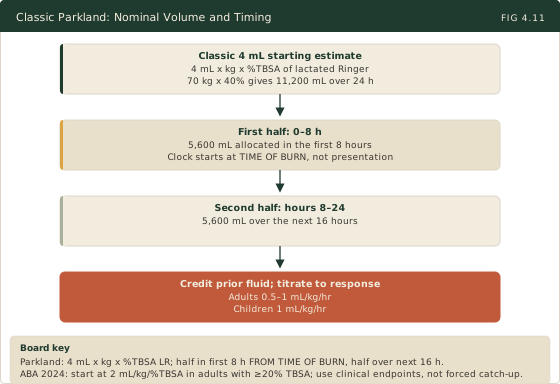
The classic Parkland (Baxter) formula estimates initial first-day fluid as 4 mL × body weight (kg) × percent TBSA of lactated Ringer. Half is allocated to the first 8 hours from the burn, with the other half over the next 16 hours. This is the initial estimate. Credit fluid already infused and adjust the rate to urine output and the overall clinical response.
The formula specifies lactated Ringer, not normal saline. Normal saline carries 154 mEq/L of chloride, and at Parkland volumes that chloride load produces a hyperchloremic metabolic acidosis on top of the burn. Lactated Ringer sits close to plasma on chloride and supplies lactate as a bicarbonate precursor, so the same volume adds far less acid. Choosing LR does not make the patient acid-base proof: hypoperfusion, sepsis and mafenide can each acidify, so work up an acidosis rather than attributing it to the fluid. The 2024 ABA guideline, for adults with burns ≥ 20% TBSA, recommends considering an initial 2 mL/kg/% TBSA approach to reduce resuscitation volume. This does not redefine classic Parkland or establish a mortality benefit, and it does not supply a pediatric maintenance-fluid prescription.
Classic Parkland arithmetic for 70 kg and 40% TBSA: 4 × 70 × 40 = 11,200 mL (11.2 L) LR over 24 h, nominally 5,600 mL in the first 8 h from injury and 5,600 mL over the following 16 h. Actual delivery is adjusted for prior fluid and response.
Target urine output: 0.5–1 mL/kg/hr in adults, 1 mL/kg/hr in children.
High Yield — Depth, TBSA, Parkland
- Depth: superficial epidermal injury is excluded from resuscitation TBSA; superficial partial injury usually heals within three weeks; deep partial injury often heals later or needs grafting; full thickness destroys the dermis; subdermal injury extends deeper.
- Insensate + dry/leathery + nonblanching supports full thickness; pain alone does not classify depth.
- Rule of Nines (adult): head 9, each UE 9, anterior trunk 18, posterior trunk 18, each LE 18, perineum 1.
- Modified pediatric Rule of Nines (infant): head and neck 18, each lower extremity 14; other regions as in the adult chart.
- Lund–Browder: a separate chart giving detailed, age-adjusted regional estimates across childhood.
- Palmar method: the patient’s palm including fingers is approximately 1% TBSA.
- Classic Parkland:4 × kg × % TBSA mL LR; half by 8 h from injury, half over 16 h. Initial estimate; credit prior fluid and titrate. ABA 2024 considers initial 2 mL/kg/% TBSA in adults ≥ 20% TBSA to reduce volume.
- Urine output: target adult 0.5–1 and child 1 mL/kg/h.
Mnemonic — “Nine head, nine arm, eighteen torso side, eighteen leg, one perineum”
The adult body sums to 100. Head 9. Each arm 9. Each torso side 18 (anterior, posterior). Each leg 18. Perineum 1. Memorize the count, then practice on a few cases. The pediatric chart shifts mass toward the head and away from the legs because the child has a relatively larger cranium.
But here is the critical trap. That eight hour clock starts from the exact time of the burn, not the time they roll through the emergency department doors.
— MEDREH-04 podcast, ~10:01
Depth assessment: A painless area can signal deep injury, but confirm with its appearance, blanching, sensation and reassessment. Pain alone cannot distinguish every burn depth.
No pain means no nerve endings left. Every single sensory receptor has been incinerated. If a wound is painless, it is definitively a full thickness injury.
— MEDREH-04 podcast, ~5:26