Before You Listen
Episode Setup
- Topic in one line: the altered physiology, immunosuppression-driven musculoskeletal complications, and organ-specific exercise prescription rules for heart, lung, liver, kidney, and bone marrow transplant recipients on the American Board of Physical Medicine and Rehabilitation (ABPMR) Part I examination.
- Prerequisites: baseline cardiac autonomic physiology (vagal tone, sympathetic drive), pulmonary mucociliary clearance and the cough reflex, hepatic and renal metabolism, the Karvonen heart rate (HR) reserve formula, the rating of perceived exertion (RPE) Borg 6-20 scale, and steroid pharmacology.
- Runtime: 48 minutes.
Vignette. A 64-year-old man is 4 months post orthotopic heart transplantation for ischemic cardiomyopathy and presents to phase II cardiac rehabilitation. His resting HR is 102 beats per minute (bpm) on the ECG monitor. He reports no chest pain. The therapist sets a Karvonen-derived target HR of 130 bpm. Within 90 seconds of treadmill walking the patient reports light-headedness, his HR is still 104, and his blood pressure (BP) drops from 124/72 to 96/58. The therapist stops the session for assessment and contacts the transplant team. His daily medications include tacrolimus, mycophenolate mofetil, prednisone 15 mg, atorvastatin, and aspirin. A recent dual-energy x-ray absorptiometry (DEXA) showed a femoral neck T-score of -2.7.
Why is a Karvonen-derived target the wrong way to set intensity in this patient, what method should the therapist use instead, what extended warm-up duration is appropriate, what is the most likely explanation for his low T-score, and what single class of medication should be reviewed before initiating high-impact exercise?
(Answer at the end of this chapter)
Section 1: Heart Transplant — The Denervated Heart and Cardiac Allograft Vasculopathy
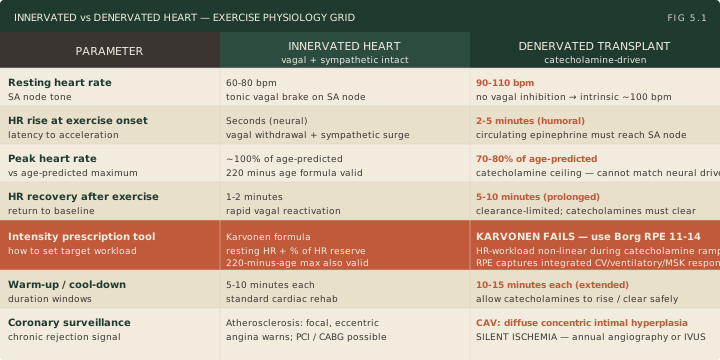
Bottom line: surgical denervation severs both vagal and sympathetic fibers to the donor heart, which raises the resting HR to 90-110 bpm (loss of vagal brake), delays the exercise HR response by 2-5 minutes (rate now depends on circulating catecholamines rather than direct neural drive), blunts the peak HR, and prolongs HR recovery for 5-10 minutes after exercise; do not set intensity from an age-predicted maximum or a Karvonen target, prescribe by the Borg RPE 6-20 scale at 11-14 with symptoms and measured workload, with HR and BP monitoring and 10-15 minute warm-up and cool-down windows; cardiac allograft vasculopathy is diffuse concentric coronary intimal hyperplasia representing chronic rejection, presents as silent ischemia because sensory denervation removes the anginal warning, and is followed by coronary angiography every 1-2 years with intravascular ultrasound as an adjunct.
The transplanted heart is denervated at the time of orthotopic implantation. Both the parasympathetic vagal fibers and the sympathetic postganglionic fibers to the donor heart are transected, and reinnervation, when it occurs, is partial, delayed, and unpredictable. The clinical signature of denervation is a constellation of four predictable autonomic findings that drive the entire exercise prescription.
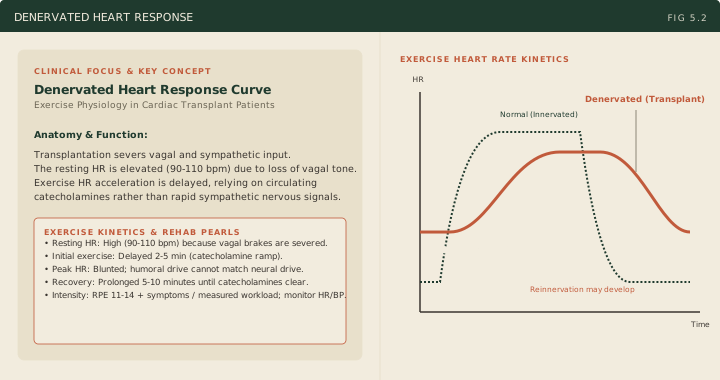
The resting HR is 90-110 bpm because the sinoatrial node, freed from tonic vagal inhibition, reverts toward its intrinsic firing rate of about 100 bpm. This is the expected physiology of denervation rather than a pathologic finding, but an elevated rate on its own does not rule out rejection, volume depletion or another illness; compare it with the patient’s own baseline and symptoms. The HR response to exercise onset is delayed by 2-5 minutes because the rapid neural acceleration normally produced by vagal withdrawal and sympathetic activation is unavailable. Rate increase now depends on circulating epinephrine released from the adrenal medulla and norepinephrine spillover from sympathetic terminals elsewhere in the body. Catecholamines must be released, traverse the bloodstream, and bind beta-adrenergic receptors on the donor sinoatrial node before HR rises. The peak HR is blunted because humoral acceleration cannot match neural drive; the degree of blunting differs between recipients. The HR recovery is prolonged: instead of the rapid drop produced by vagal reactivation, HR remains elevated for 5-10 minutes until catecholamines are cleared. Partial reinnervation may develop over time and shifts all four values, so treat the pattern as the board baseline and the individual patient as the measurement (2024 transplant rehabilitation consensus).
These four findings dictate the exercise prescription. The Karvonen formula sets a target HR as resting HR plus a percentage of HR reserve, where HR reserve is maximum HR minus resting HR. Do not use it, or 220 minus age, to prescribe intensity after heart transplantation. The estimated maximum is not valid in a denervated heart, and HR tracks workload too slowly during the catecholamine ramp for the resulting number to represent effort. Prescribe instead by the Borg RPE 6-20 scale with a target of 11-14 (fairly light to somewhat hard), read alongside symptoms and measured workload or cardiopulmonary exercise testing when it is available, and keep monitoring HR and BP. Extend the warm-up to 10-15 minutes so circulating catecholamines have time to rise and meet workload before the patient reaches target intensity, and extend the cool-down to 10-15 minutes to prevent post-exercise hypotension as catecholamines decline.
Mnemonic — “Five and Fifteen” for the denervated heart
5 minutes: the catecholamines have to ramp before HR rises, so the exercise HR response is delayed 2-5 minutes. 15 minutes: the upper end of the 10-15 minute warm-up and the 10-15 minute cool-down. HR target: forget the formula, trust the talk test at Borg 11-14. Board answers: HR rise delayed 2-5 minutes, warm-up and cool-down 10-15 minutes each.
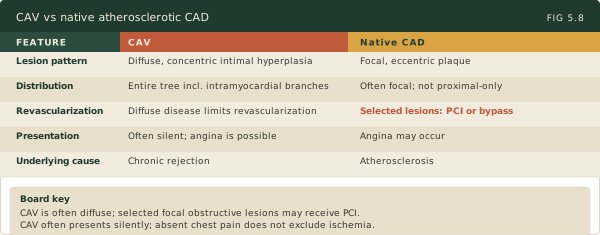
Cardiac allograft vasculopathy (CAV) is chronic rejection of the coronary vasculature and a major cause of late morbidity and mortality after heart transplantation. Unlike typical atherosclerotic coronary artery disease, which is focal and eccentric, CAV produces diffuse, concentric intimal hyperplasia that involves the entire coronary tree from large epicardial vessels down to small intramyocardial branches. The diffuse pattern limits revascularization, although selected focal obstructive lesions can be treated with percutaneous coronary intervention. Surveillance is coronary angiography every 1-2 years on a schedule individualized to the recipient, with intravascular ultrasound (IVUS) as an adjunct when indicated.
The single most important rehabilitation point about CAV is that it presents as silent ischemia, because sensory denervation removes the anginal warning that would otherwise announce it. The first manifestation may be unexplained heart failure, new arrhythmia, declining exercise tolerance during therapy sessions, or sudden cardiac death. Chest pain is not impossible after transplantation, and its absence never excludes ischemia, so never use a pain-free history to reassure a patient who has deteriorated. Rehabilitation staff must be vigilant for any unexplained drop in workload tolerance, new dyspnea at previously tolerated levels, fatigue out of proportion to activity, or new lower-extremity edema, and must escalate new deterioration promptly. Document the baseline exercise capacity carefully so a decline can be recognized.
High Yield — Heart transplant rehab
- Resting HR 90-110 bpm, exercise onset delayed 2-5 min, peak HR blunted, recovery prolonged 5-10 min.
- Do not prescribe from Karvonen or 220 minus age after cardiac transplant. Use Borg RPE 11-14 with symptoms and measured workload, and keep monitoring HR and BP.
- Warm-up and cool-down both extended to 10-15 minutes.
- Cardiac allograft vasculopathy = diffuse concentric intimal hyperplasia, chronic rejection; presents as silent ischemia and absent chest pain never excludes ischemia; surveillance by coronary angiography every 1-2 years, IVUS as an adjunct.
- Partial reinnervation is variable and unpredictable; do not assume it.
So if you calculate a Karvonen target of, say, 130 beats per minute and you tell the patient to hit it on an exercise bike, their heart simply will not climb there fast enough to match the skeletal muscle demand.
— MEDREH-05 podcast, ~6:18