Before You Listen
Episode Setup
- Topic in one line: the parameters, mechanisms, indications, and contraindications of every physical modality on the American Board of Physical Medicine and Rehabilitation (ABPMR) Part I outline — superficial and deep heat, cryotherapy, therapeutic ultrasound, shortwave and microwave diathermy, transcutaneous electrical nerve stimulation (TENS) by frequency and opioid-receptor target, neuromuscular electrical stimulation (NMES) and functional electrical stimulation (FES), iontophoresis polarity rules, cervical and lumbar traction force thresholds, ultraviolet (UV) radiation and the Goeckerman technique, massage, manual therapy, and biofeedback.
- Prerequisites: mechanisms of heat transfer (conduction, convection, radiation, conversion); the gate control theory of pain (covered in REHAB-01); A-beta, A-delta, and C fiber properties; mu, kappa, and delta opioid receptors; basic motor neuron and muscle spindle anatomy.
- Runtime: 1 hour 37 minutes.
Vignette. A 47-year-old construction worker presents with chronic right shoulder pain and a healed deep partial-thickness burn over the deltoid from a welding accident 18 months ago. He has 90 degrees of active shoulder flexion and a hypertrophic scar. The therapist proposes a treatment plan including therapeutic ultrasound at 1 megahertz (MHz) and 1.5 watts per square centimeter (W/cm²) continuous over the glenohumeral joint, transcutaneous electrical nerve stimulation at 80 hertz (Hz) at sensory level for pain, paraffin wax to soften the scar, and iontophoresis with dexamethasone for residual deltoid bursitis. He has a stainless-steel total shoulder arthroplasty implanted 2 years before the burn, secured with polymethylmethacrylate cement.
Which one of the four modalities is contraindicated and why, what is the appropriate ultrasound frequency for treating supraspinatus tendinopathy 1 to 2 centimeters below the skin, what opioid receptor mediates the analgesia of high-frequency TENS, and which electrode polarity is required for the dexamethasone iontophoresis?
(Answer at the end of this chapter)
Section 1: Superficial Heat, Cryotherapy, and the Heat-Cold Contraindication Map
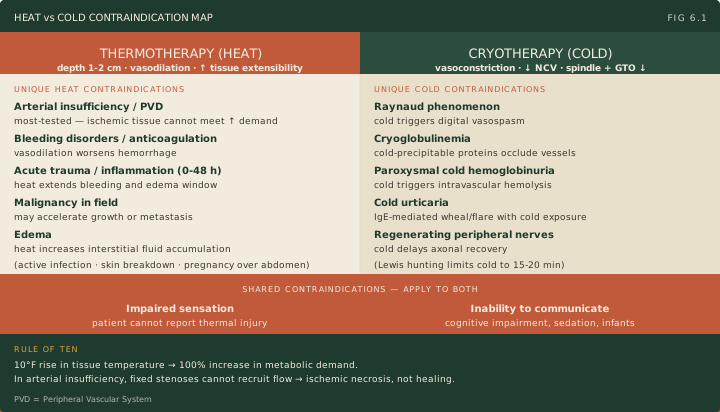
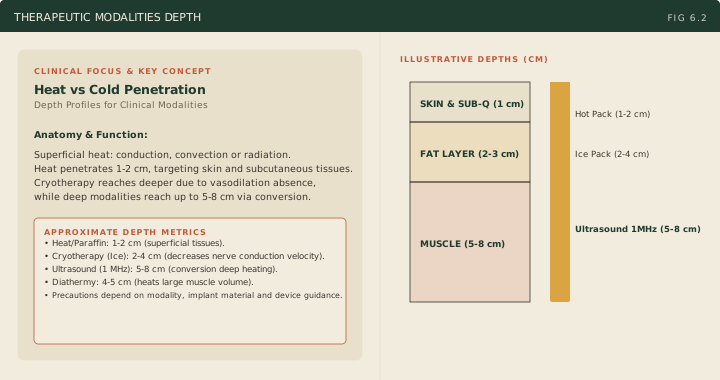
Bottom line: superficial heat penetrates 1 to 2 centimeters via conduction (hot packs, paraffin) or convection (fluidotherapy, hydrotherapy) and produces vasodilation, increased tissue extensibility, decreased pain, and decreased muscle spasm; the single most-tested heat principle is the 10-degrees-Fahrenheit-equals-100-percent-metabolic-demand-increase rule that drives the arterial-insufficiency contraindication; cryotherapy produces vasoconstriction, decreased nerve conduction velocity, and dual reduction of muscle spindle and Golgi tendon organ firing for spasticity reduction; cold packs are typically applied for 15 to 20 minutes, and cooling duration otherwise depends on site, method and patient; heat contraindications are arterial insufficiency, bleeding disorders, impaired sensation, malignancy in the field, acute trauma in the first 24 to 48 hours, and edema; cold contraindications are Raynaud phenomenon, cryoglobulinemia, paroxysmal cold hemoglobinuria, cold urticaria, and regenerating peripheral nerves.
Superficial heat modalities reach a tissue depth of 1 to 2 centimeters and use conduction, convection, or radiation, depending on the modality. Conduction transfers heat through direct contact with a heated medium and applies to hot packs (hydrocollator packs filled with silicon dioxide gel stored at 160 to 175 degrees Fahrenheit, applied with 6 to 8 layers of toweling for 20 to 30 minutes) and paraffin wax (a 7-to-1 paraffin-to-mineral-oil mixture maintained at 126 to 130 degrees Fahrenheit, ideal for hands and feet in rheumatoid arthritis, scleroderma, and contracture; the dip-wrap method uses 7 to 12 dips). Infrared lamps transfer energy by radiation; absorbed radiant energy becomes heat. Convection transfers heat by circulation of a warmed fluid or gas and applies to fluidotherapy (hot air through cellulose particles at 100 to 118 degrees Fahrenheit, allowing active range of motion during treatment) and hydrotherapy (whirlpool, Hubbard tank, and contrast baths alternating warm 100-111 degrees Fahrenheit and cold 50-64 degrees Fahrenheit, beginning warm).
The single most-tested heat principle is the metabolic-demand rule: a 10-degrees-Fahrenheit rise in tissue temperature produces a 100 percent increase in metabolic demand. In tissue with normal vasculature this demand is met; in tissue with arterial insufficiency the doubled metabolic demand cannot be met because vasodilation cannot recruit additional flow through fixed stenoses, producing ischemic injury rather than therapeutic benefit. Arterial insufficiency is therefore the single most important contraindication to heat. The full heat-contraindication list is arterial insufficiency, bleeding disorders or anticoagulation, impaired sensation, inability to communicate pain, malignancy in the treatment field, acute trauma or inflammation in the first 24 to 48 hours, scar tissue (reduced vascularity), edema, and active infection. Before heating a healed burn area, assess skin integrity, thermal sensation and local circulation; a healed scar is not by itself permission to apply heat.
Cryotherapy produces a stereotyped sequence of physiologic effects that the boards test. Vasoconstriction is the initial response, reducing blood flow and blunting edema and inflammation. Decreased nerve conduction velocity in both motor and sensory fibers slows pain transmission and produces analgesia. Reduced muscle spindle firing through decreased Type Ia and Type II afferent activity, combined with reduced Golgi tendon organ Type Ib firing, reduces spasticity through a dual mechanism that the boards specifically test. The net effect is reduced spasticity because the decrease in excitatory spindle input predominates, which is why cryotherapy is used before stretching in patients with spasticity. The patient also experiences a four-stage subjective sequence: cold, then burning, then aching, then numbness.
Cold methods include cold/ice packs, ice massage, vapocoolant spray-and-stretch and cold-compression units. Teaching durations are 15 to 20 minutes for packs and 5 to 10 minutes for small-area ice massage; these are not universal safety limits. Cooling duration depends on the site, method and patient. Cold-induced vasodilation may occur, but it does not follow a universal 20-minute switch; monitor tissue response and follow the treatment protocol. Impaired local perfusion matters for both heat and cold. Cold contraindications include Raynaud phenomenon, arterial insufficiency, impaired sensation, cryoglobulinemia, paroxysmal cold hemoglobinuria, cold urticaria and regenerating peripheral nerves.
Mnemonic — “Ten and Ten” for the heat-arterial-insufficiency rule
10 degrees Fahrenheit rise in tissue temperature. 100 percent increase in metabolic demand. In ischemic tissue the doubled demand cannot be met because vasodilation cannot recruit flow through fixed stenoses → ischemic necrosis rather than healing. Heat is contraindicated in arterial insufficiency.
High Yield — Heat and cold
- Superficial heat = 1-2 cm depth via conduction (hot packs, paraffin) or convection (fluidotherapy, hydrotherapy).
- Hot packs: 160-175°F, 6-8 towel layers, 20-30 min.
- Paraffin: 7:1 paraffin-to-mineral-oil at 126-130°F; dip-wrap 7-12 dips for hands and feet.
- 10°F rise = 100% metabolic-demand increase → arterial insufficiency is the most important heat contraindication.
- Cryotherapy: vasoconstriction, decreased nerve conduction velocity, dual reduction of muscle spindle (Ia/II) AND Golgi tendon organ (Ib) firing → reduced spasticity.
- Lewis hunting response = cold-induced vasodilation that can follow cooling, though it does not occur in every case; standard cold-pack treatment time is 15-20 minutes.
The rule states a 10 degree Fahrenheit rise in local tissue temperature produces a 100% increase in the metabolic demand of that tissue.
— MEDREH-06 podcast, ~10:20