Before You Listen
Episode Setup
- Topic in one line: the age-associated physiologic changes (sarcopenia, declining cardiac and pulmonary reserve, altered pharmacokinetics), evidence-based fall risk assessment using the Timed Up and Go (TUG), Berg Balance Scale and Tinetti Performance-Oriented Mobility Assessment in context, the Beers Criteria for potentially inappropriate medications, hip fracture classification and post-operative protocols, the Fried frailty phenotype, the Confusion Assessment Method (CAM) for delirium, and the four major dementia subtypes that drive American Board of Physical Medicine and Rehabilitation (ABPMR) Part I geriatric questions.
- Prerequisites: basic muscle fiber types (Type I slow-twitch, Type II fast-twitch), hepatic phase I cytochrome P450 metabolism vs phase II conjugation, glomerular filtration rate (GFR) estimation, anticholinergic pharmacology, and the Garden classification for femoral neck fractures.
- Runtime: 1 hour 6 minutes.
Vignette. An 82-year-old woman is admitted to inpatient rehabilitation 4 days after a left intertrochanteric hip fracture treated with a cephalomedullary nail. She has a history of hypertension, osteoporosis (T-score -3.1 at the femoral neck), and mild cognitive impairment. Her home medications include lisinopril, metoprolol, alendronate, calcium with vitamin D, alprazolam 0.5 mg three times daily for anxiety, diphenhydramine 50 mg at bedtime for sleep, and oxybutynin for urge incontinence. Her grip strength is 13 kilograms (kg), gait speed is 0.5 meters per second over 4 meters, weight has decreased 12 pounds over the past year, and she scored 21 on the Montreal Cognitive Assessment (MoCA) on admission. On hospital day 6 she becomes acutely inattentive, drowsy, and disoriented. The Confusion Assessment Method is positive.
Identify three medications on her list that the Beers Criteria flag and name the class of each, state what the postoperative measurements can and cannot establish about her prefracture Fried phenotype, identify the delirium motor subtype and the likely contributors, and state the post-operative weight-bearing status appropriate for her fixation.
(Answer at the end of this chapter)
Section 1: Aging Physiology, Sarcopenia, and Pharmacokinetic Changes
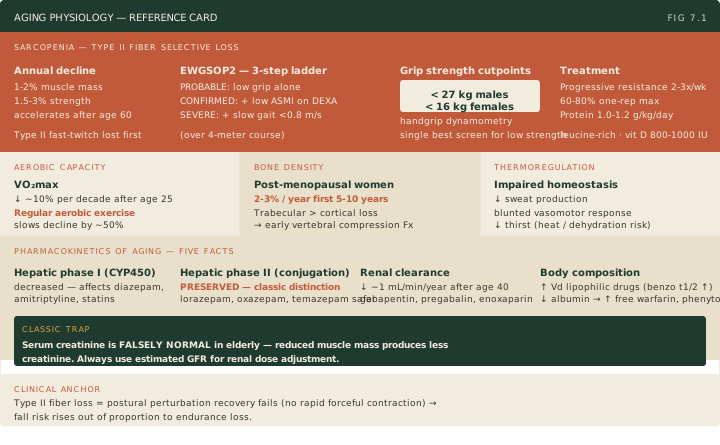
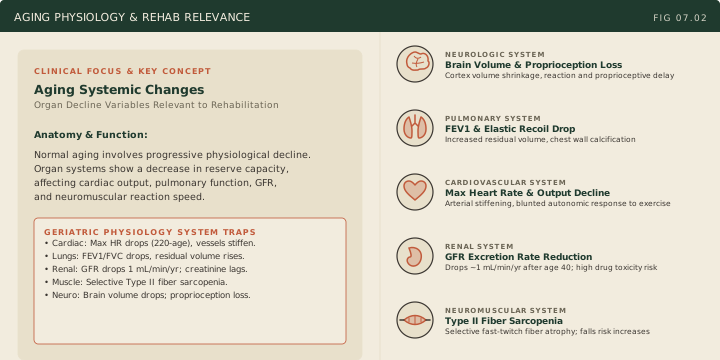
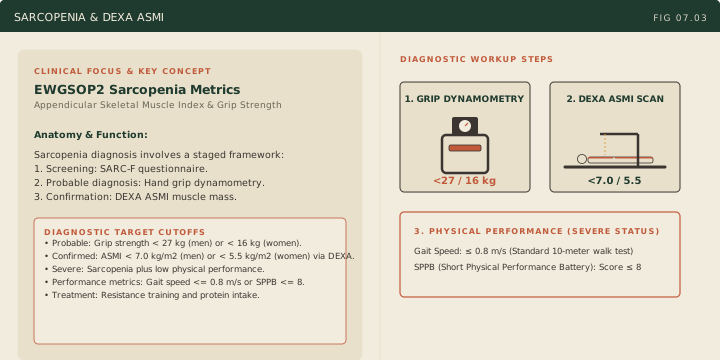
Bottom line: aging produces measurable physiologic changes that drive rehabilitation outcomes. Sarcopenia strips Type II fast-twitch fibers preferentially, with annual declines averaging 1 to 2 percent in muscle mass and 1.5 to 3 percent in muscle strength, so strength is lost faster than mass. Peak oxygen consumption falls and the fall steepens with each successive decade. Bone loss accelerates through the late menopausal transition and early postmenopause. Hepatic phase I metabolism falls while phase II conjugation is preserved; low muscle mass makes serum creatinine falsely reassuring, so dose from a kidney-function estimate in the units the drug label specifies; volume of distribution rises for lipophilic drugs. The European Working Group on Sarcopenia in Older People (EWGSOP2) stages sarcopenia in three steps: probable is low strength (grip less than 27 kg in men or less than 16 kg in women, or five chair rises taking more than 15 seconds); confirmed adds low muscle quantity or quality (appendicular skeletal muscle index below 7 kg/m² in men and 5.5 kg/m² in women on dual-energy x-ray absorptiometry); severe adds poor physical performance (gait speed 0.8 meters per second or slower, SPPB 8 or less, or Timed Up and Go 20 seconds or more).
Sarcopenia is the progressive loss of skeletal muscle strength together with low muscle quantity or quality. Aging is the major driver, and inactivity, illness and inadequate nutrition accelerate it. Muscle is lost from the third decade onward at annual rates averaging 1 to 2 percent of mass and 1.5 to 3 percent of strength, accelerating after age 60. Those are cohort averages; the onset and the slope differ between individuals, so treat them as the expected picture rather than a prediction for the patient in front of you. Strength is lost faster than mass: over 3 years in the 1,880-participant Health ABC cohort of older adults, leg lean mass fell about 1 percent per year while strength declined roughly three times faster. Measure both, because preserving mass does not preserve strength. The pathophysiology involves motor neuron loss, hormonal decline (testosterone, growth hormone, insulin-like growth factor 1, estrogen), chronic low-grade inflammation, mitochondrial dysfunction, satellite cell depletion, decreased protein synthesis, increased myostatin expression, physical inactivity, and inadequate nutrition. The loss preferentially affects Type II fast-twitch muscle fibers (rapid forceful movements: rising from a chair, catching oneself, climbing stairs); Type I slow-twitch fibers are relatively preserved. That is why sarcopenia drives fall risk: recovering from a postural perturbation requires rapid forceful contraction.
The EWGSOP2 diagnostic framework identifies probable sarcopenia by low strength: grip <27 kg in men or <16 kg in women, or >15 seconds for five chair rises. Confirmation requires low muscle quantity or quality; DXA or bioimpedance are usual clinical options. DXA appendicular skeletal muscle index cutoffs are <7 kg/m² in men and <5.5 kg/m² in women. Severe sarcopenia additionally requires poor physical performance, for example usual gait speed ≤0.8 m/s, measured over 4 meters; SPPB ≤8, TUG ≥20 seconds, or inability to complete 400 meters or taking ≥6 minutes are alternatives. EWGSOP2, 2019
Sarcopenic obesity is excess adiposity together with low muscle mass relative to body size and impaired muscle function. Myosteatosis, fat infiltration within the muscle itself, further impairs contractile function; it is a related but separate finding. Diagnose it from measured body composition plus measured function (DXA, or bioimpedance, or opportunistic CT), never from body habitus: a normal-looking limb circumference does not exclude it. ESPEN/EASO consensus, 2022
Treatment centers on progressive resistance exercise, 2 to 3 times per week, combined with balance and functional training. Moderate to high loads (60 to 80 percent of one-repetition maximum) build muscle mass, strength and physical performance even in the ninth and tenth decades; a frail patient who cannot start there still gains strength at about 40 percent of one-repetition maximum, so start at a tolerable load and progress rather than waiting. Protein intake of 1.0 to 1.2 grams per kilogram per day is the target for healthy older adults, rising to 1.2 to 1.5 g/kg/day during illness; severe kidney disease requires an individualized target. Leucine-rich sources (whey protein, dairy, eggs, lean meats) stimulate the mammalian target of rapamycin (mTOR) pathway. Ensure total energy intake is adequate first: protein cannot be used for anabolism in an energy deficit. Give vitamin D for a bone or nutritional indication, not as a stand-alone falls treatment. ESPEN, 2022
Peak aerobic capacity (VO2max) declines with age, and the decline steepens with each successive decade rather than holding at a fixed 10 percent per decade. In the Baltimore Longitudinal Study of Aging (810 participants aged 21 to 87 free of heart disease, median 7.9 years of follow-up), the rate of loss accelerated across the age decades, and the trajectory was similar across self-reported activity quartiles. Aerobic training raises the capacity a patient starts from, which is what determines whether a given task is submaximal for them. Fleg et al., 2005
Bone density peaks between ages 25 and 30 and declines thereafter. In women, loss accelerates through the late menopausal transition and early postmenopause, varying by skeletal site and body weight (SWAN, 1,902 women, up to six annual visits). Trabecular bone is affected more than cortical bone, which is why the spine loses density before the hip; that is a difference in rate, not a fixed sequence in which vertebral fracture must precede hip fracture by a set number of years. Bone remodels throughout life, so density can still be gained after age 30 with treatment. Finkelstein et al., 2008
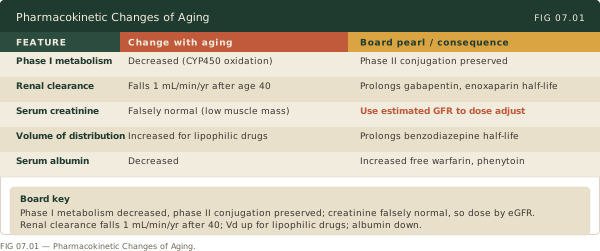
Pharmacokinetic aging comes down to four facts. Hepatic phase I metabolism (cytochrome P450 oxidation) decreases as liver blood flow and liver volume fall; phase II conjugation is preserved, the classic board distinction. That distinction narrows the choice of drug; it does not make every phase II substrate safe, and lorazepam is still a benzodiazepine. Serum creatinine is falsely normal in an older adult because reduced muscle mass produces less creatinine, so a normal value can conceal real impairment; dose from an estimate of kidney function, using the equation and units the drug label specifies, because some labels call for Cockcroft-Gault creatinine clearance rather than indexed eGFR. Volume of distribution rises for lipophilic drugs as body fat percentage increases, prolonging benzodiazepine half-life. Albumin falls with illness or malnutrition rather than with healthy aging itself, and a lower albumin raises the free fraction of warfarin and phenytoin; whether the free concentration stays up depends on clearance. Mangoni and Jackson, 2004
High Yield — Aging physiology
- Sarcopenia: Type II fiber-selective loss; about 1-2%/year mass, 1.5-3%/year strength; accelerates after 60. Strength falls roughly 3x faster than mass.
- EWGSOP2: probable = low strength (grip <27 kg M / <16 kg F, or five chair rises >15 sec) → confirmed = add low muscle quantity/quality (DXA ASMI <7 M / <5.5 F kg/m²) → severe = add poor performance (gait ≤0.8 m/s, SPPB ≤8, or TUG ≥20 sec).
- Treatment: progressive resistance training 2-3x/week at 60-80% 1RM; protein 1.0-1.2 g/kg/day (1.2-1.5 in illness), leucine-rich. Lower loads still work as a starting point.
- VO2max: declines with age and the decline accelerates each decade; training raises the capacity you start from.
- Pharmacokinetic aging: phase I decreased, phase II preserved; serum creatinine falsely normal (low muscle mass), so dose from an estimate in the units the label names; volume of distribution increased for lipophilic drugs; albumin falls with illness, not with healthy aging alone.
The steady slow shuffle survives intact, but the explosive power required to arrest a fall, it’s completely gone.
— MEDREH-07 podcast, ~7:14
Correction — 2026-09-08: preferential fast-fiber loss does not mean explosive power is completely absent or slow-twitch function entirely intact.