Before You Listen
Episode Setup
- Topic in one line: the architecture of normal sleep, age-related changes that shape rehabilitation outcomes, the diagnosis and treatment of obstructive sleep apnea (OSA) at remarkably elevated prevalence in spinal cord injury (SCI), traumatic brain injury (TBI), and stroke populations, central sleep apnea (CSA) including Cheyne-Stokes respiration and the SERVE-HF contraindication for adaptive servo-ventilation in heart failure with reduced ejection fraction (HFrEF), cognitive behavioral therapy for insomnia (CBT-I) with its five commonly taught components as first-line for chronic insomnia, circadian rhythm disorders after TBI, REM sleep behavior disorder (RBD) as a synucleinopathy prodrome, and restless legs syndrome (RLS) including the ferritin threshold and augmentation phenomenon. Cross-references to REHAB-13 (Sleep Disorders) for the neurology-side detail.
- Prerequisites: basic sleep neurophysiology (the suprachiasmatic nucleus, melatonin biology, brainstem respiratory control), Beers Criteria for elderly medication choice (covered in MEDREH-07), and gate control / opioid pharmacology that underlies opioid-induced central apnea.
- Runtime: 32 minutes.
Vignette. A 58-year-old man with a 4-month-old C5 motor-complete tetraplegia from a diving accident presents to the SCI clinic. His wife reports loud snoring, witnessed apneas, and morning headaches. He takes a long-acting opioid for neuropathic pain and sleeps supine because of his injury. His Epworth Sleepiness Scale score is 16. The team orders attended polysomnography, which shows an apnea-hypopnea index (AHI) of 38 events per hour with both obstructive and central events. The patient has a known left ventricular ejection fraction of 30 percent on transthoracic echocardiography from a remote myocardial infarction. The medical team considers continuous positive airway pressure (CPAP) versus adaptive servo-ventilation (ASV).
What is the approximate prevalence of OSA in cervical SCI, what specific positional factor in this patient elevates risk, what further details are needed before deciding whether ASV is contraindicated in his case, what role does his opioid play in the central events, and which sleep-aid class is avoided in elderly, TBI and SCI patients with sleep complaints?
(Answer at the end of this chapter)
Section 1: Sleep Architecture, Aging Changes, and the Rehabilitation Implication
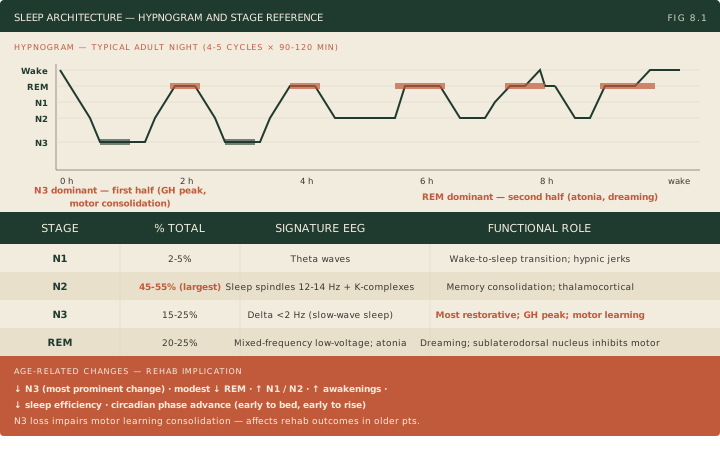
Bottom line: normal sleep cycles in 90 to 120 minute cycles with 4 to 5 cycles per night through stages N1 (light, theta waves, 2 to 5 percent), N2 (sleep spindles at 12 to 14 hertz and K-complexes, 45 to 55 percent of total), N3 (slow-wave delta in the 0.5 to 4 hertz band, 15 to 25 percent, most restorative, growth hormone peak), and REM (rapid eye movements with skeletal muscle atonia, 20 to 25 percent); N3 predominates in the first half of the night and REM in the second half; aging brings a significant decrease in slow-wave sleep, modest decrease in REM, increased N1 and N2, increased nighttime awakenings, decreased sleep efficiency, and circadian phase advance with earlier sleep onset and earlier awakening; sleep supports motor-skill consolidation, with the contribution of each stage depending on the task.
Normal sleep cycles in 90 to 120 minute cycles with 4 to 5 cycles per night. Each cycle contains the four stages.
Stage N1 is light sleep characterized by theta waves, constituting 2 to 5 percent of total sleep time. Hypnic jerks occur during this transition from wakefulness.
Stage N2 is true sleep and comprises the largest proportion of total sleep time at 45 to 55 percent. N2 is defined by two signature waveforms tested on every sleep board section: sleep spindles at 12 to 14 hertz (generated by thalamocortical circuits, implicated in memory consolidation) and K-complexes (high-amplitude biphasic waves representing cortical responses to external or internal stimuli).
Board answer vs. current evidence — sleep spindles have a frequency of 12–14 Hz — this is likely the board-tested answer, but more recent evidence (PMID 32239159) indicates the full spindle band spans 10–16 Hz — slow (frontal) spindles at 10–13 Hz and fast (centroparietal) spindles at 13–16 Hz. Answer the board-canonical version on the test.
Stage N3 is slow-wave deep sleep with high-amplitude delta waves in the 0.5 to 4 hertz band, constituting 15 to 25 percent of total sleep time. N3 is the most physiologically restorative stage. Growth hormone secretion peaks during N3, making it critical for tissue repair, immune function, and recovery from physical stress. N3 predominates in the early sleep cycles of the night — the first half is dominated by deep sleep, the second half by REM.
REM sleep features conjugate eye movements, skeletal muscle atonia from active brainstem inhibition of motor neurons, and dreaming. It constitutes 20 to 25 percent and predominates in later cycles. The atonia during REM is a safety mechanism preventing dream enactment. The mechanism involves active inhibition of alpha motor neurons by glycinergic and GABAergic neurons in the sublaterodorsal nucleus and ventral medullary reticular formation. When this atonia mechanism fails, REM sleep behavior disorder results (covered in Section 5).
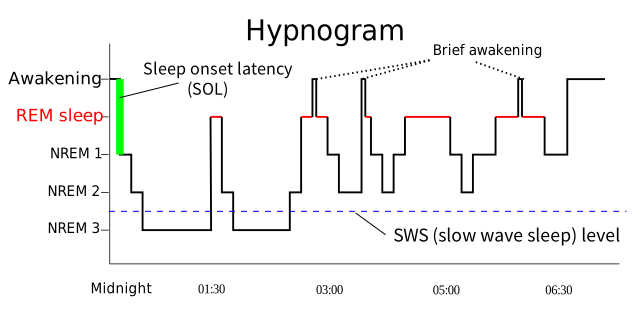
Source: RazerM, “Sleep Hypnogram”, via Wikimedia Commons, CC BY-SA 3.0 / GFDL. https://commons.wikimedia.org/wiki/File:Sleep_Hypnogram.svg
Age-related changes in sleep architecture are frequently tested. Slow-wave sleep decreases significantly (the most prominent change). REM decreases modestly. N1 and N2 increase proportionally to fill the gap. Nighttime awakenings increase, sleep efficiency decreases, and there is a circadian phase advance with earlier sleep onset and earlier morning awakening. Sleep supports motor-skill consolidation, and which stage does the work depends on the task: a young-adult finger-sequence experiment linked the overnight gain to stage 2 NREM, not to N3.
Mnemonic — “Spindles, Slow waves, Skeletal atonia”
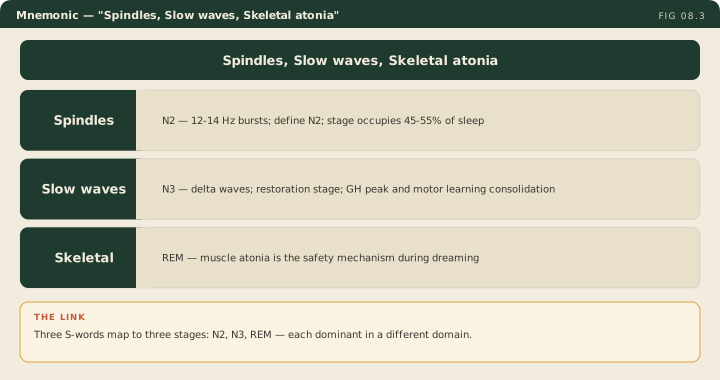
N2 is dominant by time (45-55%) and defined by sleep spindles (12-14 Hz). N3 is dominant by restoration (delta waves, GH peak). REM is dominant by dreaming with skeletal muscle atonia as the safety mechanism. Three S-words, three stages, never confused.
High Yield — Sleep architecture
- Cycles: 90-120 min × 4-5 per night.
- N2 (45-55%, largest by time) = sleep spindles 12-14 Hz + K-complexes.
- N3 (15-25%, most restorative) = delta 0.5-4 Hz, growth hormone peak, predominates first half of night.
- REM (20-25%) = atonia from sublaterodorsal nucleus inhibition; predominates second half.
- Aging: decreased N3 (most prominent), modest decreased REM, increased N1/N2, more awakenings, circadian phase advance.
- Rehabilitation implication: sleep supports motor-skill consolidation; the contribution of each stage depends on the task. N3 loss does not erase a day’s therapy gains.
If you cut the power during the save process, meaning if the patient loses their slow-wave sleep due to age, environment, or medications, the physical gains from that day are literally not written to the hard drive. The progress is completely lost.
— MEDREH-08 podcast, ~11:40