Before You Listen
Episode Setup
- Topic in one line: delirium in rehabilitation, including Diagnostic and Statistical Manual of Mental Disorders, Fifth Edition (DSM-5) criteria, the Confusion Assessment Method (CAM) with its intensive care unit (ICU) adaptation (CAM-ICU) and the four A’s test (4AT), the Richmond Agitation-Sedation Scale (RASS), the three motor subtypes, the predisposing-precipitating risk model and the DELIRIUM mnemonic, the postoperative hip-fracture scenario, the Hospital Elder Life Program (HELP) and the ABCDEF ICU bundle for prevention, and a management hierarchy that places nonpharmacologic interventions ahead of antipsychotics and keeps benzodiazepines for withdrawal and a few specialist indications.
- Prerequisites: geriatric pharmacology and the Beers Criteria, basic dementia neurocognitive disorders, the Functional Independence Measure (FIM), and the orthogeriatric model of hip-fracture care.
- Runtime: 1 hour 2 minutes.
Vignette. A 78-year-old woman is admitted to your inpatient rehabilitation facility (IRF) on postoperative day 4 after right hip hemiarthroplasty for a displaced femoral neck fracture. Her baseline includes mild Alzheimer dementia (Montreal Cognitive Assessment 22/30 six months ago), hypertension, and chronic kidney disease (estimated glomerular filtration rate 38 mL/min/1.73 m²). On the morning of IRF day 2, the night nurse reports that the patient was “quiet and tired,” ate less than 25 percent of her dinner, and slept through her overnight vital signs. On your rounds she answers questions correctly but takes a long time to respond, drifts off mid-sentence, cannot recite the months of the year backward past September, and is oriented to person but not place. Her medications include scheduled acetaminophen, oxycodone 5 mg every 6 hours as needed (4 doses in 24 hours), diphenhydramine 25 mg at bedtime for sleep that was added by the orthopedic team, lisinopril, and atorvastatin. She has an indwelling urinary catheter that was placed in the operating room and never removed.
What delirium subtype is most likely, what single bedside test confirms the cardinal feature, which three medication or device decisions most directly drive her presentation, and what is the correct sequence of management before reaching for an antipsychotic?
(Answer at the end of this chapter)
Section 1: Definition, DSM-5 Criteria, and the Three Motor Subtypes
Bottom line: delirium is an acute, fluctuating disturbance of attention and awareness that develops over hours to days and represents a change from baseline cognitive function, with the DSM-5 requiring all five criteria (attention/awareness disturbance, acute onset with fluctuation, additional cognitive disturbance, not better explained by an established or evolving neurocognitive disorder and not in the setting of severely reduced arousal such as coma, and evidence of a physiologic cause); inattention is the cardinal feature without which the diagnosis cannot be made; the three motor subtypes are hyperactive (agitated, hallucinating, classically substance withdrawal or anticholinergic toxicity), hypoactive (slowed and withdrawn, the one that gets missed, frequently misread as depression or fatigue), and mixed (both patterns over the observed course); across 131 ICU studies of 13,902 delirious patients the split was about 50 percent hypoactive, 28 percent mixed and 23 percent hyperactive, and those proportions and their prognoses shift with the population; delirium occurs in 15-30 percent of elderly medical inpatients, 25-60 percent of postoperative hip-fracture patients, 10-40 percent of IRF admissions, and up to 80 percent of ICU patients.
Delirium is an acute, fluctuating disturbance of attention and awareness that develops over hours to days and represents a change from baseline cognitive status. It is always a symptom of an underlying medical condition; identifying that condition is the cornerstone of management.
The DSM-5 criteria require all five to be met. Criterion A is a disturbance in attention and awareness. Criterion B is acute onset (hours to days) with fluctuating severity. Criterion C is an additional cognitive disturbance (memory, disorientation, language, visuospatial, or perceptual including hallucinations or illusions). Criterion D states the disturbance is not better explained by another neurocognitive disorder and does not occur in coma. Criterion E requires evidence of a physiologic cause (medical condition, substance intoxication or withdrawal, toxin, or multiple etiologies).
Inattention is the cardinal feature. Bedside tests probing attention include months-of-the-year backward (December to January), days-of-the-week backward, serial-7 subtraction from 100, digit span, and the letter-A vigilance test (the patient squeezes the examiner’s hand whenever the letter A appears in a random string). Failure in a previously oriented patient is a strong signal of delirium until proven otherwise.
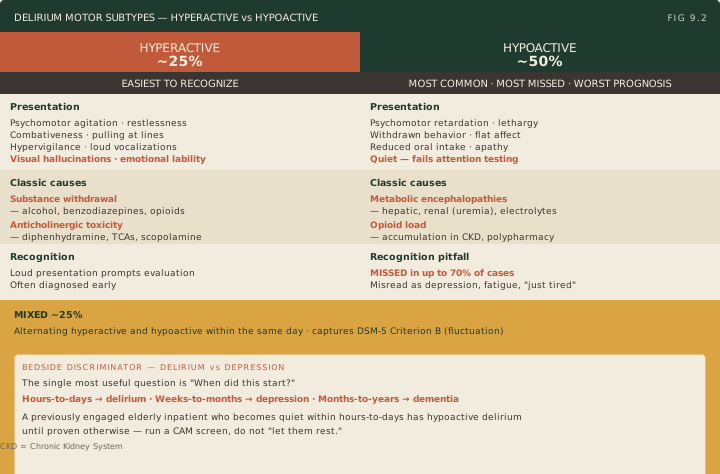
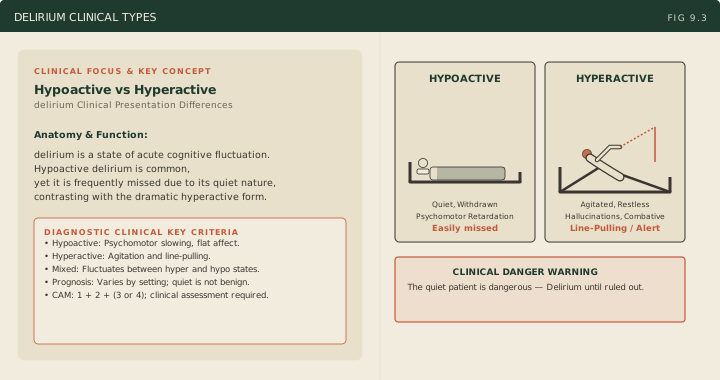
The three motor subtypes carry different recognition rates and prognoses. Hyperactive delirium presents with psychomotor agitation, restlessness, combativeness, pulling at lines, hypervigilance, hallucinations (typically visual), and emotional lability. It is the easiest subtype to recognize. The classic drivers are substance withdrawal (alcohol, benzodiazepines) and anticholinergic toxicity, but the motor subtype alone never identifies the cause.
Hypoactive delirium is the subtype that gets missed. It accounted for about half of delirious patients in a 2022 review of 131 ICU studies; the share differs by setting. It presents with psychomotor retardation, lethargy, withdrawn behavior, flat affect, reduced oral intake, and apathy. Outcomes are poor, and so are those of mixed delirium, which had the least favorable outcomes in a 1,564-patient multicenter ICU analysis; no one subtype carries the worst prognosis in every setting. It is repeatedly misdiagnosed as depression, fatigue, or “just a bad day.” The differentiator from depression is acuity: delirium develops over hours to days, depression over weeks to months. A previously engaged 78-year-old who is suddenly quiet, withdrawn, and uninterested in therapy on hospital day 3 has hypoactive delirium until proven otherwise.
Mixed delirium features both hyperactive and hypoactive behaviors over the observed course, often alternating within the same day, capturing the daily fluctuation of DSM-5 Criterion B.
The Richmond Agitation-Sedation Scale (RASS) is the standard sedation/agitation gauge in ICU and inpatient practice and pairs with the CAM-ICU. The scale runs from +4 (combative) to -5 (unarousable). Persistent non-zero scores in a patient off deliberate sedation are abnormal. A persistently negative RASS prompts CAM-ICU screening for hypoactive delirium: at RASS -4 or -5 record the CAM-ICU as unable to assess; from RASS -3 up to +4 the screen can be run. A persistently positive RASS prompts evaluation for hyperactive delirium, pain, withdrawal, and anticholinergic burden.
Epidemiology: delirium occurs in 15-30 percent of elderly medical inpatients, 25-60 percent of postoperative hip-fracture patients, 10-40 percent of IRF admissions, and up to 80 percent of ICU patients, with up to 70 percent of cases overall missed.
High Yield — Definition, DSM-5, and subtypes
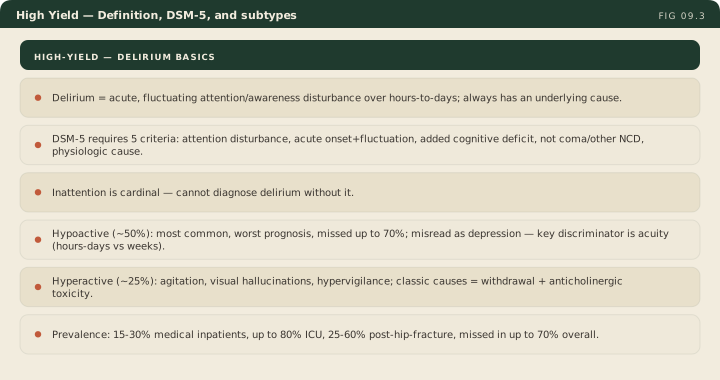
- Delirium = acute, fluctuating disturbance of attention and awareness developing over hours to days; always a symptom of an underlying cause.
- DSM-5 requires all 5 criteria: A attention/awareness disturbance, B acute onset with fluctuation, C additional cognitive disturbance, D not better explained by another neurocognitive disorder/not in coma, E evidence of a physiologic cause.
- Inattention is the cardinal feature; without it, you cannot diagnose delirium.
- Hyperactive: agitation, hallucinations (visual), hypervigilance; classic causes substance withdrawal + anticholinergic toxicity.
- Hypoactive: lethargy, withdrawal, reduced intake; the one that gets missed, with poor outcomes; misread as depression. Discriminator is acuity (hours-to-days vs weeks).
- Mixed: both patterns over the observed course, often alternating within a day.
- Subtype split in a 2022 review of 131 ICU studies: ~50% hypoactive, ~28% mixed, ~23% hyperactive. Proportions and prognostic ranking depend on the setting.
- RASS anchors agitation/sedation from +4 (combative) to -5 (unarousable); persistent non-zero off sedation = screen with CAM/CAM-ICU. RASS -4/-5 = unable to assess.
- Prevalence: 15-30% medical inpatients, 25-60% post-hip-fracture, 10-40% IRF, up to 80% ICU; missed in up to 70% overall.
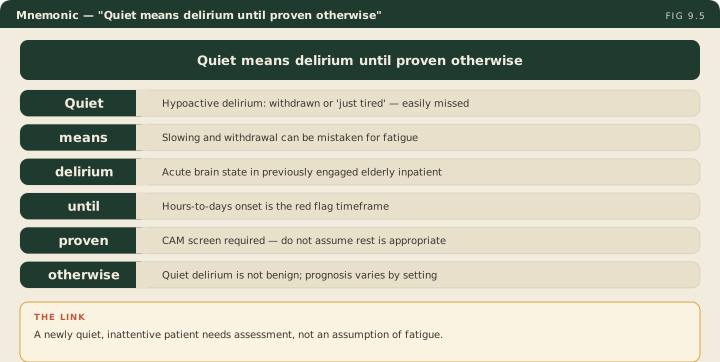
Mnemonic — “Quiet means delirium until proven otherwise”
The patient that worries you should not be the one yelling. It should be the one nobody is paying attention to. Hypoactive delirium is the one that gets missed, and its outcomes are poor. Whenever a previously engaged elderly inpatient becomes quiet, withdrawn, or “just tired” within hours-to-days, your default should be hypoactive delirium and a CAM screen, not “let them rest.”
But opioids primarily act on mu-opioid receptors, which manage pain and reward. They do not govern global cortical attention the way GABA does. Therefore, a patient in opioid withdrawal has what we call a clear sensorium.
— MEDREH-09 podcast, ~11:39
Clinical context: alcohol and benzodiazepine withdrawal are the classic withdrawal causes of delirium. Opioid withdrawal usually leaves the sensorium clear, so delirium in that setting should send you looking for another cause; delirium during opioid withdrawal exists only as scattered case reports. The receptor explanation in the quote above is an oversimplification.