Before You Listen
Episode Setup
- Topic in one line: lymphedema as the chronic accumulation of protein-rich interstitial fluid from impaired lymphatic transport, classified as primary (historical onset categories congenital, praecox and tarda; Milroy as a specific FLT4/VEGFR3 phenotype) versus secondary (post-axillary lymph node dissection (ALND) breast cancer in the United States, lymphatic filariasis worldwide, recurrent cellulitis, surgery, trauma, malignant obstruction); the International Society of Lymphology (ISL) staging system from Stage 0 (latent, transport impaired without visible edema) through Stage 3 (lymphostatic elephantiasis with papillomatosis and hyperkeratosis); the Stemmer sign (inability to pinch a skin fold at the base of the second toe or finger) as a marker of lymphatic dysfunction that is neither pathognomonic nor excluded by a negative test; lymphoscintigraphy as the gold-standard imaging study; complete decongestive therapy (CDT) as the gold-standard treatment in an intensive reductive phase (manual lymphatic drainage (MLD), multilayer short-stretch bandaging, exercise, skin care) followed by lifelong maintenance (fitted compression garment, self-MLD, exercise, skin care); compression safety gated on arterial perfusion (ABI), infection, thrombosis and cardiac status; and the three-way differential of lymphedema versus chronic venous insufficiency (CVI) edema versus lipedema.
- Prerequisites: lymphatic anatomy (superficial cutaneous network, deep system traveling along veins, thoracic duct), basic principles of compression therapy, and the cellulitis differential.
- Runtime: 1 hour 10 minutes.
Vignette. A 58-year-old woman is admitted to your inpatient rehabilitation facility (IRF) for deconditioning 6 weeks after right modified radical mastectomy with axillary lymph node dissection (12 nodes removed, 3 positive) and adjuvant axillary radiation for stage two-B breast cancer. She has noticed progressive heaviness and a tight feeling in her right arm over the past 10 days. Her right arm is visibly larger than her left, with a 4 cm circumferential difference at the mid-forearm and 5 cm at the mid-upper arm. The dorsum of her right hand is swollen, and you cannot pinch a skin fold at the base of her right second finger. The skin is intact but slightly tight. Her right elbow flexion is mildly limited by the swelling. She wonders aloud whether she should have started compression “before this got bad” and asks whether she can still travel to her son’s wedding by air in three weeks.
Which form of secondary lymphedema is this, what stage on the ISL classification, what bedside finding distinguishes it from chronic venous insufficiency, what is the gold-standard treatment program in its two phases, and what specific air-travel guidance and prospective surveillance message should you give her?
(Answer at the end of this chapter)
Section 1: Lymphatic Anatomy, Primary Versus Secondary Lymphedema, and Why the Fluid Is Protein-Rich
Bottom line: lymphedema is the chronic accumulation of protein-rich interstitial fluid from impaired lymphatic transport, and the protein content is what drives fibrosis, adipose deposition, chronic inflammation and infection susceptibility, separating lymphedema mechanistically from venous edema; the lymphatic system has three compartments (superficial cutaneous network, deep system along the veins, central thoracic duct emptying into the left subclavian vein); primary lymphedema is described by onset category (congenital, praecox, tarda) together with distribution, associated features and genetics, and onset age alone does not name an eponym; secondary lymphedema is far more common, dominated in the US by cancer treatment (BCRL in 20-40 percent after ALND and 5-8 percent after SLNB) and worldwide by lymphatic filariasis (Wuchereria bancrofti).
Lymphedema is the chronic accumulation of protein-rich interstitial fluid caused by impaired lymphatic transport. The protein content is what drives progression: trapped proteins osmotically hold fluid in the interstitium, fibroblasts proliferate, collagen deposits, adipose hypertrophies, and bacteria thrive in the stagnant proteinaceous medium. This is what separates lymphedema from venous edema, and every treatment principle follows from it: compression for hydrostatic clearance, MLD for redirection through patent territories, skin care to interrupt the cellulitis-fibrosis cycle. Diuretics do not treat isolated lymphedema and routine long-term use is discouraged; they clear water but do not restore lymphatic transport or remove the interstitial protein. Treat a coexisting systemic cause of fluid overload on its own indication.
The lymphatic system has three functional compartments. The superficial system is a dense cutaneous network organized into watershed territories (the sagittal midline separating left from right, and the transverse watershed at the umbilical level separating axillary drainage above from inguinal drainage below). When a regional outflow is obstructed, competent manual lymphatic drainage (MLD) redirects superficial flow across these watersheds into adjacent functioning territories. The deep system travels alongside the major veins and drains muscle and viscera, propelled by intrinsic lymphatic smooth muscle and the skeletal muscle pump. The thoracic duct carries lymph from the entire body below the diaphragm and the left side above the diaphragm into the left subclavian vein. The right head/neck, right arm and right upper chest drain via the right lymphatic duct into the right subclavian vein.
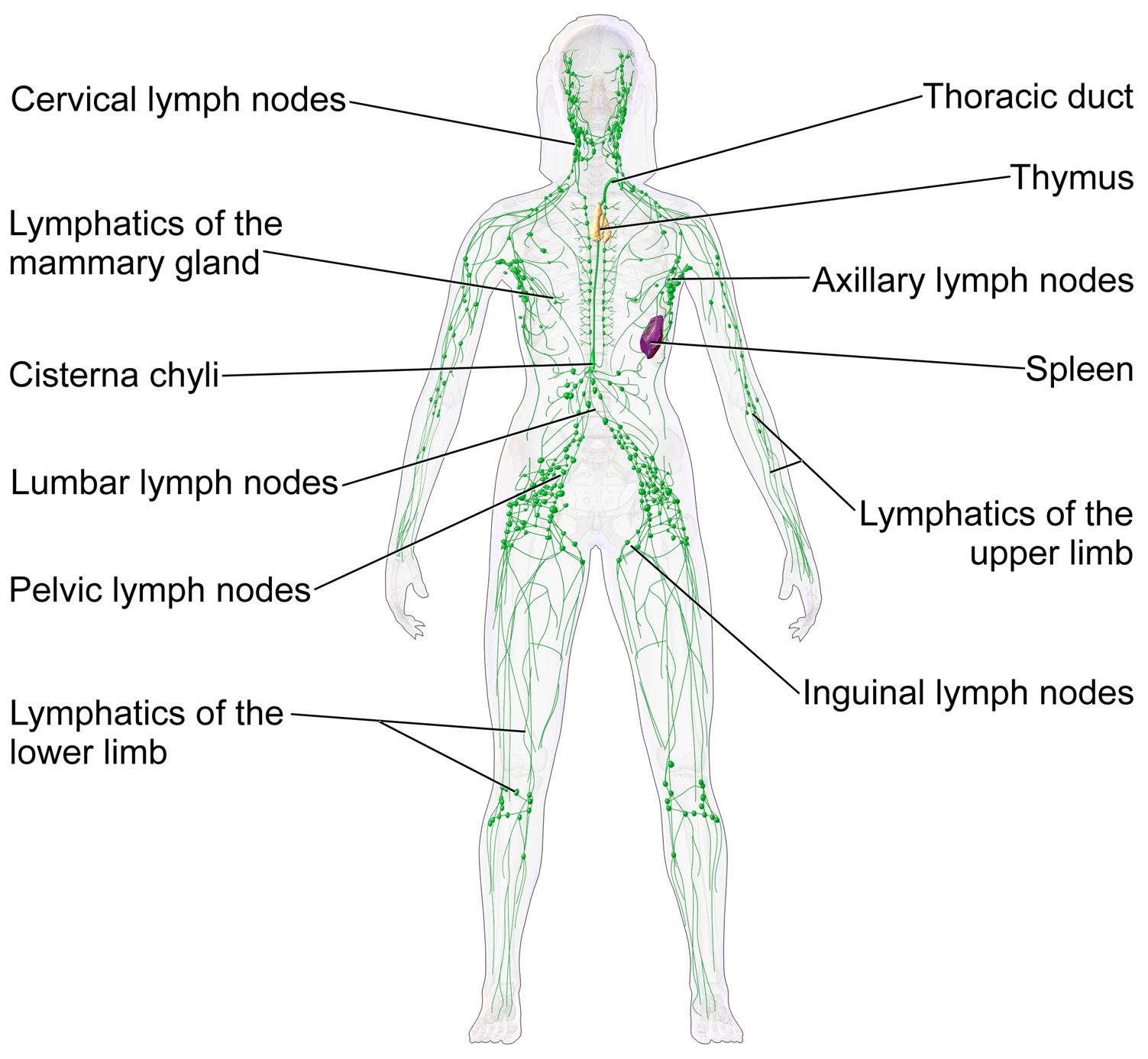
Source: BruceBlaus / Blausen Medical, “Blausen 0623 LymphaticSystem Female”, via Wikimedia Commons, CC BY 3.0. https://commons.wikimedia.org/wiki/File:Blausen_0623_LymphaticSystem_Female.png
Primary lymphedema reflects a developmental abnormality of lymphatic structure or function (aplasia, hypoplasia or hyperplasia). The onset categories are congenital, praecox (age 2 to 35, most often around puberty) and tarda (after age 35). They describe timing, not genotype. Tarda is typically unmasked by a minor insult acting on preexisting subclinical insufficiency. Milroy disease is a specific inherited phenotype: congenital or infantile, typically bilateral lower-limb swelling associated with FLT4, the gene encoding vascular endothelial growth factor receptor 3 (VEGFR-3). Penetrance is variable, so a negative family history does not exclude it, and not every early-onset case is Milroy disease. Praecox is not synonymous with Meige disease. Distribution, family history, associated features and appropriate genetic assessment refine classification.
Secondary lymphedema is far more common. In the US, the most common cause is cancer treatment with regional lymph node dissection and/or radiation, with breast-cancer-related lymphedema (BCRL) following axillary lymph node dissection (ALND) as the prototype. BCRL develops in 20-40 percent after ALND and 5-8 percent after sentinel lymph node biopsy (SLNB) alone. Pelvic and inguinal node dissection causes lower extremity lymphedema by the same mechanism. Worldwide, the most common cause is lymphatic filariasis (Wuchereria bancrofti, mosquito-transmitted), with WHO reporting an estimated 51 million infections in 2018. Other secondary causes include surgery and trauma, recurrent cellulitis (each episode further damages vessels), severe obesity (BMI > 40), and malignant obstruction.
High Yield — Anatomy and classification
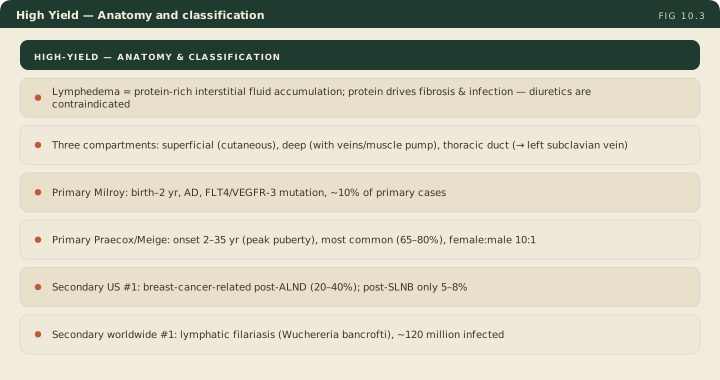
- Lymphedema reflects impaired lymphatic transport with protein-rich fluid and chronic tissue changes. Routine long-term diuretics are discouraged for isolated lymphedema; another medical indication may justify them.
- Three lymphatic compartments: superficial (cutaneous, with watershed territories MLD redirects across), deep (alongside veins, muscle pump), thoracic duct (empties into the left subclavian vein).
- Primary disease: onset timing defines the historical congenital, praecox (age 2-35, most common subtype, onset usually at puberty) and tarda (>35) categories; Milroy disease is a specific inherited phenotype associated with FLT4/VEGFR3.
- Secondary: US #1 = breast-cancer-related lymphedema after ALND (20-40% post-ALND, 5-8% post-SLNB); worldwide #1 = lymphatic filariasis (Wuchereria bancrofti), WHO estimated 51 million infections in 2018.
- Other secondary: surgery, trauma, recurrent cellulitis, obesity (BMI > 40), malignant obstruction, phlebolymphedema.
Mnemonic — “Protein draws fluid; fluid draws fibrosis; fibrosis draws bacteria”
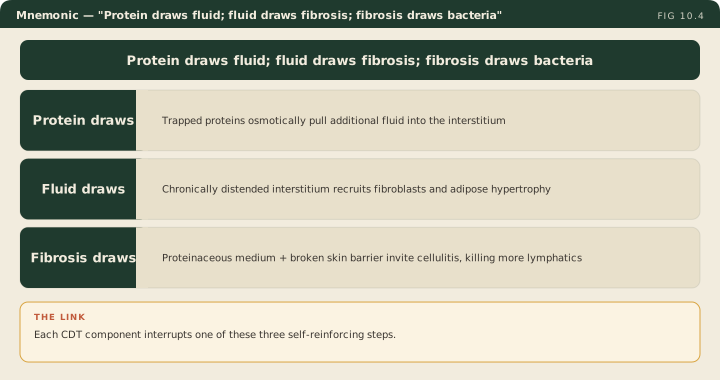
The chain reaction of untreated lymphedema runs in three steps. Trapped proteins osmotically draw additional fluid into the interstitium. The chronically distended interstitium recruits fibroblasts and adipose hypertrophy. The proteinaceous medium and the broken skin barrier invite cellulitis, and each cellulitis episode kills more lymphatics, tightening the loop. Every component of complete decongestive therapy interrupts one of these three steps.
You’d think the body would split the load 50-50 left and right, but essentially the left subclavian vein takes on the lymphatic return for roughly 75% of the total body mass.
— MEDREH-10 podcast, ~9:02
The thoracic duct drains everything except the right upper quadrant and empties into the left subclavian vein. The right lymphatic duct handles the right side of the head and neck, the right arm and the right upper chest, and drains into the right subclavian vein. Learn the two territories rather than a percentage of body mass, because the territories are what predict the clinical picture: thoracic duct obstruction can swell both legs and the left arm while sparing the right.