Before You Listen
Episode Setup
- Topic in one line: the four big shoulder soft-tissue diagnoses the boards drill once impingement and instability are off the table: rotator cuff (RC) tears built on the supraspinatus critical zone of hypovascularity and tested through the empty can/Jobe, drop arm, belly press, lift-off, external rotation lag, and hornblower tests; calcific tendinitis treated with barbotage; adhesive capsulitis with its three stages, diabetes and hypothyroidism associations, and the markedly reduced arthrographic capacity, classically under five milliliters; and biceps pathology with the Popeye sign of long head rupture plus the Yergason, Speed, and Ludington tests. The total shoulder arthroplasty (TSA) postoperative phases and the 50-30-50 fusion position for shoulder arthrodesis close the loop.
- Prerequisites: Chapter 1 (rotator cuff anatomy, scapulohumeral rhythm, impingement and the Bigliani acromion).
- Runtime: 59 minutes.
Vignette. A 58-year-old type-2 diabetic woman presents with eight months of right shoulder pain and progressive stiffness. She cannot reach behind her back to fasten her bra, cannot reach across the body to wash the opposite axilla, and cannot reach overhead to a kitchen cabinet. On examination, both active and passive ranges of motion are equally restricted; external rotation and abduction are the most severely limited. There is no point tenderness over the acromioclavicular joint or bicipital groove and no impingement signs. Plain radiographs are unremarkable. A diagnostic glenohumeral injection during arthrography meets resistance after only three milliliters.
What is the most likely diagnosis, what stage of disease is the patient in given the symptom pattern, what two endocrine associations explain why this patient is at higher risk, and at what point in the disease course is manipulation under anesthesia (MUA) considered if conservative care fails?
(Answer at the end of this chapter)
Section 1: Rotator Cuff Tears and the Critical Zone of Hypovascularity
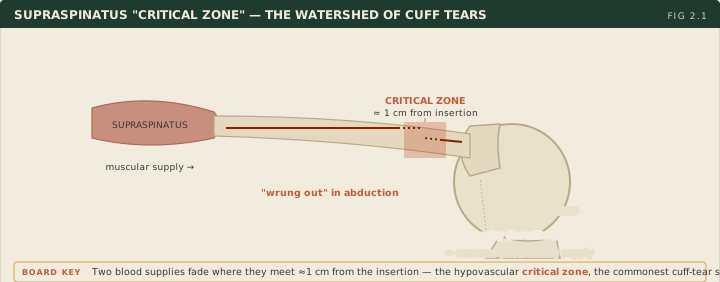
Bottom line: the supraspinatus is the most commonly torn rotator cuff (RC) tendon, and it is not even close, because of a watershed zone of hypovascularity located approximately one centimeter proximal to its insertion on the greater tuberosity, where the bone-side and muscle-side blood supplies barely overlap; tears are partial-thickness (articular surface more common than bursal) or full-thickness (small, medium, large, or massive), and massive tears that involve two or more tendons are associated with irreversible fatty infiltration of the muscle bellies and a poor prognosis for surgical repair.
The supraspinatus is the most commonly torn rotator cuff (RC) tendon, and it is not even close. The reason is blood supply. About 1 cm proximal to its insertion on the greater tuberosity, the supraspinatus tendon passes through a watershed called the critical zone of hypovascularity, where the bone-side and muscle-side supplies barely overlap. Years of repetitive overhead use produce microdamage that the poorly perfused tendon cannot repair, which is why degenerative RC tears are overwhelmingly supraspinatus tears in the same location.
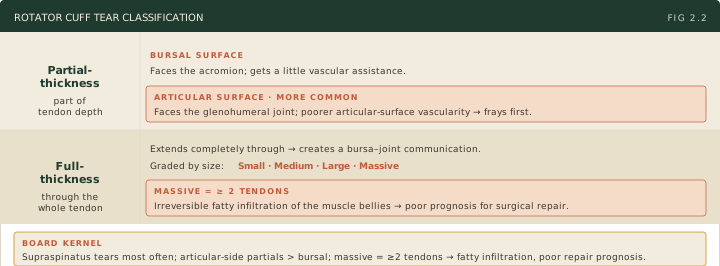
RC tears are partial- or full-thickness. Partial-thickness tears involve only part of the tendon depth, either on the bursal surface (facing the acromion) or the articular surface (facing the glenohumeral joint). Articular-side tears are more common, reflecting poorer articular-surface vascularity. Full-thickness tears extend completely through, creating bursa-joint communication, and are classified as small, medium, large, or massive. Massive tears involve two or more tendons and are associated with irreversible fatty infiltration of the muscle bellies, a poor prognostic indicator for surgical repair.
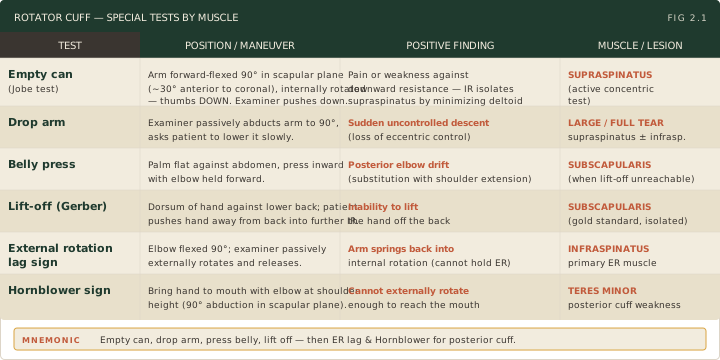
Each RC special test maps to a specific tendon. The empty can (Jobe) test evaluates the supraspinatus: arms forward-flexed to 90° in the scapular plane (~30° anterior to the coronal plane), internally rotated so thumbs point down (“emptying a soda can”); the examiner pushes down while the patient resists. Pain or weakness indicates supraspinatus pathology. Internal rotation with forward flexion isolates the supraspinatus by minimizing the deltoid.
The drop arm test evaluates for a large or complete RC tear: the examiner passively abducts the arm to 90° and asks the patient to lower it slowly. Sudden uncontrolled descent indicates a large full-thickness supraspinatus (± infraspinatus) tear because eccentric control is lost. The test is highly specific for a complete tear.
The belly press and lift-off tests both evaluate the subscapularis. Lift-off (Gerber): dorsum of the hand against the lower back; the patient pushes the hand away from the back into further internal rotation. Inability to lift = subscapularis weakness. Belly press is the alternative when the lift-off starting position is unreachable: palm flat against the abdomen, press inward with the elbow held forward; posterior elbow drift = substitution with shoulder extension = subscapularis weakness.
The external rotation lag sign evaluates the infraspinatus: the examiner passively externally rotates with the elbow flexed 90° and releases; the arm springing back into internal rotation = infraspinatus weakness. The hornblower sign evaluates teres minor: the patient brings the hand to the mouth with the elbow at shoulder height; inability to externally rotate enough to reach the mouth = teres minor pathology.
High Yield — Rotator cuff anatomy and special tests
- Supraspinatus is the most commonly torn cuff tendon because of the critical zone of hypovascularity about 1 cm proximal to the greater tuberosity insertion.
- Articular-side partial tears > bursal-side (poorer vascularity articular).
- Massive tears = ≥2 tendons; fatty infiltration on MRI = poor surgical prognosis.
- Empty can (Jobe) = supraspinatus. Drop arm = large/complete supraspinatus tear.
- Belly press / lift-off = subscapularis. ER lag = infraspinatus. Hornblower = teres minor.
Mnemonic — “Empty the can, drop the arm, press the belly, lift it off”
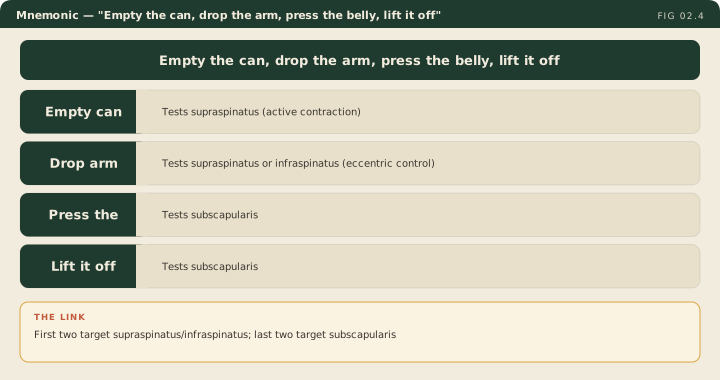
The four supraspinatus-and-subscapularis tests in order: Empty can (supraspinatus active), Drop arm (supraspinatus or infraspinatus eccentric), Belly press (subscapularis), Lift-off (subscapularis). Add ER lag and Hornblower for the posterior cuff.
It doesn’t matter if a tear is four centimeters wide. If it is isolated solely to the supraspinatus, it is a large tear, not a massive tear.
— MSK-02 podcast, ~5:19