Before You Listen
Episode Setup
- Topic in one line: the deepest joint in the body, its labrum-deepened ball-and-socket, the muscle-by-muscle innervation pattern that recurs on every cycle, and the special-test toolkit (Trendelenburg, Thomas, FABER, FADIR, Ober, Stinchfield, log roll, Ely, Craig) that separates intra-articular pathology from extra-articular mimics.
- Prerequisites: lumbosacral plexus anatomy at the level of the femoral, obturator, superior gluteal, and inferior gluteal nerves; the basic concept of avascular necrosis (AVN) from disrupted end-arterial supply; basic gait phases.
- Runtime: 45 minutes.
Vignette. A 28-year-old recreational soccer player presents to the clinic with six months of deep right anterior groin pain that worsens with prolonged sitting, pivoting on the planted leg, and getting in and out of a low car. He has no antecedent trauma. On examination, passive right hip internal rotation is reduced to 10 degrees compared with 35 degrees on the left. Flexion to 90 degrees with adduction across midline and internal rotation reproduces his familiar deep groin pain. Hip flexion in the figure-four position with the contralateral pelvis stabilized produces anterior groin discomfort but no posterior buttock pain. Plain anteroposterior pelvic radiograph shows a slight asphericity at the right femoral head-neck junction.
Which special-test maneuver was just described as positive, what bony lesion does the radiograph suggest, what soft-tissue structure is most likely torn at the labral rim, and which imaging study is the gold standard for confirming that soft-tissue diagnosis?
(Answer at the end of this chapter)
Section 1: Hip Joint Anatomy and Range of Motion
Bottom line: the hip is the deepest joint in the body, a true ball-and-socket articulation between the femoral head and the acetabulum, deepened by a fibrocartilaginous labrum that creates a suction seal; the normal arc is approximately 120 degrees of flexion, 30 of extension, 45 of abduction, 30 of adduction, 35 of internal rotation, and 45 of external rotation; intra-articular hip pathology typically limits internal rotation first (the classic osteoarthritis pattern), and a unilateral deficit of passive internal rotation in a patient with groin pain is the single highest-yield physical-finding pointer toward labral pathology, femoroacetabular impingement (FAI), or early osteoarthritis (OA).
The hip is the deepest joint in the human body, a true diarthrodial ball-and-socket articulation between the femoral head and the acetabulum of the pelvis. Acetabular depth is the dominant reason normal hips do not dislocate without a high-energy mechanism such as a dashboard injury during a motor vehicle collision. The acetabulum itself is formed by the convergence of three pelvic bones, the ilium, the ischium, and the pubis, which fuse during adolescence at the triradiate cartilage. The mature socket faces laterally and slightly anteriorly, and its orientation determines the inherent stability of the hip.
The pelvic girdle contains five joints worth distinguishing on the boards: the two femoroacetabular joints, the two sacroiliac (SI) joints, and the pubic symphysis. The femoroacetabular joints are diarthrodial and built for tri-axial motion. The pubic symphysis is an amphiarthrodial (fibrocartilaginous) joint, and each sacroiliac joint is a hybrid, synovial in its anterior part and a fibrous syndesmosis posteriorly; both are built for stability and force transmission rather than mobility. When intra-articular hip pathology drives a patient’s pain, passive range of motion of the hip is restricted and painful in a predictable pattern. When the SI joint is the pain generator, passive hip range of motion is generally preserved because the SI joint sits posterior and superior to the femoroacetabular articulation and does not mechanically gate hip motion in the same way.
Surrounding the bony rim of the acetabulum is the acetabular labrum, a horseshoe-shaped ring of fibrocartilage that attaches directly to the acetabular margin. The labrum performs two mechanical jobs: it deepens the socket and increases the contact surface between the femoral head and the acetabulum, and it generates a suction seal that helps maintain negative intra-articular pressure. That suction effect is a meaningful passive stabilizer of the hip, and disruption of the seal by a labral tear compromises both joint congruity and stability. The labrum is heavily tested because of its tight relationship to femoroacetabular impingement (FAI) and accelerated hip osteoarthritis.
The ligamentum teres runs from the fovea of the femoral head to the transverse acetabular ligament. In the adult, it carries the artery of the ligamentum teres, a branch of the obturator artery, which contributes only a small fraction of femoral head blood supply, a minor or negligible amount in adults; the adult femoral head is supplied chiefly by the retinacular branches of the medial femoral circumflex artery, the vessel a displaced femoral neck fracture shears (MSK-09). In children, this artery contributes a larger share, which is one reason pediatric femoral head vascular anatomy differs from adult anatomy and why pediatric hip disease occupies its own chapter.
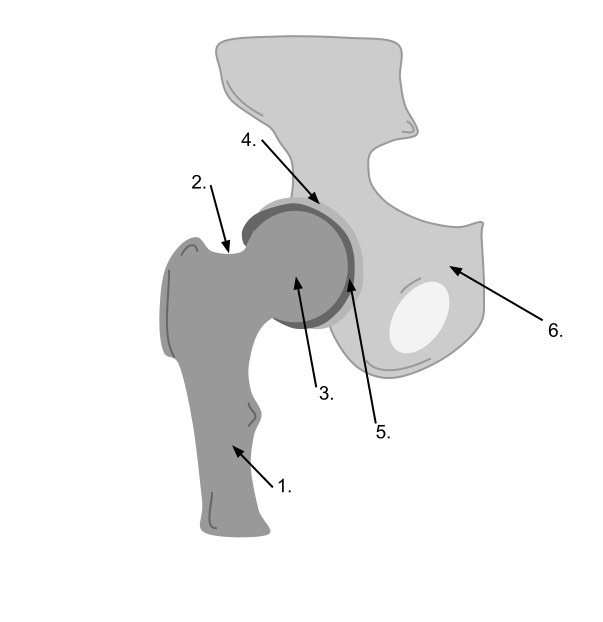
Source: Base diagram: Kcotton15, “Ball and Socket Joint (Hip joint)”, Wikimedia Commons, CC BY-SA 4.0. https://commons.wikimedia.org/wiki/File:Ball_and_Socket_Joint_(Hip_joint).svg Key panel added by Reflex — derivative shared under CC BY-SA 4.0.
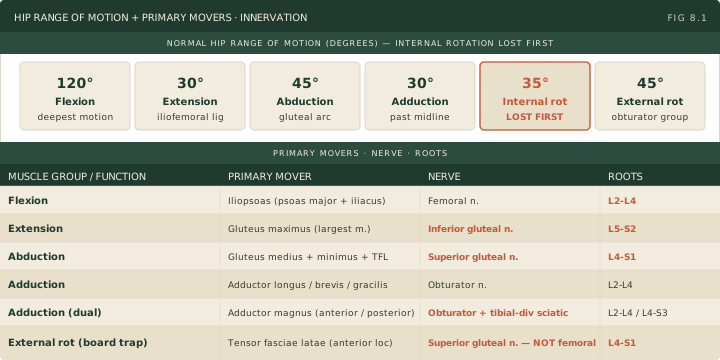
Normal hip range of motion values are committed to memory because they appear directly on board questions. Flexion is approximately 120 degrees, extension 30, abduction 45, adduction 30, internal rotation 35, and external rotation 45. External rotation is normally only modestly larger than internal rotation, and the size of the gap depends on the testing position: measured with the hip flexed (seated or supine at 90 degrees) the two values converge, while measured prone with the hip extended the external-rotation advantage persists, so any quoted value should carry the position it was measured in. The asymmetry between flexion and extension reflects the functional priorities of human movement: sitting, squatting, and stair climbing demand large flexion arcs, while extension is constrained by the powerful iliofemoral ligament on the anterior hip and is used mostly during the late stance phase of gait.
Three capsular ligaments spiral around the joint, and they are worth knowing by name because each checks a different motion:
- Iliofemoral ligament, the Y ligament of Bigelow — the strongest ligament in the body. It runs from the anterior inferior iliac spine (AIIS) to the intertrochanteric line in an inverted-Y shape, and it limits extension, and secondarily external rotation and abduction. It is what lets a person stand with the hip in slight extension using ligamentous tension rather than muscular work.
- Pubofemoral ligament, running anteroinferiorly from the pubic ramus, limits abduction (and assists against extension).
- Ischiofemoral ligament, the weakest of the three, spirals posteriorly from the ischium and limits internal rotation (and extension).
The practical consequence is that the anterior capsule is far stronger than the posterior, which is exactly why the hip dislocates posteriorly in roughly 90% of cases — the direction with the least ligamentous resistance.
The single highest-yield clinical correlate, tested on every cycle, is that intra-articular hip pathology typically limits internal rotation first, the classic osteoarthritis pattern. Before flexion drops, before abduction is restricted, and well before a visible limp appears, the earliest physical sign of joint surface disease at the hip is a unilateral painful loss of passive internal rotation. A patient with groin pain and reduced internal rotation compared to the opposite side has, by default, a labral tear, FAI, or early osteoarthritis until proven otherwise. This finding routinely predates any radiographic evidence of joint space narrowing.
High Yield — Hip joint anatomy and ROM
- Deepest joint in the body; ball-and-socket; acetabulum from ilium + ischium + pubis fusing at the triradiate cartilage.
- Iliofemoral ligament = Y ligament of Bigelow = strongest ligament in the body; AIIS → intertrochanteric line; limits extension (also ER, abduction). Pubofemoral limits abduction; ischiofemoral (weakest) limits internal rotation.
- The anterior capsule is stronger than the posterior, which is why ~90% of hip dislocations are posterior.
- Labrum deepens the socket and creates a suction seal — disruption produces FAI-related symptoms and accelerates OA.
- Ligamentum teres artery (branch of obturator) contributes a minor/negligible amount to adult femoral head blood supply.
- Normal ROM: flexion 120, extension 30, abduction 45, adduction 30, internal rotation 35, external rotation 45. External rotation is only modestly larger than internal rotation, and the gap depends on testing position (hip flexed narrows it, hip extended preserves it).
- Internal rotation typically lost first in intra-articular hip pathology (classic in osteoarthritis) — the highest-yield single physical sign.
If you think about a wet glass stuck to a smooth coaster, when you try to lift it, that negative pressure fights you.
— MSK-08 podcast, ~7:15