Before You Listen
Episode Setup
- Topic in one line: the largest synovial joint in the body, its tibiofemoral and patellofemoral articulations, the four-ligament force-vector framework that anchors every knee diagnosis (anterior cruciate ligament, posterior cruciate ligament, medial collateral ligament, lateral collateral ligament), the special tests that isolate each ligament, the unhappy triad and the Segond fracture as anterior cruciate ligament (ACL) signposts, and the knee dislocation as a vascular emergency.
- Prerequisites: thigh muscle innervation (femoral nerve quadriceps L2-L4 versus tibial-division sciatic hamstrings L5-S2 (medial hamstrings L4-S2) with short head of biceps femoris from the peroneal division), basic concept of intracapsular versus extracapsular and what that means for healing, and the principle that the popliteal artery sits tethered behind the knee.
- Runtime: 47 minutes.
Vignette. A 19-year-old female collegiate soccer player plants her right foot to cut and pivot during a game. She feels a pop and a sense that the knee gave way, and within two hours the knee has developed a tense effusion. On examination the next morning, the right knee has a positive Lachman maneuver with a soft endpoint at 25 degrees of flexion, an anterior drawer at 90 degrees that is less impressive, and a positive pivot shift under examiner-applied valgus and internal rotation. Plain anteroposterior radiograph of the knee shows a small elliptical avulsion fragment adjacent to the lateral tibial plateau.
Which ligament is torn, why is the Lachman test more sensitive than the anterior drawer, what is the name and clinical significance of the radiographic finding, and what is the imaging study of choice to confirm the diagnosis and assess for additional injuries?
(Answer at the end of this chapter)
Section 1: Knee Anatomy, Range of Motion, and Q-Angle
Bottom line: the knee is the largest synovial joint in the human body, comprising the tibiofemoral and patellofemoral articulations within a single capsule; normal range of motion is approximately 0 to 135 degrees with a small amount of physiologic hyperextension; the screw-home mechanism (terminal external tibial rotation) locks the extended knee for stability, and the popliteus unlocks it; the quadriceps (femoral nerve, L2-L4) extends the knee and the hamstrings (tibial division of sciatic, L5-S2, medial hamstrings L4-S2, with the short head of biceps femoris uniquely peroneal division) flex it; and the Q-angle (~14 degrees in men, ~17 in women) sets the lateral vector force on the patella that drives much of patellofemoral pathology.
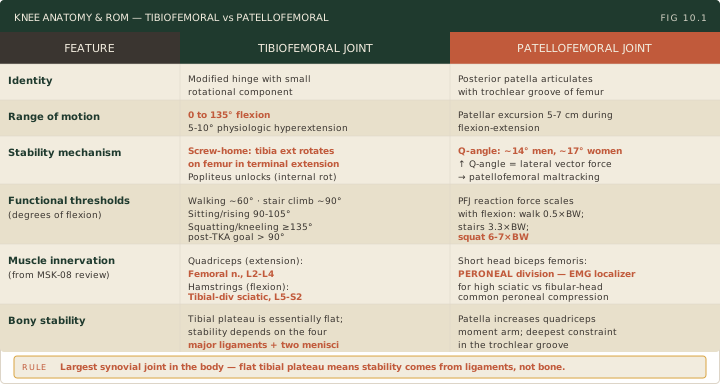
The knee is the largest synovial joint in the human body. It contains two distinct articulations within a single joint capsule, the tibiofemoral joint and the patellofemoral joint, and is conventionally divided into three compartments (medial tibiofemoral, lateral tibiofemoral, patellofemoral); a stem that counts articulations expects three, one per compartment. The tibiofemoral joint functions as a modified hinge with a small amount of rotational motion. The patellofemoral joint is the articulation between the posterior surface of the patella and the trochlear groove of the femur and is critical for the extensor mechanism. Boards frequently test the largest-synovial-joint identification as a free point.
The tibiofemoral joint is not a pure hinge. During terminal extension, the knee undergoes the screw-home mechanism, in which the tibia externally rotates on the femur as the knee reaches full extension, tightening the cruciate ligaments and locking the knee into a stable extended position. The popliteus muscle is responsible for unlocking the knee from this position by internally rotating the tibia, initiating flexion. The screw-home mechanism explains why the knee is most stable in full extension and why cruciate disruption compromises rotational stability.
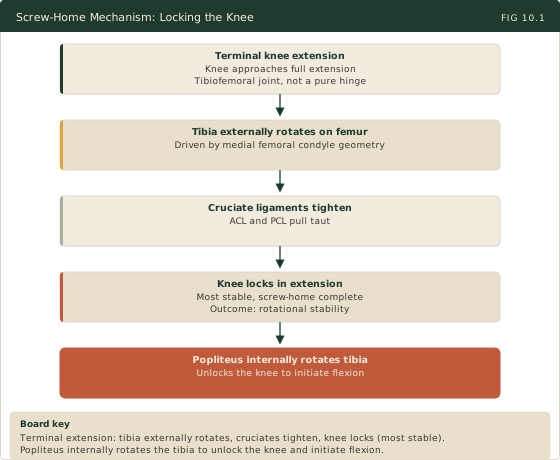
The bony architecture of the tibiofemoral joint provides relatively little inherent stability compared with a ball-and-socket joint. The tibial plateau is essentially flat, and the femoral condyles sit on top of it. Stability depends almost entirely on the surrounding ligamentous, meniscal, and muscular structures, which is why the knee compensates with four major ligaments and two menisci.
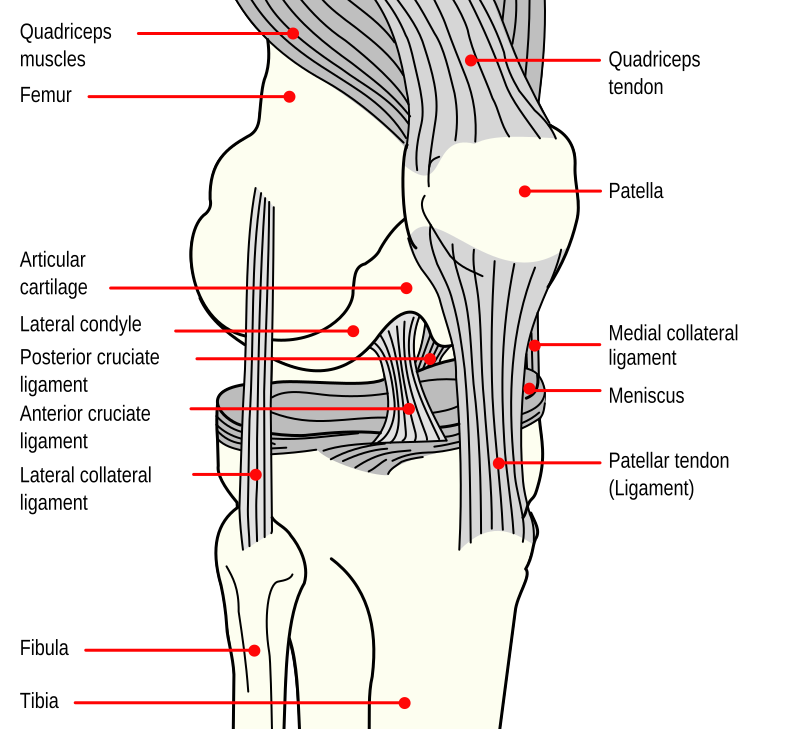
Source: Mysid (vectorized from a US Federal Government work), “Knee diagram”, via Wikimedia Commons, Public Domain. https://commons.wikimedia.org/wiki/File:Knee_diagram.svg
Normal knee flexion is 135 degrees. Normal extension is zero degrees, with a small amount of physiologic hyperextension (5-10 degrees) accepted in many individuals and called recurvatum. Functional thresholds: walking on level ground uses about 60 degrees of flexion; stair climbing needs about 100, the figure derived as the mean plus two standard deviations in the original activity-of-daily-living goniometry, above the measured mean of roughly 85 to 95; sitting into and rising from a standard chair both need about 90 to 95, with a low chair pushing toward 110 to 120; kneeling upright, with the shank flat on the floor, is about 90 degrees by geometry, while full kneeling with the heel to the buttock needs 130 to 150; and squatting needs about 125 to 130 with the heels planted and 150 to 160 in a deep squat. Stair descent uses the same range as ascent, not more; what rises on the way down is the knee extensor moment, roughly 2.5 times that of ascent, which is why descent feels harder without demanding more motion. The figure of about 105 degrees often quoted for rising from a chair is not in the source goniometry study, and no study separates the flexion needed to sit down from the flexion needed to stand back up. The single number to carry into rehabilitation is 110 degrees, the goal that covers stairs and chair transfers with margin, rather than the 90 degree bare minimum (Laubenthal 1972; Rowe 2000; Protopapadaki 2007; Andriacchi 1980).
The Q-angle, or quadriceps angle, is a static measurement of the alignment of the extensor mechanism. It is measured by drawing a line from the anterior superior iliac spine to the center of the patella (representing the line of pull of the quadriceps) and a second line from the center of the patella to the tibial tubercle (representing the patellar tendon). The angle formed at the patella between these two lines is the Q-angle. Normal values are approximately 14 degrees in men and 17 degrees in women. An increased Q-angle (greater than 15 degrees in men, greater than 20 in women) produces excessive lateral vector force on the patella and predisposes to lateral maltracking. Those are the board numbers; the normative studies put men nearer 11 to 14 degrees and women 15 to 17 with wide scatter by technique and position. Answer the board thresholds on the exam. The wider female pelvis places the anterior superior iliac spine more laterally, increasing the Q-angle and explaining the higher prevalence of patellofemoral pain syndrome in women, a topic developed in MSK-11.
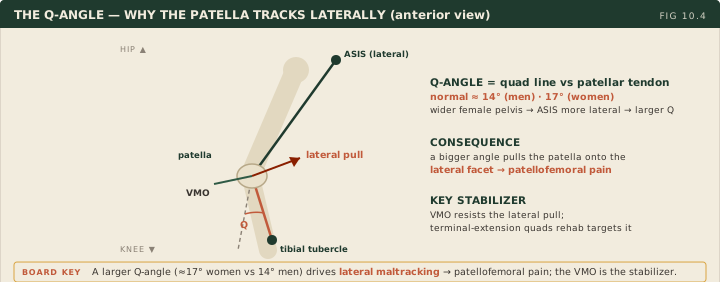
Board answer vs. current evidence — The wider female pelvis places the anterior superior iliac spine more laterally, increasing the Q-angle and explaining the higher prevalence of patellofemoral pain syndrome in women, a topic developed in MSK-11 — this is likely the board-tested answer, but more recent evidence indicates the Q-angle difference between sexes is real but its causal role in female-predominant patellofemoral pain is unestablished, and Q-angle’s clinical utility and link to knee pathology remain conflicting. Answer the board-canonical version on the test.
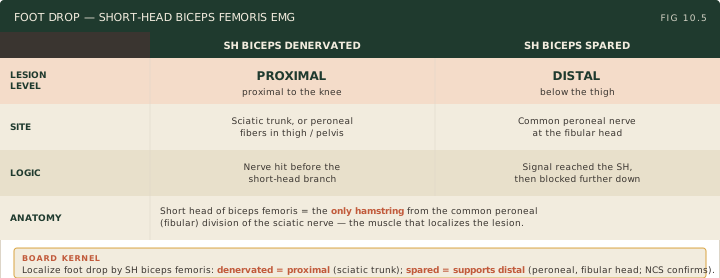
The quadriceps femoris is innervated by the femoral nerve at L2-L4 and consists of four heads (rectus femoris, vastus medialis, vastus lateralis, vastus intermedius). Only the rectus femoris crosses the hip joint and contributes to hip flexion; the other three are pure knee extensors. The hamstrings flex the knee and are innervated by the tibial division of the sciatic nerve at L5-S2, with the medial hamstrings also drawing on L4 (semimembranosus, semitendinosus, long head of biceps femoris), with the short head of biceps femoris uniquely innervated by the common peroneal (fibular) division of the sciatic nerve. This distinction is the EMG localizing pearl from the hip chapter, repeated here because it remains the highest-yield way to separate a high sciatic lesion from a fibular-head common peroneal compression.
High Yield — Knee anatomy and ROM
- Largest synovial joint in the body; tibiofemoral (modified hinge) + patellofemoral.
- Normal ROM: 0 to 135 degrees flexion; physiologic hyperextension up to 5-10 degrees.
- Screw-home mechanism: tibia externally rotates on the femur in terminal extension to lock the joint; popliteus unlocks it.
- Q-angle: ~14 degrees men, ~17 degrees women; increased angle = lateral vector = patellofemoral maltracking.
- Quadriceps = femoral nerve, L2-L4. Hamstrings = tibial-division sciatic, L5-S2 (medial hamstrings L4-S2), except short head of biceps femoris = peroneal-division sciatic.
The medial condyle is longer than the lateral condyle, so as the tibia glides forward during extension, it runs out of room on the lateral side first.
— MSK-10 podcast, ~3:18