Before You Listen
Episode Setup
- Topic in one line: the meniscus and its red-red, red-white, and white-white vascular zones, the four common tear morphologies (bucket handle, parrot beak, flap, radial), the McMurray, Apley, and Thessaly provocative tests, patellofemoral pain syndrome with the J sign and patellar grind, IT band syndrome with the Ober and Noble tests, pes anserine bursitis, the adolescent traction apophysitides (Osgood-Schlatter and Sinding-Larsen-Johansson), plica syndrome, and Kellgren-Lawrence grading of knee osteoarthritis.
- Prerequisites: MSK-10 knee anatomy (medial meniscus tethered to MCL, lateral meniscus separated from LCL by popliteus), Q-angle anatomy from Section 1 of MSK-10, and the eccentric-load mechanism of tendinopathy.
- Runtime: 42 minutes.
Vignette. A 16-year-old female cross-country runner presents with three weeks of progressively worsening lateral knee pain on the right side. The pain begins approximately two miles into every run, intensifies as she continues, and resolves with rest. Examination is significant for point tenderness over the lateral femoral epicondyle. The Ober test is positive on the right. With the patient supine and the knee flexed, the examiner presses over the lateral femoral epicondyle and asks the patient to actively extend the knee; sharp lateral knee pain is reproduced as the knee passes through approximately 30 degrees of flexion. There is no joint line tenderness, the Lachman is negative, and the McMurray test is negative.
Which diagnosis explains the lateral knee pain, what is the name of the second provocative test described, what hip-side weakness contributes to the pathomechanics, and what is the cornerstone of rehabilitation?
(Answer at the end of this chapter)
Section 1: Meniscus Anatomy, Vascular Zones, and Tear Patterns
Bottom line: the medial meniscus is C-shaped and tethered to the deep medial collateral ligament, less mobile, and the more commonly injured meniscus, while the lateral meniscus is O-shaped and separated from the lateral collateral ligament by the popliteus tendon, with greater mobility; the meniscal blood supply is zonal — the outer third (red-red) heals and is repaired, the middle third (red-white) has variable healing, and the inner third (white-white) is avascular and is resected; common tear morphologies include bucket handle (mechanical locking), parrot beak, flap, and radial; the McMurray, Apley, and Thessaly tests are the high-yield bedside maneuvers.
The menisci are crescent-shaped wedges of fibrocartilage that sit on the tibial plateau and serve as the shock absorbers of the knee. They deepen the otherwise flat tibial surface to better cradle the round femoral condyles, increase contact area, distribute load across the joint, convert compressive forces into hoop stress around the rim, and contribute to lubrication and proprioception. Removing the meniscus dramatically increases point-loading pressure on the articular cartilage and accelerates the onset of osteoarthritis.
The medial meniscus is C-shaped and is firmly attached to the deep layer of the medial collateral ligament and the joint capsule. Because of these attachments, the medial meniscus is less mobile than the lateral meniscus. This reduced mobility makes it more vulnerable to injury because it cannot escape from compressive and rotational forces as effectively. The medial meniscus is more commonly injured than the lateral meniscus, and that vulnerability is directly attributable to its restricted mobility.
The lateral meniscus is O-shaped, more circular, and covers a greater proportion of the lateral tibial plateau. Critically, it is not attached to the lateral collateral ligament. The popliteus tendon passes between the lateral meniscus and the LCL, separating them. This lack of tethering allows the lateral meniscus to move more freely, which makes it better able to escape injury during twisting and loading. The lateral meniscus is less commonly injured than the medial meniscus.
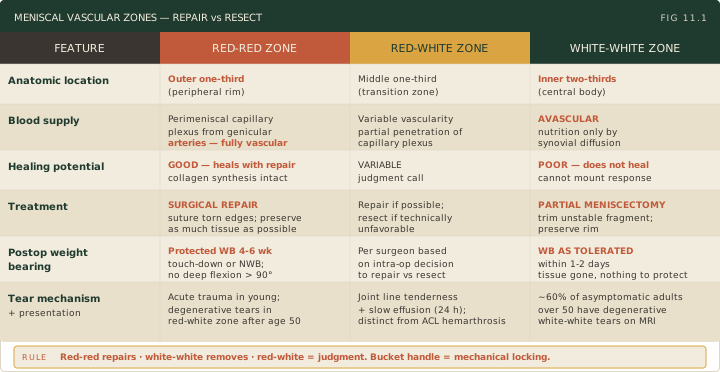
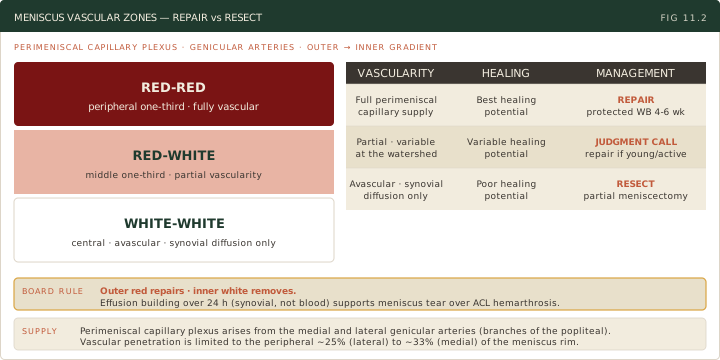
The blood supply of the menisci follows a zonal pattern that directly determines healing potential. The peripheral zone, called the red-red zone, receives blood supply from the perimeniscal capillary plexus branching off the genicular arteries. Because this zone is vascular, tears in the red-red zone have the best healing potential and are amenable to surgical repair. The middle zone, the red-white zone, has variable vascularity and therefore variable healing potential. The central zone, the white-white zone, is avascular and receives nutrition only through diffusion from synovial fluid. Tears in the white-white zone have poor healing potential and are typically treated with partial meniscectomy rather than repair, because the tissue cannot mount a healing response. The board rule is simple: peripheral red-red tears heal and can be repaired; central white-white tears do not heal and are resected; red-white tears are a judgment call.
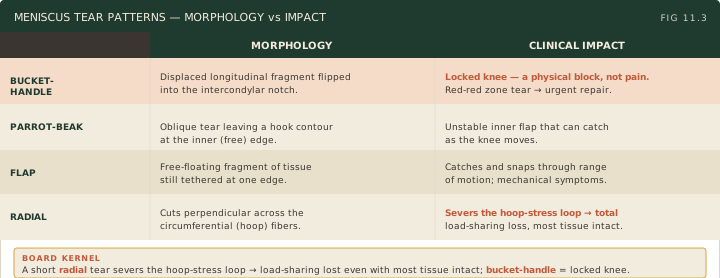
Common tear morphologies are tested as a recognition pattern. A bucket handle tear is a longitudinal vertical tear of the inner edge of the meniscus. A torn fragment of meniscus, the “handle,” can flip into the intercondylar notch and physically block full knee extension, producing true mechanical locking with the knee stuck at roughly 20-30 degrees of flexion. Bucket handle tears require urgent surgical attention, with repair preferred if the tear is in the red-red zone. A parrot beak tear is an oblique tear at the inner edge with a hooked appearance resembling a parrot’s beak. A flap tear is a radial-oblique tear that creates a free-floating flap of meniscal tissue that can produce mechanical symptoms. A radial tear runs perpendicular to the meniscal rim and disrupts the circumferential collagen fibers responsible for hoop stress, dramatically reducing the load-distributing function of the meniscus even with a small tear length. A complex tear has multiple components and is common in degenerative meniscal disease.
The classic mechanism for an acute meniscus tear is a twisting or rotational force applied to a flexed, weight-bearing knee. The femur rotates over a fixed tibia, and the meniscus, trapped between the two surfaces, is sheared. Squatting is another classic mechanism, particularly for the lateral meniscus, because deep flexion loads the posterior horn against the femoral condyle. Patients with meniscus tears present with joint line tenderness, which is one of the most sensitive physical examination findings. Locking (mechanical block to extension) is the hallmark of a bucket handle tear. Catching refers to a sensation of something getting pinched, followed by a sudden release. Effusion from a meniscus tear develops slowly over 24 hours because the fluid is synovial, not blood, distinguishing meniscal tears from ACL injuries that produce a hemarthrosis within hours. Asymptomatic meniscal tears are found in about 60 percent of people over age 50 who also have radiographic knee osteoarthritis, and in about 23 percent of those without radiographic osteoarthritis, so the clinician must determine whether a tear seen on MRI is the cause of pain or an incidental finding before recommending surgery.
Mnemonic — “Outer red repairs, inner white removes”
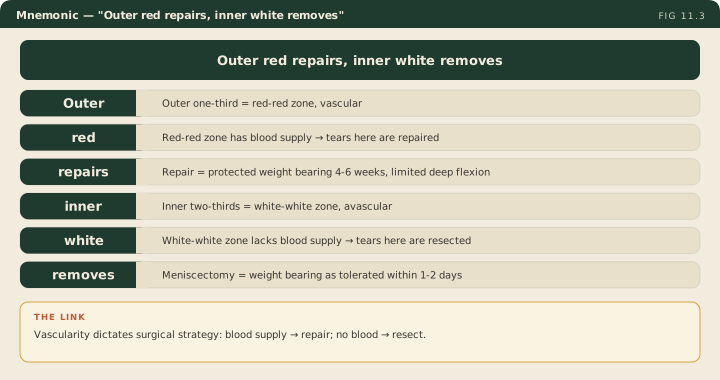
The outer third of the meniscus is red-red and has blood. Tears here repair. The middle third is red-white with variable healing and is the judgment call. The inner third is white-white and avascular. Tears here are resected. Match this rule to the postoperative protocol: repair = protected weight bearing 4-6 weeks and limited deep flexion; meniscectomy = weight bearing as tolerated within 1-2 days.
You go from spreading 100 pounds of force over 10 square inches to driving it all into one square inch.
— MSK-11 podcast, ~4:37