Before You Listen
Episode Setup
- Topic in one line: the architectural and biomechanical foundation for every ankle and lower-leg vignette on the boards, organized around the asymmetric mortise, the lateral ligament sequence, the watershed Achilles zone, and the four-compartment lower leg with its 5 P’s of acute compartment syndrome.
- Prerequisites: basic foot and ankle bony anatomy, lower-extremity peripheral nerve organization, and goniometric measurement positions for ankle motion.
- Runtime: 1 hour 8 minutes.
Vignette. A 23-year-old recreational basketball player lands awkwardly on another player’s foot during a rebound. He feels the ankle roll inward with the foot pointed downward and reports immediate severe lateral ankle pain. In the urgent care he has diffuse swelling and ecchymosis over the lateral malleolus and cannot bear weight for four steps. The examiner pulls the heel anteriorly and feels a soft, mushy endpoint compared to the contralateral side; forced inversion of the calcaneus produces only a mild increase in tilt. There is no point tenderness along the posterior edge of either malleolus, and palpation of the base of the fifth metatarsal is unremarkable.
What ligament is most likely completely torn, what ligament is partially torn, what is the sprain grade, do the Ottawa ankle rules require a radiograph, and what test would the examiner perform next to evaluate the second ligament?
(Answer at the end of this chapter)
Section 1: The Ankle Mortise, Range of Motion, and the Inversion Bias
Bottom line: the tibiotalar joint is a pure hinge whose lateral malleolus extends further distally than the medial malleolus, creating a bony doorstop against eversion that funnels almost every traumatic force into inversion; the strict normal range of motion values are 20° dorsiflexion and 50° plantarflexion at the tibiotalar joint, with 35° inversion and 15° eversion for the foot as a whole and only about 5° in each direction at the subtalar joint measured in isolation, and 10° of dorsiflexion required in terminal stance for tibial advancement over the planted foot (swing phase only requires return to neutral, 0°, for toe clearance).
The tibiotalar joint is a pure hinge, and almost every clinical entity in this chapter is a consequence of one piece of bony architecture: the mortise. Three bones interlock like a woodworker’s mortise-and-tenon. The distal tibia provides the medial wall (medial malleolus) and the ceiling (tibial plafond), the distal fibula provides the lateral wall (lateral malleolus), and the dome of the talus is the tenon that wedges into the bracket. This three-sided contact creates a remarkably stable joint when the bones are intact.
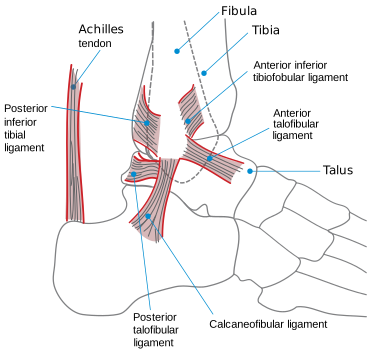
Source: Jak, “Ankle en”, via Wikimedia Commons, Public Domain. https://commons.wikimedia.org/wiki/File:Ankle_en.svg
The architecture is not symmetric, and that asymmetry is the foundation for the chapter. The lateral malleolus extends further distally than the medial malleolus, acting as a bony buttress that blocks the talus from tilting outward. Eversion must overcome bone; inversion only has to overcome ligament. The bones funnel kinetic energy into a single direction, which is why isolated medial sprains are rare and lateral sprains dominate.
The strict normal range of motion values are board memorization, and they belong to two different joints. Dorsiflexion is 20 degrees and plantarflexion is 50 degrees at the ankle (tibiotalar) joint. Inversion is 35 degrees and eversion is 15 degrees for the foot as a whole, the combined subtalar and transverse tarsal motion measured at the bedside; the subtalar joint scored in isolation contributes only about 5 degrees in each direction, so a stem that specifies the subtalar joint wants 5 and 5 rather than 35 and 15. Plantarflexion is two and a half times greater than dorsiflexion because the posterior compartment must accelerate the entire body forward against gravity during push-off. The single most clinically loaded number is the 10 degrees of dorsiflexion required in terminal stance for the tibia to advance over the planted foot; swing phase only requires the ankle to return to neutral (0°) for toe clearance. Loss of that terminal-stance minimum blocks tibial advancement over the foot, producing early heel rise or compensatory pronation; when the ankle cannot even reach neutral, swing clearance fails and circumduction at the hip or a steppage gait appears to keep the toe from dragging.
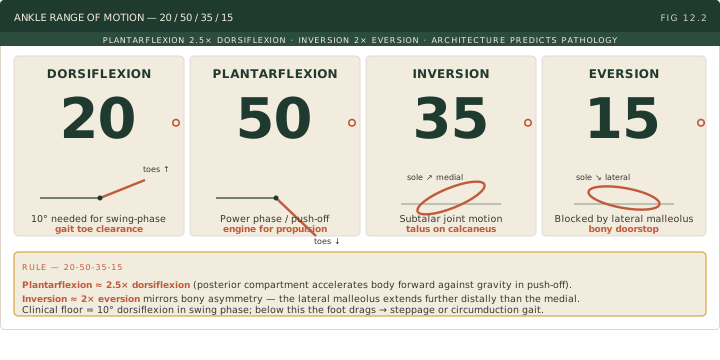
Inversion and eversion happen below the tibiotalar joint, shared between the subtalar joint (talus on calcaneus) and the transverse tarsal joint; neither is true ankle motion. That division is why the subtalar joint graded on its own scores only about 5 degrees each way while the whole foot reaches 35 and 15. Eversion is checked partly by the rigid lateral malleolus and partly by the deltoid complex. When you combine the asymmetric bony architecture with the differential ligament strength on the lateral side, the result is a joint that is essentially engineered to fail one specific way.
Mnemonic — 20-50-35-15
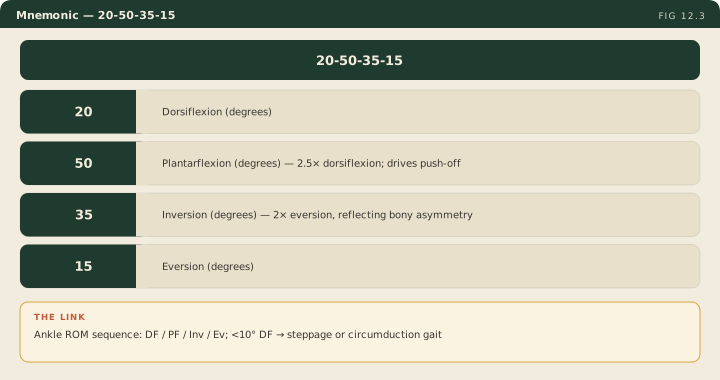
Ankle range of motion is 20-50-35-15 (dorsiflexion / plantarflexion / inversion / eversion). Plantarflexion is 2.5 times dorsiflexion (the engine for push-off). The 35 and 15 are whole-foot values (subtalar plus transverse tarsal); the subtalar joint alone is only about 5 degrees each way. The clinical floor is 10 degrees of dorsiflexion in terminal stance (tibial advancement over the planted foot); below that, early heel rise and compensatory pronation appear, and once neutral is lost in swing, steppage or circumduction follows.
High Yield — Mortise and motion
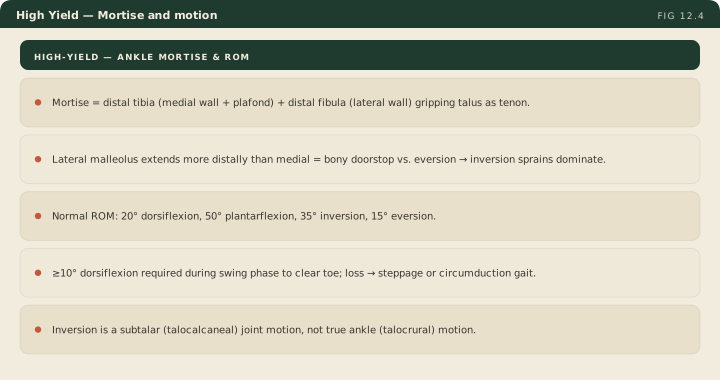
- Mortise = distal tibia (medial wall and tibial plafond ceiling) plus distal fibula (lateral wall) gripping the talus as the tenon.
- Lateral malleolus extends further distally than the medial malleolus = bony doorstop against eversion. This is the structural reason inversion sprains dominate.
- Normal range of motion = 20° dorsiflexion, 50° plantarflexion at the ankle; 35° inversion, 15° eversion for the whole foot (subtalar joint alone about 5° each way).
- 10° of dorsiflexion is required in terminal stance for tibial advancement over the planted foot (swing phase only needs return to neutral, 0°, for toe clearance); loss of the 10° blocks tibial advance (early heel rise, pronation), and loss of neutral produces steppage or circumduction gait.
- Inversion and eversion are subtalar plus transverse tarsal motion (talus on calcaneus, then midfoot), not true ankle motion; the isolated subtalar joint scores about 5° in each direction.
Because that lateral malleolus extends farther down, it acts as a physical bony buttress. It physically blocks the talus bone and by extension, your entire foot from tilting outward.
— MSK-12 podcast, ~4:06