Before You Listen
Episode Setup
- Topic in one line: the degenerative cascade that produces lumbar spinal stenosis (with its position-dependent neurogenic claudication) and cervical myelopathy (with upper motor neuron signs below the lesion), the spondylolysis-to-spondylolisthesis pipeline at L5-S1 in young athletes versus L4-L5 facet arthropathy in older adults, and the facet-mediated pain syndrome diagnosed by the dual comparative medial branch block and treated with radiofrequency ablation.
- Prerequisites: vertebral column anatomy and the upper motor neuron versus lower motor neuron distinction.
- Runtime: 1 hour 4 minutes.
Vignette. A 68-year-old retired teacher has bilateral leg pain, numbness, and a sense of heaviness in the thighs and calves that begins after walking about half a block. She can walk for an hour pushing a shopping cart at the grocery store but cannot walk to the mailbox without stopping. She rides a stationary bicycle without difficulty. Her dorsalis pedis and posterior tibial pulses are normal bilaterally; the ankle-brachial index is 1.05 on each side. A magnetic resonance imaging study of the lumbar spine shows multilevel facet hypertrophy, ligamentum flavum thickening, and central canal narrowing maximal at L4-L5.
What is the diagnosis, why does pushing a shopping cart relieve symptoms, why does she tolerate the stationary bicycle but not walking, what would the contrasting vascular condition look like, and what is the rehabilitation prescription?
(Answer at the end of this chapter)
Section 1: Cervical Stenosis and Cervical Myelopathy
Bottom line: cervical stenosis is the narrowing of the cervical canal to where the spinal cord itself is compressed; absolute stenosis is less than 10 mm anteroposterior diameter; cervical myelopathy is the resulting clinical syndrome with upper motor neuron signs below the level of compression and lower motor neuron signs at the level of compression; magnetic resonance imaging is the imaging of choice with T2 hyperintensity in the cord predicting clinical severity; surgical decompression is the definitive treatment for moderate, severe or progressive myelopathy, while mild stable disease can be observed with serial examination.
Cervical stenosis is narrowing of the cervical spinal canal to a degree that compresses the spinal cord. A normal cervical canal measures approximately 17 mm in anteroposterior diameter, and the cord occupies about 10 mm. Relative stenosis is a band from about 10 to 13 mm; absolute stenosis exists below 10 mm. At absolute stenosis there is no room for cerebrospinal fluid around the cord and the neural tissue is being directly compressed.
Because a plain lateral radiograph magnifies the image by an amount that depends on how far the neck sat from the plate, an exact millimeter cutoff is not fully reliable across films. The Torg-Pavlov ratio corrects for this: divide the sagittal (anteroposterior) diameter of the canal by the sagittal diameter of the vertebral body at the same level. Both structures are magnified by the same factor, so the ratio is unaffected by radiographic magnification. A ratio below 0.8 is the standard discriminator for developmental cervical stenosis, but it is a screening measurement and not a diagnosis. In the original football cohorts a ratio at or below 0.8 was about 93 percent sensitive for transient cervical neurapraxia while its positive predictive value was well under 1 percent, because a large-bodied athlete carries an oversized vertebral body rather than a narrow canal. An abnormal ratio calls for MRI measurement of the canal and cord, and it must never by itself disqualify an asymptomatic athlete from contact sport.
The distinction between radiculopathy and myelopathy is one of the most critical differentiations in spine medicine. Radiculopathy involves compression of an individual nerve root and produces lower motor neuron signs at a single dermatomal and myotomal level. Myelopathy involves compression of the spinal cord itself, an upper motor neuron structure, and produces a different clinical picture. The hallmark pattern is upper motor neuron signs below the level of compression combined with lower motor neuron signs at the level of compression. At the compressed segment the exiting nerve root is damaged directly, producing lower motor neuron findings (weakness, diminished reflexes) in the muscles innervated by that root. Below the level of compression the descending corticospinal and other long tracts are disrupted, releasing the segmental reflexes from their normal inhibition and producing exaggerated reflexes, spasticity, and pathologic reflexes.
The clinical presentation is insidious and progressive. Patients have gait disturbance described as stiff, clumsy, or unsteady; the gait is spastic because the corticospinal tracts controlling the lower extremities are impaired. Balance deteriorates and falls become more frequent. A hallmark early finding is hand clumsiness (“myelopathy hand”): difficulty with fine motor tasks such as buttoning shirts, handling coins, or writing, with frequent dropping of objects. This hand dysfunction results from compression of the corticospinal fibers controlling the intrinsic hand muscles.
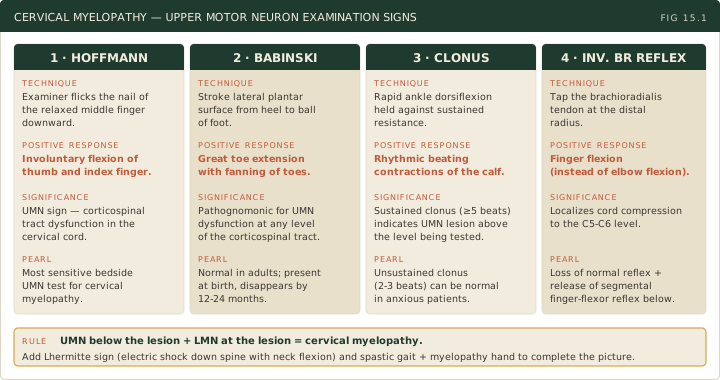
The physical examination reveals a constellation of upper motor neuron signs. Brisk reflexes are found in the lower extremities and often in the upper extremities below the level of the lesion. Clonus may be elicited at the ankles by rapidly dorsiflexing the foot and sustaining the dorsiflexion pressure. The Hoffmann sign is elicited by flicking the nail of the patient’s relaxed middle finger downward; a positive response is involuntary flexion of the thumb and index finger. The Babinski sign is tested by stroking the lateral sole from heel to ball; a positive response is extension of the great toe with fanning of the remaining toes, pathognomonic for upper motor neuron dysfunction. An inverted brachioradialis reflex (tapping the tendon produces finger flexion instead of elbow flexion) suggests cord compression at the C5-C6 level. The Lhermitte sign (electric shock sensation down the spine with neck flexion) may also be present. No single one of these signs is sensitive enough to rule the diagnosis in or out. Pooled data give the Hoffmann sign a positive likelihood ratio of only about 2.2 and a negative likelihood ratio of about 0.63, and myelopathic signs are absent altogether in roughly one fifth of surgically confirmed cases. What performs is the cluster: gait deviation, the Hoffmann sign, an inverted brachioradialis reflex, the Babinski sign, and age over 45. With none of the five present the diagnosis becomes unlikely, and with three of the five present it becomes very likely.
Magnetic resonance imaging is the imaging modality of choice. The critical finding is increased signal intensity within the spinal cord on T2-weighted sequences. T2 hyperintensity represents edema, demyelination, or gliosis within the compressed cord and correlates with clinical severity. T1 hypointensity in severe cases suggests irreversible myelomalacia and carries a worse prognosis.
Two grading systems classify the severity of cervical myelopathy. The Nurick grading system is a six-level scale (Grade 0 through Grade 5) based on ambulatory function and employment status. Grade 0 indicates root signs only; Grade 1 indicates signs of cord involvement without difficulty walking; Grade 2 is slight ambulation difficulty without preventing employment; Grade 3 is severe ambulation difficulty preventing employment; Grade 4 is ambulation only with assistance; Grade 5 is chairbound or bedridden. The modified Japanese Orthopaedic Association (mJOA) score evaluates upper extremity motor, lower extremity motor, sensory, and sphincter function on an 18-point scale. Mild myelopathy is mJOA 15 or higher; moderate is 12 to 14; severe is less than 12.
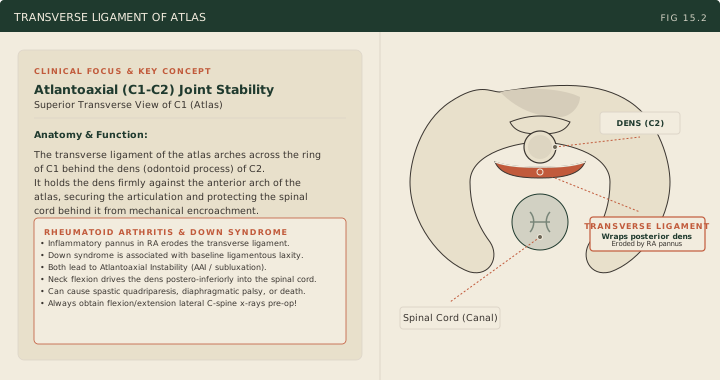
The causes of cervical myelopathy extend beyond simple disc herniation. Degenerative spondylosis with osteophyte formation is the most common mechanical cause. The differential includes tumor, arteriovenous malformation, spinal cord infarction, multiple sclerosis, syringomyelia, amyotrophic lateral sclerosis, and tabes dorsalis. Motor neuron disease (including ALS) mimics myelopathy by combining upper and lower motor neuron signs, but it spares sensation—that sensory sparing is the discriminator from true cord compression. A particularly important cause is atlantoaxial instability from rheumatoid arthritis: pannus erodes the transverse ligament, allowing C1 to sublux anteriorly on C2 and compress the upper cervical cord. Any patient with rheumatoid arthritis undergoing general anesthesia requires cervical spine imaging to rule out atlantoaxial instability before intubation.
Surgical decompression is the definitive treatment for cervical myelopathy with progressive neurological deficits or moderate to severe functional impairment. The key teaching point is that established cervical myelopathy does not improve with conservative management: medications, immobilization, therapy and injections do not reverse cord compression. Mild, non-progressive myelopathy (mJOA 15 or higher, stable examination) can be observed with structured rehabilitation and neurologic re-examination every 6 to 12 months, but any progression, and moderate or severe disease, calls for surgical decompression, and earlier surgery produces better outcomes than waiting once deterioration begins.
High Yield — Cervical stenosis and myelopathy
- Normal cervical canal ~17 mm; relative stenosis a band of about 10-13 mm; absolute stenosis less than 10 mm.
- Torg-Pavlov ratio (canal AP diameter ÷ vertebral body AP diameter) <0.8 = developmental cervical stenosis; magnification-independent, unlike raw mm cutoffs.
- Myelopathy = upper motor neuron signs below the lesion + lower motor neuron signs at the lesion.
- Hallmarks: spastic gait, myelopathy hand (fine motor loss, dropping objects), hyperreflexia, Hoffmann sign, Babinski, clonus, Lhermitte sign, inverted brachioradialis reflex.
- MRI with T2 cord hyperintensity correlates with clinical severity.
- Grading: Nurick 0-5 (gait); mJOA 18 max (≥15 mild, 12-14 moderate, less than 12 severe).
- Rheumatoid pannus eroding the transverse ligament → atlantoaxial instability → check before intubation.
- Surgical decompression is the definitive treatment for moderate, severe or progressive myelopathy; mild, stable disease can be observed with serial examination. Conservative care does not reverse established myelopathy.
That is the exact opposite of the Nurick scale, where a higher number means a worse, more disabled clinical state. You do not want to mix up which direction means the patient is declining when you are reading a vignette.
— MSK-15 podcast, ~14:40
Both structures are magnified by the exact same mathematical factor. When you divide the canal diameter by the body diameter, that magnification factor cancels itself out entirely.
— MSK-15 podcast, ~6:23