Before You Listen
Episode Setup
- Topic in one line: the dangerous and the testable spine syndromes that hide inside back pain — red flags, cauda equina syndrome (a 48-hour surgical emergency), spinal infection, scoliosis with the Cobb angle and bracing thresholds, ankylosing spondylitis with sacroiliitis and the bamboo spine, diffuse idiopathic skeletal hyperostosis (DISH), and the cervical spine clearance rules.
- Prerequisites: vertebral column anatomy, the upper motor neuron versus lower motor neuron distinction, and the dermatome map of the perineum (S2-S4).
- Runtime: 57 minutes.
Vignette. A 38-year-old warehouse worker presents to the emergency department with three days of progressively worsening low back pain radiating bilaterally into both legs. Today he developed difficulty initiating urination and noticed numbness when wiping after a bowel movement. On examination he has bilateral 4/5 ankle dorsiflexion and plantarflexion weakness, decreased sensation in a saddle distribution on the inner thighs and perineum, decreased rectal tone, and absent ankle reflexes bilaterally. A bladder ultrasound shows a post-void residual of 480 milliliters.
What is the diagnosis, what is the most likely causative lesion and most likely level, what is the imaging modality of choice, what is the time window for definitive treatment, and what neurologic examination feature distinguishes this syndrome from the spinal cord pathology that occurs above this level?
(Answer at the end of this chapter)
Section 1: Red Flags for Back Pain
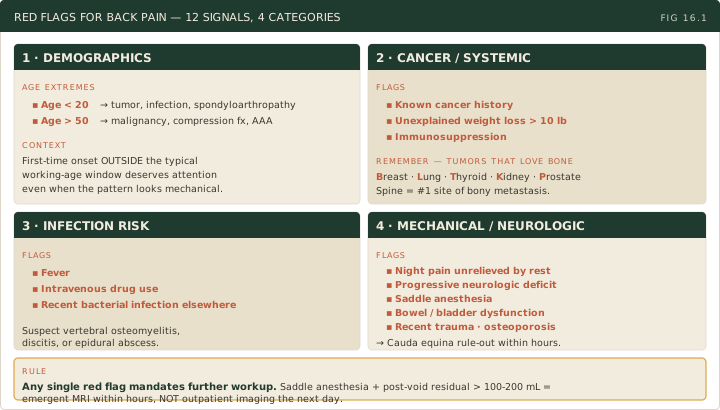
Bottom line: most low back pain is mechanical, benign, and self-limited; the red flag list (age less than 20 or greater than 50, history of cancer, unexplained weight loss, fever, night pain, progressive neurologic deficit, saddle anesthesia, bowel or bladder dysfunction, intravenous drug use, immunosuppression, recent trauma, osteoporosis) identifies the small percentage of patients whose back pain represents malignancy, infection, fracture, or cauda equina, and any single red flag warrants prompt reassessment rather than empiric treatment, with targeted investigation when the flag or its combination raises the probability of serious disease.
The vast majority of low back pain is mechanical, benign, and self-limited. The challenge is identifying the small percentage of patients whose back pain represents a serious underlying condition such as malignancy, infection, fracture, or cauda equina syndrome. Red flags are clinical features in the history or examination that raise suspicion for a dangerous cause and mandate further workup, typically with advanced imaging and laboratory studies.
Age is the first red flag. New onset of back pain in a patient younger than 20 or older than 50 warrants heightened suspicion. In adolescents and young adults, new back pain raises the possibility of tumor, infection, or spondyloarthropathy. In patients over 50, the differential expands to include metastatic disease, compression fracture from osteoporosis, and abdominal aortic aneurysm. A history of cancer is one of the most important red flags. Any patient with a known malignancy who develops new back pain must be evaluated for spinal metastasis until proven otherwise. The spine is the most common site for bony metastasis, and the most common tumors that metastasize to bone are breast, lung, thyroid, kidney, and prostate (“the five tumors that love bone”).
Unexplained weight loss is a constitutional symptom suggesting malignancy or chronic infection. Fever in the setting of back pain raises the possibility of vertebral osteomyelitis or epidural abscess. Intravenous drug use is a specific and critical red flag because it dramatically increases the risk of hematogenous seeding of the spine. Staphylococcus aureus remains the single most common organism in this population, as it is in native vertebral osteomyelitis overall, but Pseudomonas aeruginosa and other gram-negative organisms are disproportionately more frequent in people who inject drugs than in the general vertebral osteomyelitis population, so empiric coverage is broadened while cultures are pending. Immunosuppression from any cause (chronic corticosteroids, chemotherapy, human immunodeficiency virus infection) lowers the threshold for infection. Night pain that is unrelieved by rest is a classic red flag for malignancy; mechanical back pain characteristically worsens with activity and improves with rest, so pain that wakes the patient from sleep, is constant regardless of position, and does not respond to lying down suggests a process that is independent of mechanical loading.
Progressive neurologic deficit is a red flag that demands urgent evaluation; worsening weakness, numbness, or reflex changes may indicate a compressive lesion (tumor, abscess, or disc herniation) threatening the neural elements. Saddle anesthesia and bowel or bladder dysfunction are specific red flags pointing directly toward cauda equina syndrome. Recent trauma, particularly in osteoporosis, raises the possibility of compression fracture; a seemingly minor fall or even a forceful cough in an osteoporotic patient can produce a vertebral body fracture.
High Yield — Red flags
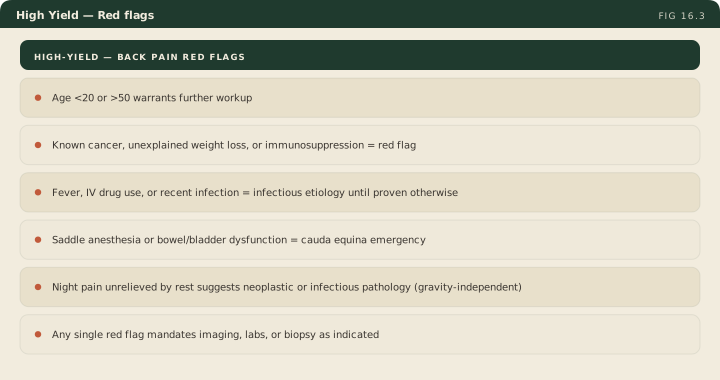
- Demographics: age less than 20 or greater than 50.
- Cancer/systemic: known cancer, unexplained weight loss, immunosuppression.
- Infection: fever, IV drug use, recent infection.
- Mechanical/neurologic: night pain unrelieved by rest, progressive neurologic deficit, saddle anesthesia, bowel/bladder dysfunction, recent trauma, osteoporosis.
- Any single red flag warrants prompt reassessment rather than empiric treatment, with imaging, labs, or biopsy when the flag or its combination raises the probability of serious disease; suspected cauda equina goes straight to emergent MRI.
A tumor does not care if you are standing up or lying down. The pathological process, like an expanding mass, stretching the periosteum, or an active bacterial infection destroying trabecular bone, it is continuous.
— MSK-16 podcast, ~7:28