Before You Listen
Episode Setup
- Topic in one line: the sideline framework for traumatic brain and brachial plexus injury in athletes, including concussion as a functional rather than structural injury, the Sport Concussion Assessment Tool sixth edition (SCAT-6) as the standardized sideline tool, the six-step graduated return-to-play protocol with its absolute prohibitions, second impact syndrome as the catastrophic complication that justifies every rule, chronic traumatic encephalopathy (CTE) as the long-term tau-protein consequence, the unilateral stinger versus bilateral cervical spinal cord injury fork, and the female athlete triad with its expansion into Relative Energy Deficiency in Sport (RED-S).
- Prerequisites: basic neuroanatomy of the brachial plexus (upper trunk = C5-C6), the Glasgow Coma Scale concept of altered mentation, and the principle that the brachial plexus and the cervical spinal cord are anatomically distinct structures that fail in distinct clinical patterns.
- Runtime: 35 minutes.
Vignette. A 17-year-old high school football player takes a hit during the third quarter. He returns to the sideline reporting a headache and feeling “in a fog.” He never lost consciousness. The athletic trainer performs a sideline assessment: the patient has a symptom severity score of 22 on the symptom checklist, 38 of 50 on the Standardized Assessment of Concussion (SAC), 8 errors on the modified Balance Error Scoring System (mBESS), and a normal coordination examination. Twelve minutes later, the headache has resolved completely. The coach asks if the athlete can re-enter the game. Three weeks later, after the athlete has begun the graduated return-to-play protocol and reached step 3 (sport-specific running drills), he develops a recurrence of headache during practice. The team physician then asks about the next protocol step.
Can the athlete return to play that same game once symptoms resolve, what is the correct next step in the graduated return-to-play protocol after symptom recurrence at step 3, and why does the protocol mandate a minimum of 24 hours per step regardless of how rapidly symptoms appear to resolve?
(Answer at the end of this chapter)
Section 1: Concussion Definition and Pathophysiology
Bottom line: concussion is a transient functional disturbance of brain physiology caused by biomechanical force; standard computed tomography (CT) and magnetic resonance imaging (MRI) are normal; loss of consciousness (LOC) is not required for the diagnosis (occurs in only about 10 percent of cases); headache is the most common symptom; and the underlying neurometabolic cascade of glutamate efflux, ionic flux, and energy crisis is the physiologic basis for second impact syndrome.
Concussion is one of the most heavily tested sports medicine topics on the Physical Medicine and Rehabilitation board examination, and the definition itself carries multiple testable nuances. A concussion is a transient alteration in brain function caused by biomechanical forces transmitted to the brain. The defining word is transient. Concussion is a functional disturbance of brain physiology rather than a structural injury, and by definition standard neuroimaging is normal. If CT or conventional MRI demonstrates structural damage, the injury has moved beyond the category of concussion into a complicated mild or more severe traumatic brain injury (TBI) classification, depending on the clinical severity indicators.
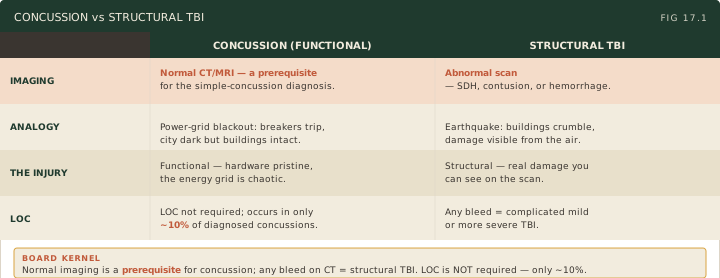
The CT scan in concussion is normal because there is no macroscopic structural injury. The MRI is also normal under standard sequences. Functional changes such as altered metabolic activity may be apparent on advanced research modalities like diffusion tensor imaging or functional MRI, but those modalities are not part of standard clinical care.
Loss of consciousness is not required for the diagnosis. This is a high-yield board point because it contradicts older grading systems that classified concussion severity by LOC duration. Under the current consensus definition, an athlete can sustain a concussion without ever losing consciousness. LOC occurs in only roughly 10 percent of concussions. The diagnosis rests on any transient alteration in brain function: confusion, disorientation, slowed processing, amnesia, or any of the characteristic symptom clusters.
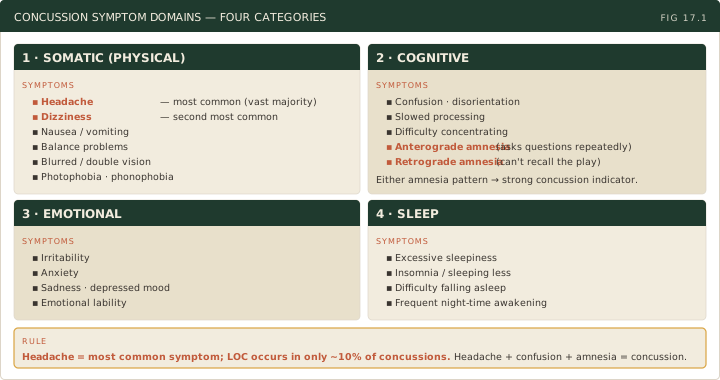
Concussion symptoms cluster into four domains. The somatic domain includes headache (the single most common symptom, present in the vast majority of patients), dizziness (the second most common, reflecting vestibular dysfunction), nausea, vomiting, balance problems, visual disturbance such as blurred or double vision, and photophobia or phonophobia. The cognitive domain includes confusion, disorientation, slowed processing, difficulty concentrating, and amnesia. Post-traumatic amnesia is the inability to form new memories after the injury (the athlete repeatedly asks the same questions); retrograde amnesia is the inability to recall events before the injury (the athlete cannot remember the play or moments leading up to the impact). Either pattern is a strong indicator of concussion even without LOC. The emotional domain includes irritability, anxiety, sadness, and emotional lability. The sleep domain includes either excessive sleepiness or insomnia.
Board answer vs. current evidence — dizziness (the second most common, reflecting vestibular dysfunction) — this is likely the board-tested answer, but more recent evidence (PMID 34009789) indicates dizziness in concussion reflects multiple overlapping contributors — vestibular dysfunction, anxiety, cervicogenic pain, and postural instability — rather than vestibular dysfunction alone. Answer the board-canonical version on the test.
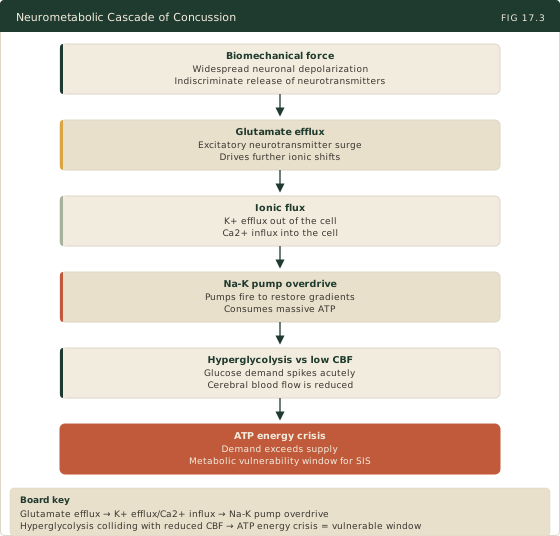
The pathophysiology of concussion is a neurometabolic cascade. Biomechanical forces produce widespread neuronal depolarization, release of excitatory neurotransmitters (especially glutamate), ionic flux with potassium efflux and calcium influx, an acute increase in glucose metabolism, and a subsequent energy crisis as metabolic demand exceeds supply. This metabolic vulnerability is the physiologic basis for why a second impact during the recovery window can be catastrophic, as detailed in Section 4.
High Yield — Concussion definition and basics
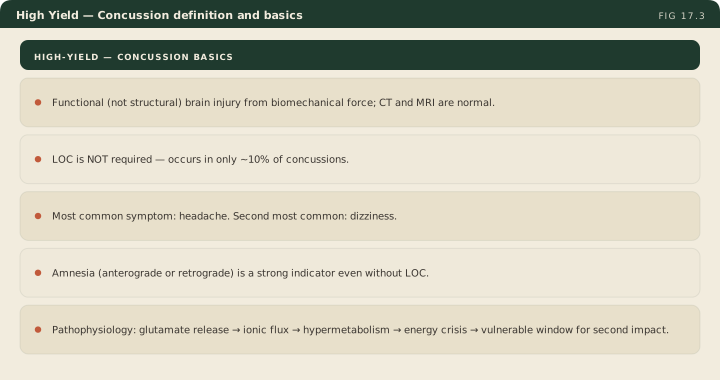
- Definition: transient alteration in brain function from biomechanical force; functional, not structural.
- Imaging: standard CT and MRI are normal.
- Loss of consciousness NOT required: occurs in only about 10% of concussions.
- Most common symptom: headache. Second: dizziness.
- Amnesia (anterograde or retrograde) is a strong clinical indicator even without LOC.
- Pathophysiology: glutamate release, ionic flux, hypermetabolism then energy crisis, producing a vulnerable window for second impact.
Board Trap — “He never lost consciousness, so it cannot be a concussion”
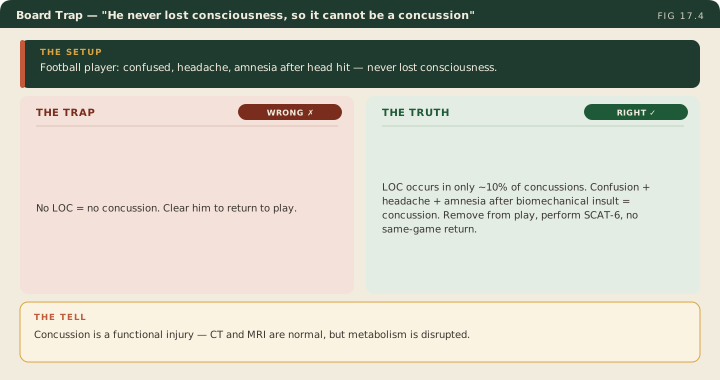
A vignette describes a football player struck in the head who is now confused, has a headache, and is unable to recall the prior play, but never lost consciousness. The trap is to call this not-a-concussion. LOC is present in only about 10% of concussions. Headache plus confusion plus amnesia after a biomechanical insult is concussion until proven otherwise. The athlete is removed from play, evaluated with a standardized tool (SCAT-6), and never returned to the same game.
So post-traumatic amnesia is the inability to form new memories after the biomechanical force is applied. This is the athlete who jogs to the sideline, asks the athletic trainer what quarter it is, gets the answer and then asks the exact same question two minutes later.
— MSK-17 podcast, ~5:54