Before You Listen
Episode Setup
- Topic in one line: the equation-and-cell-biology backbone of sports medicine, comprising maximal oxygen consumption (VO2max), the metabolic equivalent (MET), the cardiac output and Fick equations, the Karvonen formula and Borg Rating of Perceived Exertion (RPE) scale, the FITT principle (Frequency, Intensity, Time, Type) for exercise prescription, the three skeletal muscle fiber types and the Henneman size principle, the four contraction types and their force hierarchy, length-tension and force-velocity relationships, and the rate-pressure product (RPP) as the cardiac rehabilitation safety threshold.
- Prerequisites: basic vocabulary of aerobic versus anaerobic metabolism, ATP and lactate, the Frank-Starling mechanism, and sarcomere structure (actin, myosin, cross-bridges, Z-lines, titin).
- Runtime: 44 minutes.
Vignette. A 62-year-old man presents to your cardiac rehabilitation clinic six weeks after an uncomplicated coronary artery bypass graft (CABG). He is taking metoprolol and lisinopril. His stated goal is to return to recreational tennis. On his graded exercise test (GXT) he reaches a peak VO2 of 24.5 mL/kg/min before stopping for fatigue without chest pain or arrhythmia, with a peak heart rate of 110 beats per minute (bpm) and a peak systolic blood pressure (SBP) of 170 mmHg. His resting heart rate is 68 bpm. He asks two questions: “How hard can I safely exercise?” and “Why is my watch heart rate so much lower than the trainer’s chart predicts for my age?”
What is his maximal MET capacity? What target heart rate range would you prescribe at 60-80 percent intensity using the Karvonen method? What single bedside tool should replace heart rate monitoring as his primary intensity gauge, and why? What rate-pressure product ceiling defines his safe exercise envelope?
(Answer at the end of this chapter)
Section 1: VO2max, METs, and the Integrated Aerobic System
Bottom line: maximal oxygen consumption (VO2max) is the gold-standard measure of aerobic fitness, integrating pulmonary gas exchange, cardiovascular delivery, and muscle extraction; the defining test feature is a plateau in oxygen consumption despite continued workload increase; a typical young adult sits at 35-50 mL/kg/min and elite endurance athletes reach 70-85+ mL/kg/min; one metabolic equivalent (MET) equals 3.5 mL/kg/min, and VO2max divided by 3.5 gives maximal MET capacity.
VO2max is the single most important measurement in exercise physiology and the gold-standard measure of aerobic fitness. It represents the maximal rate at which the body can consume oxygen during intense whole-body exercise, integrating three sequential systems: the pulmonary system exchanging gas, the cardiovascular system delivering oxygenated blood, and the skeletal muscle extracting and utilizing oxygen for aerobic metabolism. When a board question asks for the best single measure of aerobic or cardiopulmonary fitness, the answer is VO2max.
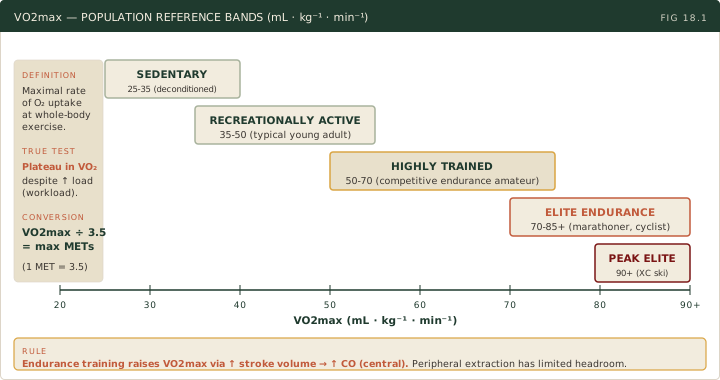
The defining feature of a true VO2max test is a plateau in oxygen consumption despite a continued increase in workload. The test is performed during a graded exercise protocol on a treadmill or cycle ergometer with progressively increasing workload until volitional exhaustion. Without a plateau, the value is a peak VO2 and the reason the test ended stays open: motivation, discomfort, dyspnea, claudication or chest pain can each stop it. With a plateau, the patient has reached the physiologic ceiling: any further work is being bought entirely from the anaerobic system and will collapse within seconds to minutes.
VO2max is reported in absolute terms (L/min) or relative terms (mL/kg/min); the relative value is preferred because it normalizes for body size. The defining benchmark numbers for the boards: a deconditioned sedentary adult sits at 25-35 mL/kg/min, a recreationally active typical young adult at 35-50 mL/kg/min, while elite endurance athletes (marathoners, cross-country skiers, cyclists) routinely reach 70-85+ mL/kg/min, sometimes into the 90s. VO2max is higher in males than females at any given age, with women’s relative values running roughly 20-30 percent below men’s (about 22 percent in the twenties in large reference registries). It peaks in the late teens to about age 20 and then declines, but not at a flat rate: the loss runs roughly 3-6 percent per decade in young adulthood and accelerates to more than 20 percent per decade after age 70, so the often-quoted 1 percent per year is a crude average rather than a model.
VO2max is determined by both central factors (cardiac output) and peripheral factors (arteriovenous oxygen extraction). Training improves VO2max primarily through increased cardiac output via stroke volume gains; peripheral adaptations (capillary density, mitochondrial content, oxidative enzyme activity) contribute additionally. The peripheral side has limited headroom, since even untrained muscles extract oxygen well; the dominant lever is central. Across short training programs in previously untrained adults, maximal cardiac output rises significantly while the maximal arteriovenous oxygen difference shows no significant average change, which is why the pump side carries most of the improvement. The pattern reverses in heart failure: central pump capacity stays disease-limited, so the training gain there leans on peripheral muscle adaptation.
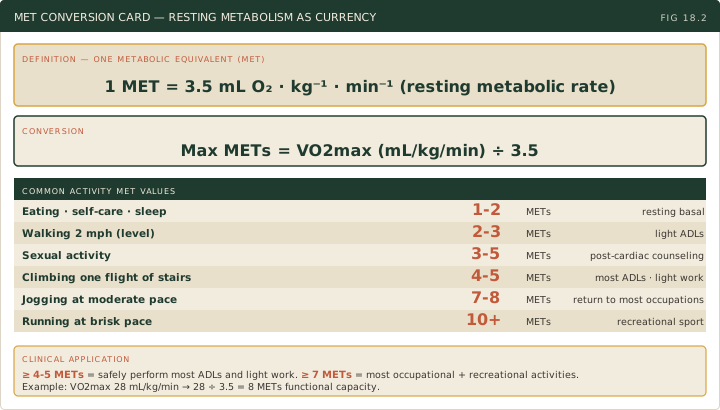
The metabolic equivalent (MET) is a standardized unit used to express the energy cost of physical activities. One MET equals 3.5 mL of oxygen per kilogram of body weight per minute, the resting metabolic rate of a quiet seated individual. The MET system allows clinicians to express the intensity of any activity as a multiple of resting metabolism: a 5-MET activity consumes oxygen at five times the resting rate (17.5 mL/kg/min).
Common MET values that the boards expect you to know: eating and self-care 1-2 METs; walking at 2 mph on level ground 2-3 METs; climbing one flight of stairs 3-4 METs (two flights about 5 METs); jogging at moderate pace 7-8 METs; running at a brisk pace 10+ METs; sexual activity 3-5 METs (clinically relevant when counseling patients after cardiac events about safe resumption of sexual activity).
The MET system has direct clinical application in exercise prescription and in determining functional capacity for activities of daily living (ADLs) and return to work. A patient who can achieve 4-5 METs on a graded exercise test can safely perform most ADLs. A patient who can achieve 7+ METs generally has sufficient functional capacity for most occupational and recreational activities. METs are also used in cardiac rehabilitation to prescribe exercise at an appropriate intensity. The conversion from VO2max to MET capacity is straightforward: VO2max divided by 3.5 equals maximal MET capacity. A patient with a VO2max of 28 mL/kg/min has a functional capacity of 8 METs.
High Yield — VO2max and METs
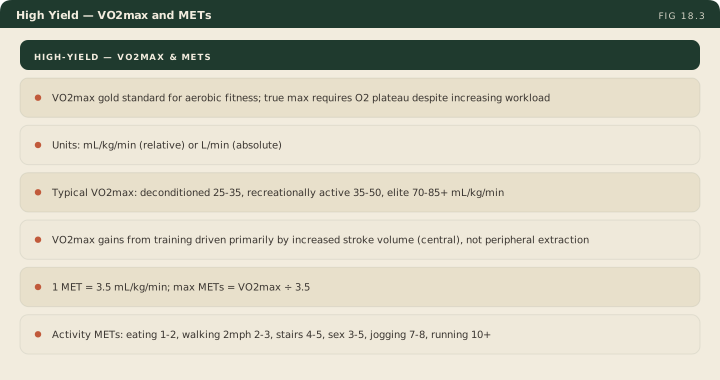
- VO2max is the gold-standard measure of aerobic fitness, expressed in mL/kg/min (relative) or L/min (absolute).
- A true VO2max test requires a plateau in oxygen consumption despite continued workload increase.
- Typical values: deconditioned sedentary 25-35, recreationally active young adult 35-50, elite endurance 70-85+ mL/kg/min.
- VO2max gains with endurance training are driven primarily by increased stroke volume (central), not peripheral extraction.
- 1 MET = 3.5 mL/kg/min (resting metabolic rate).
- VO2max / 3.5 = max METs.
- Activity METs: eating 1-2; walking 2 mph 2-3; one flight of stairs 3-4; sex 3-5; jogging 7-8; running 10+.
The peripheral tissue does not adapt drastically, because untrained skeletal muscle is already a near perfect extraction machine.
— MSK-18 podcast, ~6:09