Before You Listen
Episode Setup
- Topic in one line: the environmental and metabolic emergencies of sports medicine, including the heat illness spectrum (cramps, exhaustion, stroke), the altitude illness ladder of acute mountain sickness (AMS) progressing to high altitude cerebral edema (HACE) and high altitude pulmonary edema (HAPE), exertional rhabdomyolysis with myoglobinuric acute kidney injury, exercise-associated hyponatremia from over-hydration, the shared decision-making framework for single-organ athletes, Wolff law and Davis law of mechanical remodeling, the open versus closed kinetic chain distinction for rehabilitation, and the three lever classes of the human body.
- Prerequisites: basic thermoregulation (sweating, vasodilation, evaporative cooling), the antidiuretic hormone (ADH) axis, the carbonic anhydrase mechanism of acetazolamide, and the principle that the brain is enclosed in a rigid cranial vault that punishes both swelling and shrinking.
- Runtime: 1 hour 11 minutes.
Vignette. A 28-year-old recreational marathon runner is brought to the medical tent at mile 24 of a marathon held on a humid 88 degrees Fahrenheit (31 degrees Celsius) day. He had been running strongly despite cramping in his thighs and is now confused, nauseated, and unable to stand. The medical team measures a rectal temperature of 41.5 degrees Celsius. His skin is hot and dry. His blood pressure is 92/58 mmHg, heart rate 138 bpm. He is moaning and answering questions inappropriately. A point-of-care chemistry panel returns a creatine kinase (CK) of 22,000 units per liter, sodium 132 milliequivalents per liter, potassium 5.8 milliequivalents per liter, and a urinalysis with 3+ blood on dipstick but no red blood cells (RBCs) seen on microscopy. His urine is dark cola-colored.
What is the principal diagnosis driving his decompensation, what is the first-line on-site treatment that must be initiated within minutes, what does the urine dipstick discrepancy tell you about a coexisting diagnosis, and how does the sodium of 132 milliequivalents per liter inform fluid resuscitation strategy?
(Answer at the end of this chapter)
Section 1: Heat Illness Spectrum
Bottom line: heat illness is a continuum from heat cramps (normal core temperature, electrolyte imbalance) to heat exhaustion (core temperature less than 40 degrees Celsius, profuse sweating, intact mental status) to heat stroke (core temperature greater than 40 degrees Celsius plus central nervous system dysfunction, classically with hot dry skin from thermoregulatory failure although exertional cases may still be sweating); heat stroke is a medical emergency requiring aggressive cooling, with cold water immersion the gold-standard intervention for exertional heat stroke.
Heat illness represents a continuum of conditions caused by the body’s inability to dissipate heat adequately during physical exertion or environmental heat exposure. The boards test the three stages, the core temperature thresholds, and the treatment for each. The critical distinction is between heat exhaustion and heat stroke, because crossing from one to the other represents the boundary between a manageable condition and a life-threatening emergency.
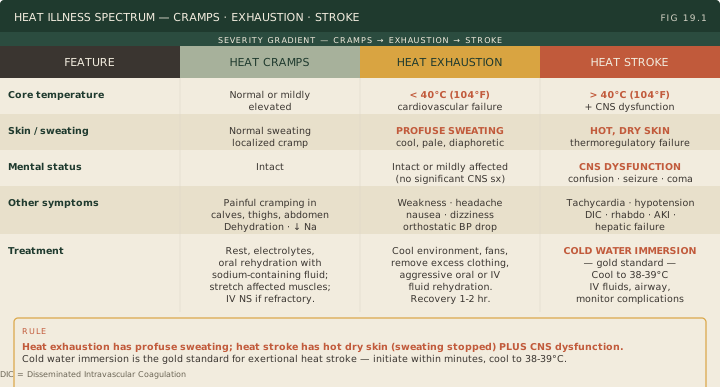
Heat cramps are the mildest form. They present as painful involuntary skeletal muscle contractions, typically affecting the large muscle groups of the calves, thighs, and abdomen. They occur during or after intense physical exertion in hot environments and are associated with dehydration, sodium depletion from sweat losses, and muscle fatigue, with the exact mechanism still debated. The core body temperature is typically normal or only mildly elevated. Treatment is rest, removal from the hot environment, oral rehydration with electrolyte-containing fluids, and gentle stretching of the affected muscles. Intravenous (IV) normal saline may be necessary for severe or refractory cramps. Heat cramps are self-limited and resolve with appropriate fluid and electrolyte replacement.
Heat exhaustion is the intermediate stage and represents the body’s failure to maintain adequate cardiovascular and thermoregulatory function under heat stress. The defining temperature criterion is a core body temperature less than 40 degrees Celsius. The patient presents with profuse sweating, which is a critical distinguishing feature from heat stroke. The sweating mechanism remains intact, meaning the thermoregulatory system is still attempting to cool the body. Additional symptoms include weakness, fatigue, headache, nausea, vomiting, dizziness, and orthostatic blood pressure drops. The patient may appear pale and diaphoretic with tachycardia. Mental status is intact or only mildly affected: there is no significant central nervous system dysfunction. Treatment is removal from the heat, placement in a cool environment, removal of excess clothing, application of cool water or fans, and aggressive oral or IV fluid rehydration. Most patients recover within 1-2 hours with appropriate treatment.
Heat stroke is a medical emergency and a true life-threatening condition. The defining temperature criterion is a core body temperature greater than 40 degrees Celsius (104 degrees Fahrenheit) combined with central nervous system (CNS) dysfunction. CNS dysfunction can manifest as confusion, delirium, agitation, seizures, or coma. The classic physical examination finding of heat stroke is hot, dry skin: the thermoregulatory center has failed and the sweating mechanism has ceased. That finding is characteristic of classic (non-exertional) heat stroke; in exertional heat stroke sweating is often still present, so the diagnosis rests on core temperature above 40 degrees Celsius plus CNS dysfunction, and a drenched collapsed athlete who is hyperthermic and confused still has heat stroke.
Heat stroke is classified as classic or exertional. Classic heat stroke occurs in elderly or chronically ill individuals during heat waves and develops over days. Exertional heat stroke occurs in young healthy individuals performing strenuous physical activity in hot conditions and develops over hours. Both forms carry significant mortality if not treated immediately.
The treatment of heat stroke is aggressive rapid cooling. The most effective method is cold water immersion, in which the patient is submerged in an ice water bath. This is the gold standard for exertional heat stroke and the most testable intervention on the boards. Evaporative cooling with misting and fans is an alternative when immersion is not available. Cooling should be initiated immediately and continued until the core temperature reaches 38-39 degrees Celsius. IV fluids, airway management, and monitoring for complications including disseminated intravascular coagulation (DIC), rhabdomyolysis, acute kidney injury (AKI), and hepatic failure are essential components of management.
Board Trap — Hot dry skin versus profuse sweating
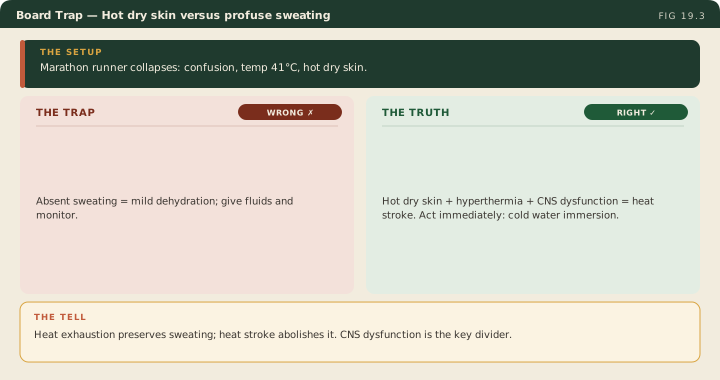
A vignette describes a marathon runner who collapses with confusion, a core temperature of 41 degrees Celsius, and hot dry skin. The trap is to over-anchor on the absence of sweat as a sign of mild dehydration. Hot dry skin in the setting of hyperthermia plus CNS dysfunction is heat stroke, not heat exhaustion, and the answer is cold water immersion immediately. Heat exhaustion preserves the sweating mechanism; classic heat stroke loses it, and exertional heat stroke may keep sweating, so wet skin never argues you out of the diagnosis.
High Yield — Heat illness spectrum
- Heat cramps: painful muscle cramping, normal or mildly elevated core temperature, electrolyte imbalance; treat with electrolytes and fluids.
- Heat exhaustion: core temperature less than 40 degrees Celsius, profuse sweating, intact mental status; treat with cool environment, fluids.
- Heat stroke: core temperature greater than 40 degrees Celsius (104 degrees Fahrenheit) plus CNS dysfunction, hot dry skin from thermoregulatory failure is the classic finding (exertional cases may still be sweating).
- Treatment of exertional heat stroke = cold water immersion (gold standard); cool to 38-39 degrees Celsius.
- Watch for DIC, rhabdomyolysis, AKI, hepatic failure as complications of heat stroke.
When the core temperature rises above 40 degrees Celsius, the delicate tissues of the hypothalamus sustain acute thermal injury. It short circuits. It shuts down entirely. And when the thermostat dies, the signal telling the sweat glands to operate just stops.
— MSK-19 podcast, ~11:24