Before You Listen
Episode Setup
- Topic in one line: the seronegative spondyloarthropathies as a family bound by HLA-B27, sacroiliitis, enthesitis, extra-articular manifestations, and rheumatoid factor (RF) negativity. The four members are ankylosing spondylitis (AS), psoriatic arthritis (PsA), reactive arthritis (ReA), and the enteropathic arthritis of inflammatory bowel disease. The chapter closes with fibromyalgia, a centralized pain syndrome with no objective findings in which opioids are avoided (tramadol the one exception).
- Prerequisites: spine and sacroiliac anatomy, basic understanding of HLA major histocompatibility complex class I presentation, RA pattern recognition (synovial target, RF positive) from MSK-20 to contrast with the spondyloarthropathies (enthesis target, RF negative), and exposure to NSAIDs and biologics from prior rheumatology chapters.
- Runtime: 42 minutes.
Vignette. A 27-year-old man presents with two years of insidious low back pain that wakes him at 3 AM and forces him to pace before he can return to sleep. Pain improves with walking and worsens with sitting. He notes alternating right and left buttock pain, occasional posterior heel pain at the calcaneus, and one episode of unilateral painful red eye six months ago. Examination shows a modified Schober test increase from 15 to 18 cm with maximal forward flexion and chest expansion of 2 cm at the fourth intercostal space. Pelvic radiographs show bilateral sacroiliac sclerosis with blurred margins. Rheumatoid factor and antinuclear antibody are negative.
What is the diagnosis, what genetic marker is positive in over 90% of patients with this disease, what is the most common extra-articular manifestation, and what late skeletal complication should be prevented through positioning and exercise?
(Answer at the end of this chapter)
Section 1: The Seronegative Spondyloarthropathies as a Family
Bottom line: the seronegative spondyloarthropathies share five defining features (HLA-B27 association, sacroiliitis, enthesitis, extra-articular involvement, RF and ANA negativity); the four members are ankylosing spondylitis, psoriatic arthritis, reactive arthritis, and IBD-associated enteropathic arthritis; the target tissue is the enthesis (tendon-to-bone insertion), not the synovium of RA.
The seronegative spondyloarthropathies are a unified family. The four members are ankylosing spondylitis (AS), psoriatic arthritis (PsA), reactive arthritis (ReA), and the enteropathic arthritis of inflammatory bowel disease (IBD). What binds them is shared immunogenetics, a sacroiliac epicenter, an enthesis target tissue, predictable extra-articular spread, and a defining negative serology (Figure 22.1).
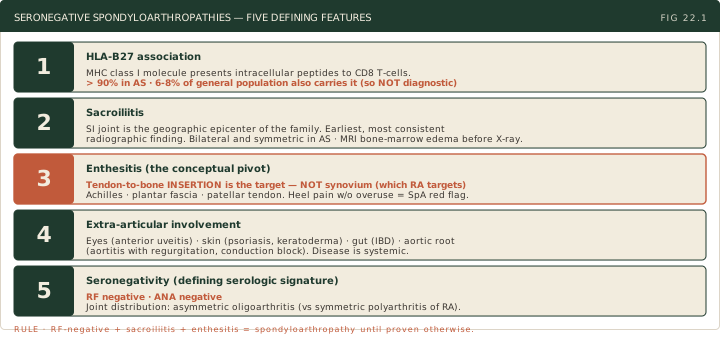
The first unifying feature is human leukocyte antigen B-27 (HLA-B27), a major histocompatibility complex class I molecule that presents intracellular peptide fragments to CD8 T-cells. In the proposed mechanisms, the molecule misfolds or presents self-peptides aberrantly, triggering chronic T-cell-driven inflammation directed at the axial skeleton, the entheses, and select extra-articular tissues. The strength of association varies: greater than 90% in AS, lower but still elevated in PsA and ReA. The test is not diagnostic because 6-8% of the general population carries HLA-B27 without ever developing disease.
The second feature is sacroiliitis. The sacroiliac joint sits where the spine wedges into the pelvis and is the geographic ground zero for the family. Inflammation here is the earliest and most consistent radiographic finding, especially in AS where it is bilateral and symmetric.
The third feature is enthesitis, inflammation at the precise insertion of a tendon, ligament, or capsule into bone. This is the conceptual pivot that separates the spondyloarthropathies from RA. RA targets the synovium; spondyloarthropathies target the enthesis. The Achilles insertion on the calcaneus, the plantar fascia origin on the calcaneus, and the patellar tendon insertion on the tibial tubercle are the archetypal sites. A young patient with new mysterious heel pain and no overuse history should trigger a spondyloarthropathy workup.
The fourth feature is extra-articular involvement. The same dysregulated immune circuit that attacks bone insertions also lights up the eyes (anterior uveitis), skin (psoriasis, keratoderma blennorrhagica), gut (IBD), and aortic root (aortitis with regurgitation and conduction block). The fifth is seronegativity. RF and ANA are negative. A clinician using only the standard RA screening panel will declare the patient healthy and miss the disease entirely. The joint distribution also tilts toward asymmetric oligoarthritis rather than the symmetric polyarthritis of RA.
High Yield — The Family Rules
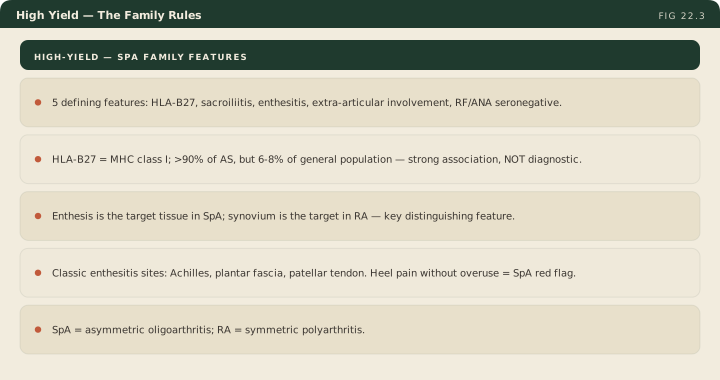
- Five defining features: HLA-B27 association, sacroiliitis, enthesitis, extra-articular involvement, RF/ANA seronegative.
- HLA-B27 = MHC class I; present in >90% of AS but in 6-8% of general population. Strong association, NOT diagnostic.
- Enthesis is the target tissue — separates spondyloarthropathies from RA, which targets synovium.
- Achilles, plantar fascia, patellar tendon = classic enthesitis sites. Heel pain without overuse = SpA red flag.
- Joint distribution: asymmetric oligoarthritis (SpA) versus symmetric polyarthritis (RA).
They’re attacking the literal foundation bolts on the outside that hold the house to the concrete slab.
— MSK-22 podcast, ~8:47