Before You Listen
Episode Setup
- Topic in one line: the diagnostic architecture of osteoporosis on the PM&R boards: the World Health Organization (WHO) bone-density classification by T-score and Z-score, the dual-energy X-ray absorptiometry (DEXA) sites and their pitfalls, the Fracture Risk Assessment Tool (FRAX) thresholds for treatment, the modifiable and non-modifiable risk factors, the secondary causes worth chasing, the calcium and vitamin D math you must memorize, and the laboratory and radiographic distinctions between osteoporosis, osteomalacia, and Paget disease of bone.
- Prerequisites: basic bone histology (osteoblast, osteoclast, osteocyte, the remodeling unit), the calcium-phosphate-parathyroid hormone (PTH) axis, vitamin D metabolism through the liver and kidney, and the difference between trabecular and cortical bone compartments.
- Runtime: 44 minutes.
Vignette. A 68-year-old postmenopausal woman with a body mass index of 19, chronic obstructive pulmonary disease (COPD) on inhaled and intermittent oral prednisone for the past 4 years (typical dose 7.5 mg daily), and a 30-pack-year smoking history presents to a physiatrist after a low-trauma wrist fracture from a fall onto her outstretched hand. Her DEXA shows a T-score of −1.8 at the lumbar spine, −2.7 at the femoral neck, and −2.2 at the total hip. Laboratory studies show a 25-hydroxy vitamin D of 18 ng/mL, a serum calcium of 9.4 mg/dL, a phosphorus of 3.6 mg/dL, an alkaline phosphatase of 84 U/L, a thyroid-stimulating hormone of 2.1 mIU/L, and a parathyroid hormone of 72 pg/mL.
What is her diagnosis based on the DEXA result, why does the femoral neck T-score govern the diagnosis rather than the lumbar spine value, what is her FRAX-relevant risk factor profile, what is the most likely explanation for the elevated parathyroid hormone, and what laboratory and lifestyle interventions are required before any pharmacologic osteoporosis treatment is started?
(Answer at the end of this chapter)
Section 1: WHO Classification, T-Score versus Z-Score, and the Diagnostic Threshold
Bottom line: osteoporosis is defined on DEXA by a T-score of −2.5 or lower at the lumbar spine, femoral neck, or total hip; osteopenia (low bone mass) is a T-score between −1.0 and −2.5; the T-score compares bone mineral density (BMD) to a young healthy adult reference and governs diagnosis in postmenopausal women and men aged 50 or older, while the Z-score compares to age-matched controls and is used in premenopausal women, men under 50, and children to flag secondary causes.
Osteoporosis is a systemic skeletal disease characterized by low bone mass and microarchitectural deterioration of bone tissue, leading to bone fragility and fracture susceptibility. The World Health Organization established the diagnostic classification based on bone mineral density measured by dual-energy X-ray absorptiometry (DEXA), and the resulting T-score thresholds are tested directly on every PM&R board examination.
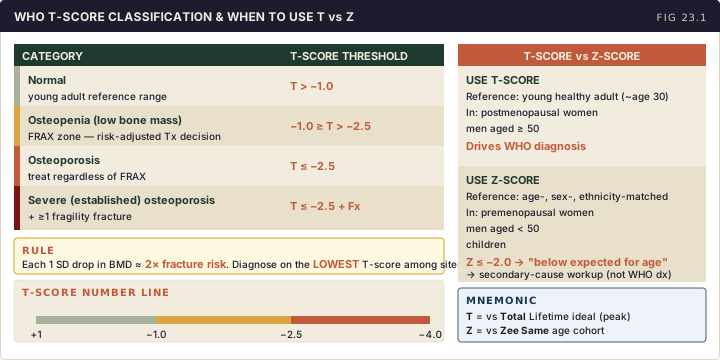
The WHO classification defines four categories. Normal bone density is a T-score of −1.0 or higher. Osteopenia, also called low bone mass, is a T-score below −1.0 and above −2.5 (−1.0 itself is normal; −2.5 itself is osteoporosis). Osteoporosis is a T-score equal to or less than −2.5. Severe (or established) osteoporosis is a T-score of −2.5 or lower in a patient who has also sustained one or more fragility fractures. The bands are not the whole story: in a postmenopausal woman or a man aged 50 or older, a hip fracture is diagnostic of osteoporosis regardless of the T-score, while a vertebral, proximal humerus, pelvic, or distal forearm fragility fracture is diagnostic when bone density is already osteopenic (T-score −1.0 to −2.5). A T-score of exactly −2.5 counts as osteoporosis, not osteopenia. Memorize these cutoffs precisely; the boards test them as recognition items, asking you to translate a number on a paper DEXA report into the correct diagnostic label.
The most heavily tested concept in this section is the distinction between the T-score and the Z-score. The T-score compares the patient’s BMD to the BMD of a young healthy adult at peak bone mass (around age 30) and is reported in standard deviations below that reference. The T-score is used for diagnosis in postmenopausal women and men aged 50 or older. The Z-score, by contrast, compares the patient’s BMD to age-matched, sex-matched, and ethnicity-matched controls. The Z-score is used in premenopausal women, men younger than 50, and children. A Z-score of −2.0 or below is described as “below the expected range for age” and should trigger an evaluation for secondary causes of bone loss rather than a diagnosis of osteoporosis based on the WHO threshold.
The clinical distinction matters. A 75-year-old woman with a T-score of −2.7 carries a WHO diagnosis of osteoporosis. A 30-year-old premenopausal woman with the same numerical BMD value would be evaluated using the Z-score; if her Z-score is −2.5, the result is below the age-expected range and triggers a secondary-cause workup (hyperparathyroidism, celiac disease, anorexia nervosa, glucocorticoid exposure, hypogonadism), not a label of osteoporosis on the WHO axis.
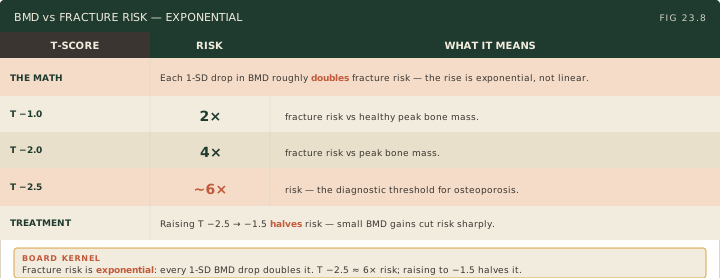
A T-score of −2.5 means the patient’s BMD is 2.5 standard deviations below the young adult reference mean. Each standard-deviation decrease in BMD corresponds to roughly a doubling of fracture risk, so a T-score of −2.5 carries about a six-fold higher fracture risk than a T-score of 0. This exponential relationship explains why modest treatment-induced improvements still translate into meaningful fracture-risk reduction.
Discordance between DEXA sites is common and testable. A patient may have osteopenia at the lumbar spine and osteoporosis at the femoral neck, or the reverse. The spine is predominantly trabecular bone, which loses density faster after estrogen withdrawal. The hip is a mix of trabecular and cortical bone, and aging-related cortical loss eventually dominates. Postmenopausal estrogen-deficient women therefore show early lumbar declines, while elderly patients show disproportionate hip declines. The diagnosis is always made from the lowest T-score among the measured sites.
High Yield — WHO classification and which score to use
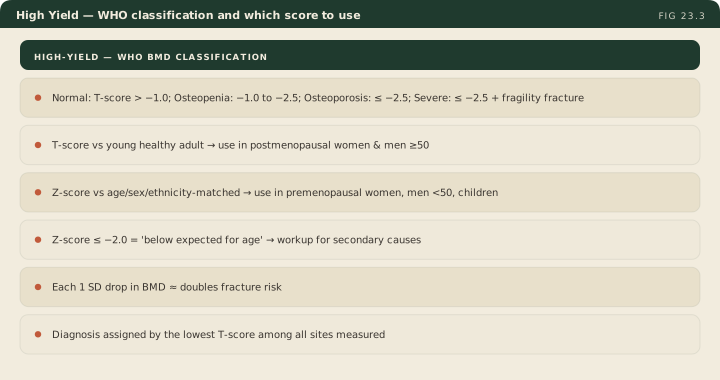
- Normal: T-score ≥ −1.0
- Osteopenia (low bone mass): −2.5 < T-score < −1.0
- Osteoporosis: T-score ≤ −2.5
- Severe osteoporosis: T-score ≤ −2.5 plus one or more fragility fractures
- T-score = vs young healthy adult; use in postmenopausal women + men ≥50.
- Z-score = vs age/sex/ethnicity-matched; use in premenopausal women, men <50, children.
- Z-score ≤ −2.0 = “below expected for age” → workup for secondary causes.
- Each standard deviation drop in BMD ≈ doubling of fracture risk.
- Diagnosis made on the lowest T-score among the sites measured.
Mnemonic — “T for Total Lifetime, Z for Zee Same Age”
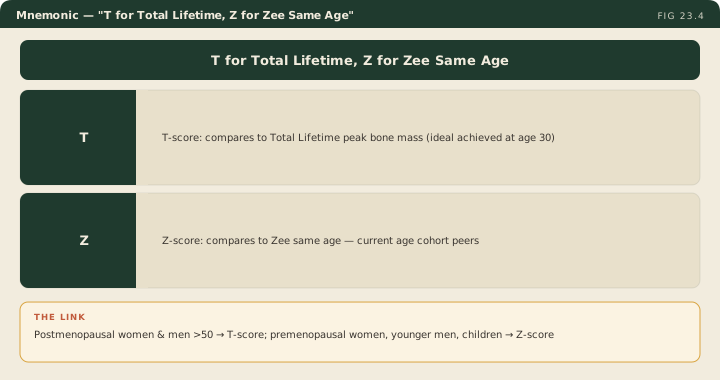
Think of the T-score as comparing the patient to her Total Lifetime ideal: the peak bone mass she should have reached at age 30. The Z-score compares her to Zee same age — her actual current age cohort. Postmenopausal women and men over 50 always get a T-score (they are past the age where the question is “what should you have had?”). Premenopausal women, younger men, and children get a Z-score (the question is “are you tracking with peers?”).