Before You Listen
Episode Setup
- Topic in one line: the groin pain differential and leg length discrepancy. The groin is a deceptively crowded anatomic neighborhood where adductor strain, athletic pubalgia (sports hernia), osteitis pubis, hip flexor strain, pediatric apophyseal avulsion fractures, true inguinal hernia, hip labral tear, and femoral neck stress fracture all overlap. Leg length discrepancy (LLD) is split into true (bony), apparent (pelvic obliquity), and functional (contracture/postural) categories with distinct measurement techniques and treatment thresholds.
- Prerequisites: hip and pelvic anatomy (anterior superior iliac spine [ASIS], anterior inferior iliac spine [AIIS], pubic tubercle, pubic symphysis, ischial tuberosity, lesser trochanter), the adductor compartment muscles, the iliopsoas, the conjoint tendon, the inguinal canal, gait phases, and the Salter-Harris growth plate framework from MSK-27.
- Runtime: 55 minutes.
Vignette. A 26-year-old professional hockey player presents with four months of progressive right lower abdominal and inguinal pain. The pain began insidiously, worsens with skating and shooting, and improves with rest. On examination, the inguinal canal is normal bilaterally with no palpable hernia and no cough impulse. There is tenderness on deep palpation through the right external ring. Pain is reproduced with resisted sit-ups and Valsalva maneuver. There is mild tenderness along the right adductor longus origin. MRI shows edema at the right pubic symphysis and enthesopathy at the rectus abdominis insertion.
What is the diagnosis, what is the proposed mechanism of injury, what is the most common misdiagnosis in this clinical picture, what is the expected response rate to a structured 6-8 week conservative rehabilitation program, and how does the location of tenderness distinguish this entity from osteitis pubis and from a pure adductor strain?
(Answer at the end of this chapter)
Section 1: Adductor Strain — The Most Common Groin Injury
Bottom line: adductor-related groin pain is the most common defined cause of athletic groin pain, roughly 61% of athletes presenting with groin pain, and groin strains are about 10% of all injuries within ice hockey and soccer rather than 10% of sports injuries overall; the adductor longus at its proximal pubic tubercle origin is the most commonly torn structure; tenderness sits at the pubic tubercle or along the adductor muscle belly with pain on resisted adduction (the squeeze test); the Copenhagen adduction exercise has level 1 evidence for prevention; and the adductor-to-abductor strength ratio below 0.80 is a validated modifiable risk factor.
Adductor-related groin pain is the most common defined clinical entity among athletes who present with groin pain, roughly 60% in consensus-classified series, and more than 40% of those athletes have more than one cause at once. The frequently quoted “about 10%” figure belongs to a different denominator: groin strains account for approximately 10 to 11% of all injuries within professional ice hockey and soccer, not 10% of sports injuries generally. Adductor strains are most prevalent in soccer, hockey, football, and equestrian sports, all of which demand rapid changes of direction, forceful kicking, and powerful adduction against resistance. The injury is partial or complete tearing of the adductor muscle-tendon unit, most commonly the adductor longus at its proximal attachment on the pubic tubercle and inferior pubic ramus. The mechanism is typically eccentric overload during forced abduction of a planted leg or rapid acceleration and deceleration with change of direction. The adductor longus is the most commonly injured because it has the smallest cross-sectional area relative to the force demands placed on it, and its proximal attachment concentrates stress at the bone-tendon junction.
Risk factors include previous adductor injury (the strongest predictor of recurrence), inadequate warm-up, weak adductors relative to abductors with an adductor-to-abductor strength ratio of less than 0.80 (a validated modifiable risk factor), and limited hip abduction range of motion. Clinical presentation includes acute or insidious groin pain that worsens with activity. On examination, there is tenderness at the pubic tubercle or along the adductor muscle belly, pain with resisted hip adduction (assessed using the squeeze test where the patient squeezes the examiner’s fist between their knees), and pain with passive hip abduction stretching. Grading follows the standard muscle strain classification: grade 1 (mild pain, no strength loss), grade 2 (moderate pain, partial tear, measurable strength loss), grade 3 (complete tear, palpable defect, significant weakness).
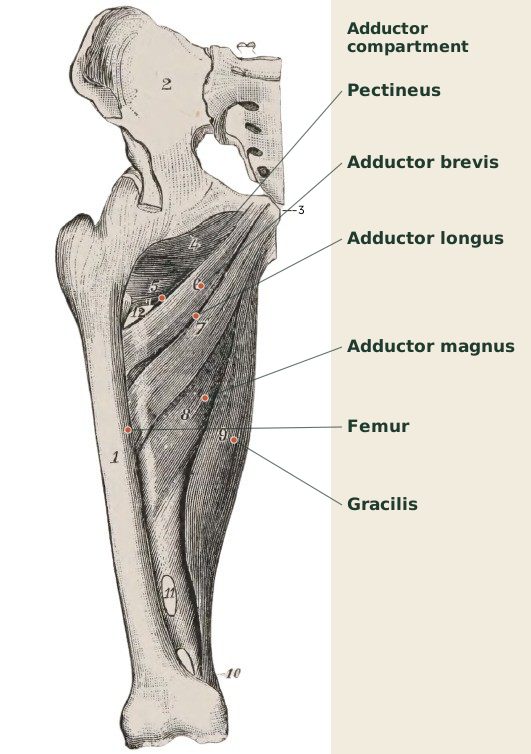
Source: Alfred W. Hughes, A Manual of Practical Anatomy (1901), Wikimedia Commons, Public Domain
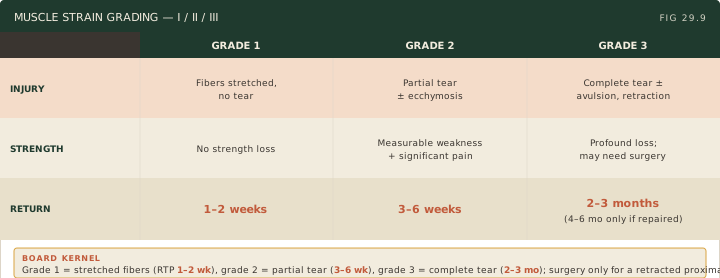
Imaging with MRI confirms the diagnosis and characterizes tear extent. Ultrasound can identify acute tears but is operator-dependent. Treatment is conservative: relative rest, ice, NSAIDs, and progressive rehabilitation emphasizing eccentric strengthening and neuromuscular control. The Copenhagen adduction exercise has level 1 evidence for prevention of adductor injuries in soccer players. That evidence rests on a single cluster-randomized controlled trial of a single-exercise adductor strengthening program in men’s football, which lowered the risk of reporting a groin problem by about 41%. The older preseason adductor strengthening work in ice hockey is a non-randomized prevention study with a historical comparison, and it is the historical precedent rather than a trial of this exercise. The athlete lies on the side with the top leg supported on a bench or by a partner and the bottom leg adducts against gravity, lifting from the floor. Return to play is guided by pain-free resisted adduction at full strength and sport-specific functional testing. Surgical repair is reserved for complete proximal avulsions with significant retraction. The rehabilitation timeline follows the injury grade: grade 1 in 1-2 weeks, grade 2 in 3-6 weeks, grade 3 complete tears in 2-3 months, and surgical candidates with significant retraction in 4-6 months.
An anatomic point worth knowing: the adductor magnus has dual innervation. The adductor portion is innervated by the obturator nerve, while the hamstring portion (which arises from the ischial tuberosity and inserts on the adductor tubercle of the femur) is innervated by the tibial division of the sciatic nerve. The gracilis is the only adductor that crosses both the hip and knee joints and is one of the three tendons of the pes anserinus insertion on the proximal medial tibia (along with sartorius and semitendinosus).
High Yield — Adductor Strain
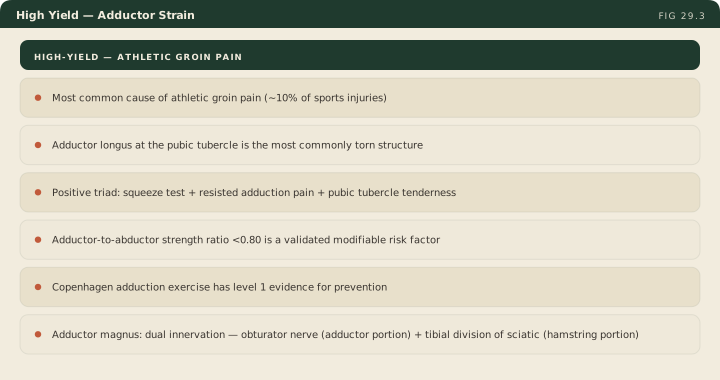
- Most common cause of athletic groin pain; the ~10% figure counts injuries within ice hockey and soccer, not all sports injuries.
- Adductor longus at the pubic tubercle is the most commonly torn structure.
- Squeeze test + resisted adduction pain + pubic tubercle tenderness = positive triad.
- Copenhagen adduction exercise has level 1 evidence for prevention.
- Adductor-to-abductor strength ratio <0.80 is a validated modifiable risk factor.
- Adductor magnus dual innervation: obturator (adductor portion) + tibial division of sciatic (hamstring portion).
But the posterior hamstring portion of the magnus, which originates all the way back at the ischial tuberosity, is innervated by the tibial division of the sciatic nerve.
— MSK-29 podcast, ~12:07
You have a muscle firing concentrically with all its might to shorten, being forcibly lengthened by an overwhelming external force.
— MSK-29 podcast, ~4:24