Before You Listen
- Prerequisites: peripheral nerve anatomy and the Schwann-cell myelin/node-of-Ranvier organization (BASIC); the upper vs lower motor neuron distinction; basic neuromuscular junction anatomy (presynaptic ACh vesicles, postsynaptic AChR).
- Runtime: 55 minutes.
- Topic in one line: four immune-and-overuse syndromes: acute demyelination (Guillain-Barré syndrome [GBS]), chronic demyelination (chronic inflammatory demyelinating polyneuropathy [CIDP]), motor unit exhaustion decades after polio, and the postsynaptic-versus-presynaptic neuromuscular junction (NMJ) split between myasthenia gravis and Lambert-Eaton.
Vignette. A 58-year-old man presents with 5 days of progressive ascending leg weakness, two weeks after an episode of bloody diarrhea. Reflexes are absent. Cerebrospinal fluid (CSF) shows protein 92 mg/dL with 2 white cells. Forced vital capacity (FVC) has fallen from 4.0 L on admission to 1.4 L this morning. Nerve conduction studies show reduced compound muscle action potential (CMAP) amplitudes with preserved conduction velocities and normal sensory nerve action potentials (SNAPs).
What is the GBS subtype, the most likely antecedent organism, the immediate mandatory management, and which standard GBS treatment must NOT be used?
Section 1 — GBS Definition, Subtypes, and Antecedent Triggers
Bottom line: acute, ascending, areflexic, monophasic with nadir <4 weeks; acute inflammatory demyelinating polyneuropathy (AIDP) is most common in the West; AMAN is Campylobacter + anti-GM1 + pure motor; Miller Fisher is anti-GQ1b + the ophthalmoplegia-ataxia-areflexia triad.
Guillain-Barré syndrome is an acute immune-mediated polyradiculoneuropathy: the most common cause of acute flaccid paralysis in the developed world, incidence 1-2 per 100,000 per year. The defining clinical trajectory is monophasic: rapid progression over days to a maximum of four weeks (the nadir), then plateau, then gradual recovery over weeks to months. The four-week nadir ceiling is the hard clinical line that separates GBS from CIDP (which by definition progresses beyond eight weeks). Weakness is ascending, symmetric, predominantly motor, and flaccid with areflexia: areflexia appears early, often before significant weakness is detectable, and is one of the strongest clinical clues in the acute setting. Sensory paresthesias and neuropathic pain are common (up to 70%) despite the motor-predominant label. Bilateral facial weakness occurs in roughly 50%; bulbar involvement signals impending respiratory compromise.
The pathogenesis is molecular mimicry: an antecedent infection generates antibodies against microbial lipooligosaccharides that share carbohydrate epitopes with peripheral-nerve gangliosides, and those antibodies cross-react with nerve membranes. Roughly two-thirds of patients report a preceding respiratory or GI infection within six weeks of onset. The antecedent organism predicts the subtype because different gangliosides cluster at different anatomic sites: anti-GM1/GD1a at motor-axon nodes of Ranvier, anti-GQ1b at oculomotor nerves and muscle spindles, anti-GT1a at glossopharyngeal/vagus.
| Variant | % of cases | Pattern | Ganglioside antibody | Trigger / Population | EMG/NCS signature |
|---|---|---|---|---|---|
| AIDP (acute inflammatory demyelinating polyneuropathy) | 85-90% (US/Europe) | Demyelinating, motor + sensory | None consistent | Heterogeneous; often respiratory infection | Slow conduction velocity, prolonged distal latencies, conduction block, prolonged F-waves |
| AMAN (acute motor axonal) | 30-65% (Asia); minority in West | Pure motor, no sensory loss | Anti-GM1, anti-GD1a | Campylobacter jejuni | Reduced CMAP amplitudes, normal CV and SNAPs |
| AMSAN (acute motor + sensory axonal) | <5% | Motor + sensory axonal | Anti-GM1, anti-GD1a | Severe Campylobacter | Reduced CMAP and SNAP amplitudes, normal CV |
| Miller Fisher | ~5% | Descending — ophthalmoplegia → ataxia → areflexia | Anti-GQ1b (>90%) | Often respiratory infection | Often near-normal NCS; antibody test confirms |
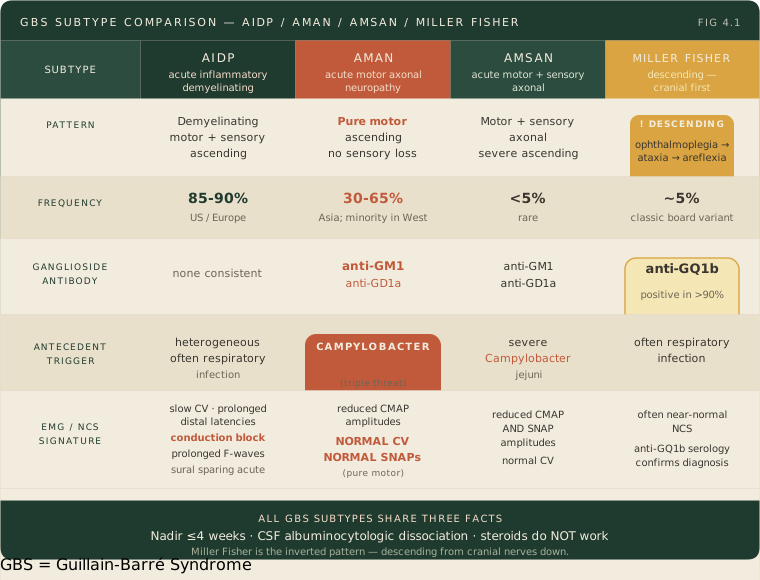
The triggers carry their own board pearls. Campylobacter jejuni is the triple threat: most common trigger overall (25-50% of cases), most strongly tied to AMAN through anti-GM1, and worst prognosis. Cytomegalovirus is second, associated with younger patients and severe sensory involvement (anti-GM2). Mycoplasma pneumoniae dominates pediatric cases (anti-galactocerebroside). COVID-19 has produced an AIDP-pattern surge worldwide.
Board note — clinical association: While standard clinical literature (such as the International GBS Outcome Study) highlights that cytomegalovirus (CMV)-associated GBS often presents with prominent acute cranial nerve involvement and severe motor weakness, board exams historically pair CMV-GBS with severe sensory loss and a distinct anti-GM2 antibody profile in younger populations. When evaluating a patient with prominent sensory deficits and a recent viral illness, keep CMV high on your differential for the boards.
Miller Fisher is the variant boards love because the pattern is the opposite of typical GBS. The triad (ophthalmoplegia, ataxia, areflexia) descends from the cranial nerves down rather than ascending from the legs up, because GQ1b ganglioside is concentrated in oculomotor, trochlear, and abducens nerves and in muscle spindles. Anti-GQ1b is positive in over 90% of cases, and prognosis is generally excellent with full recovery within months.
The vignette that nails Miller Fisher: a middle-aged adult presents with a few days of double vision, unsteady gait, and absent reflexes after an upper respiratory infection, cranial nerves III/IV/VI on exam, broad-based gait, normal limb strength. CSF is consistent with albuminocytologic dissociation; anti-GQ1b confirms. Rare overlap with the Bickerstaff brainstem encephalitis spectrum (Miller Fisher features plus altered consciousness from brainstem involvement) shares the anti-GQ1b antibody but adds central nervous system features.
Board Trap — “Pleocytosis means GBS”
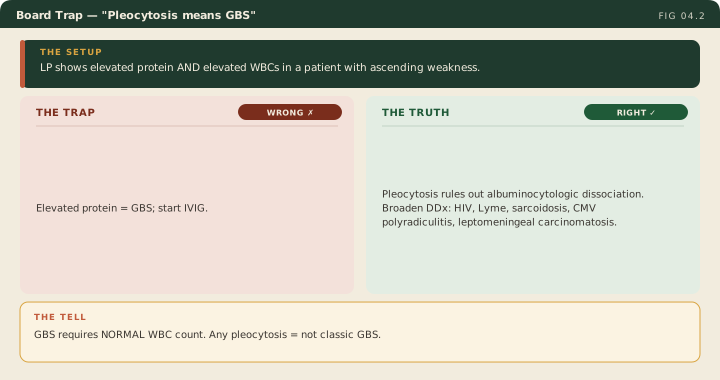
CSF in GBS shows albuminocytologic dissociation. Elevated protein with normal white blood cell count. If the cell count is elevated (pleocytosis), it is not albuminocytologic dissociation, and the differential expands to HIV, Lyme (especially with facial diplegia), sarcoidosis, CMV polyradiculitis, and leptomeningeal carcinomatosis. Protein may be normal in the first week of GBS — sensitivity rises after week one.
High Yield — GBS subtypes
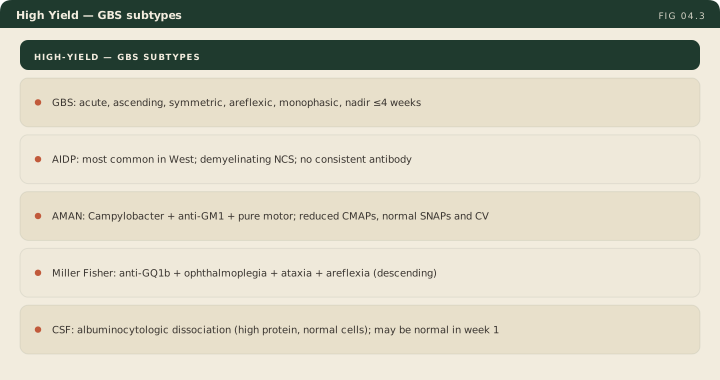
- GBS in one line: acute, ascending, symmetric, areflexic, monophasic, nadir ≤4 weeks.
- AIDP: most common in West, demyelinating NCS, no consistent antibody.
- AMAN: Campylobacter + anti-GM1 + pure motor + axonal NCS (reduced CMAPs, normal SNAPs and CV).
- Miller Fisher: anti-GQ1b + ophthalmoplegia + ataxia + areflexia (descending pattern).
- CSF: albuminocytologic dissociation (high protein, normal cells); may be normal in week 1.
But if you check their Achilles and patellar reflexes and find they are completely absent, well, that early loss of reflexes is the sharpest early indicator you are going to get.
— NEURO-04 podcast, ~5:28
And if the patient reaches their absolute worst point of weakness within four weeks, the diagnosis is Guillain-Barre syndrome. But if they keep progressing past the eight-week mark, well, the diagnosis flips to chronic inflammatory demyelinating polyneuropathy.
— NEURO-04 podcast, ~2:11