Before You Listen
Episode Setup
- Topic in one line: the developmental ruler against which every pediatric pathology is measured. Part 1 builds that ruler across the four behavioral domains, gross motor, fine motor, language and social-emotional, and the brainstem-mediated primitive reflexes whose persistence localizes upper motor neuron injury; Part 2 turns the ruler into a workflow by adding the screening-versus-diagnostic toolkit (Denver II, Ages and Stages Questionnaire (ASQ-3), Bayley Scales of Infant and Toddler Development (Bayley-4), Modified Checklist for Autism in Toddlers, Revised with Follow-Up (M-CHAT-R/F)), the red-flag inventory, the Diagnostic and Statistical Manual fifth edition (DSM-5) criteria for autism spectrum disorder (ASD), intellectual disability (ID), and global developmental delay (GDD), and the federal scaffold of the Individuals with Disabilities Education Act (IDEA) Part C and Part B.
- Prerequisites: basic neuroanatomy of the corticospinal tract, the difference between upper motor neuron (UMN) and lower motor neuron (LMN) lesions, and the concept of the cephalocaudal and proximal-to-distal maturation gradient.
- Runtime: 33 minutes.
Vignette. A 14-month-old former 28-week preterm infant is referred to pediatric rehabilitation. His mother reports he is not pulling to stand, has never crawled reciprocally, and reaches only with the right hand. On exam he sits independently and bears partial weight with two-hand support. Both palmar grasp reflexes are still elicitable. He babbles “ba-ba-ba,” says “mama” nonspecifically, points, and turns to his name half the time. The left hand stays fisted during reach with mild flexor posturing.
What is his corrected age, which red flag is most concerning, what screening and diagnostic workup is indicated, and what federal program governs the early intervention services?
(Answer at the end of this chapter)
Section 1: Gross Motor Milestones and the Cephalocaudal Gradient
Bottom line: gross motor development advances cephalocaudally and proximally to distally on a tightly conserved schedule, with antigravity head control by 4 months, independent sitting by 9 months, independent walking by 12 months (99th percentile about 17.6 months, so 18 months is the referral threshold), reciprocal stair climbing up at 3 years and down at 4 years, and skipping at 5 years; the World Health Organization Multicentre Growth Reference Study established the population windows of achievement that frame what is typical and what is delayed; and corrected age for prematurity must be applied until at least 24 months for any child born preterm.
Gross motor development follows two gradients: cephalocaudal (head before trunk before pelvis before lower limbs) and proximal to distal (girdle before elbow and knee before hand and foot). Both reflect corticospinal tract maturation. Myelination begins centrally and propagates outward, so the same neuroanatomy that produces the textbook timeline also explains why a child cannot fire a precise pincer grasp before they can stabilize a shoulder, and why a child cannot toe-walk in pattern before they can stand independently.
At birth a full-term newborn shows physiologic flexor tone and complete head lag; flexor predominance is the expected finding, and a “floppy newborn” raises hypotonia. By 2 months the infant lifts the head 45 degrees in prone. By 3 months the infant lifts to 90 degrees, props on the forearms, with minimal head lag. By 4 months the infant props on extended arms, rolls prone to supine, and demonstrates no head lag; persistent head lag past 4 months is a red flag. By 6 months the infant rolls both directions, sits in a tripod position, and briefly sits unsupported. By 9 months the infant crawls reciprocally, pulls to stand, and cruises. At 12 months the median child walks independently (range 9-15 months); the 99th percentile for walking alone is about 17.6 months (97th about 16 months), which is why 18 months is the referral threshold.
Board answer vs. current evidence — Independent walking is typically achieved around 12 months — this is likely the board-tested answer, but more recent evidence indicates the WHO normative range for independent walking spans 8 to 18 months, wider than the 9 to 15 months often quoted. Answer the board-canonical version on the test.
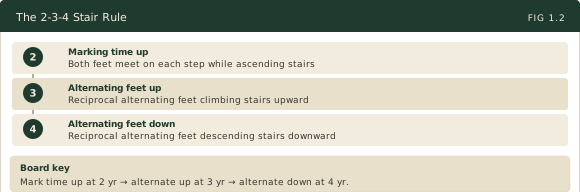
After the first birthday the toddler progresses through stiff-legged running at 15 months, true running and jumping with both feet by 24 months, and reciprocal stair patterns that follow the 2-3-4 stair rule: marking time (both feet on each step) up at 2 years, alternating feet up at 3 years, alternating feet down at 4 years. At 3 years the child also rides a tricycle and stands on one foot for 1 to 2 seconds. At 4 years the child hops on one foot, alternates feet downstairs, and catches a large ball thrown from a short distance. At 5 years the child skips, hops on each foot independently, and walks heel-to-toe in tandem; skipping is the signature 5-year gross motor achievement.
The World Health Organization (WHO) Multicentre Growth Reference Study established population windows of achievement, defined as the range during which 98 percent of typically developing children (1st to 99th percentile) attain each skill: sitting without support 3.8 to 9.2 months; standing with assistance 4.8 to 11.4 months; hands-and-knees crawling 5.2 to 13.5 months; walking with assistance 5.9 to 13.7 months; standing alone 6.9 to 16.9 months; walking alone 8.2 to 17.6 months. The order of motor acquisition is largely conserved across cultures (about 90 percent of infants follow the common sequence, and about 4 percent skip hands-and-knees crawling), while the timing varies more than textbook tables suggest. A child who skips hands-and-knees crawling and progresses directly from rolling to cruising is uncommon but not necessarily abnormal; the usual order, more than any single checkpoint, is what cortical maturation enforces.
Corrected age is mandatory for preterm infants. Corrected age equals chronological age minus weeks of prematurity. Apply correction until at least 24 months; many experts recommend correction until 36 months for infants born before 28 weeks. A 12-month-old born at 28 weeks (12 weeks early) has corrected age 9 months, and developmental expectations match a 9-month-old. Forgetting to apply the correction is one of the most common board errors, because every milestone in this section, every reflex window in Section 4, and every screening cutoff in Part 2 lives on a corrected-age axis until the second birthday.
A practical consequence: a preterm-born 14-month-old who is not pulling to stand is 2 months past the 9-month checkpoint if her corrected age is 11 months, 4 months past it if her corrected age is 13 months, and 5 months past it, with the 18-month walking referral threshold approaching, if her corrected age is 14 months. The same data point yields three different degrees of delay depending on which age you put in the denominator.
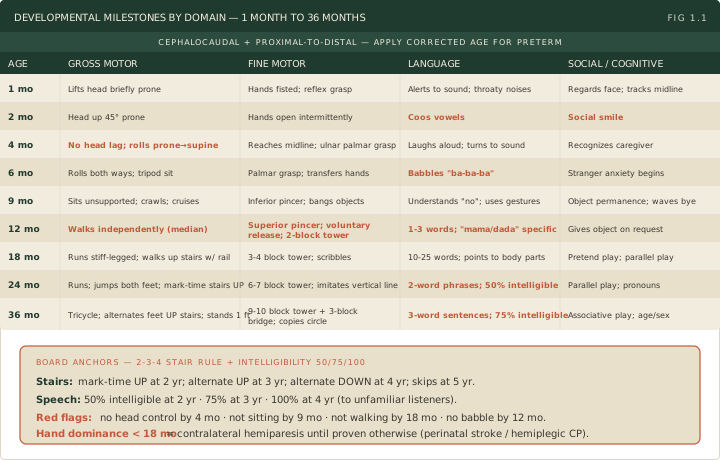
High Yield — Gross motor anchors
- Cephalocaudal + proximal-to-distal: head control precedes trunk, trunk precedes pelvis; shoulder and pelvis precede hand and foot.
- No head lag by 4 months; persistent head lag past 4 months is a red flag.
- Sits unsupported by 6 to 9 months; not sitting by 9 months is a red flag.
- Walks independently by 12 months (range 9 to 15 months); the 99th percentile for walking alone is about 17.6 months (97th about 16 months), which is why 18 months is the referral threshold.
- 2-3-4 stair rule: mark time up at 2 yr; alternate up at 3 yr; alternate down at 4 yr.
- Tricycle at 3 yr; hops at 4 yr; skips at 5 yr.
- WHO windows of achievement: walking alone 8.2 to 17.6 months (98 percent range, 1st to 99th percentile).
- Corrected age = chronological age minus weeks premature; use until 24 months (until 36 months for less-than-28-week preterm infants).
Clinical Pearl — Fontanelle Closure and Head Circumference
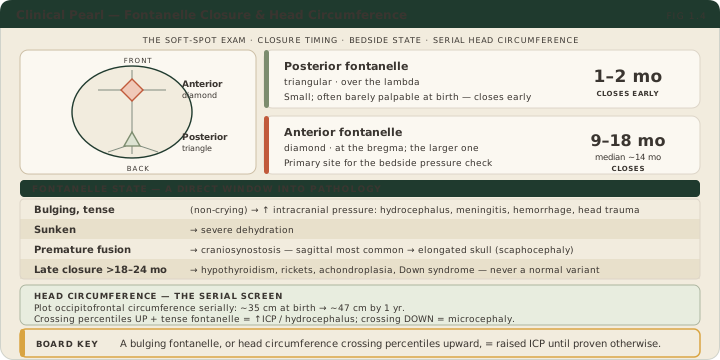
Cranial growth is tracked alongside motor milestones at every well-child visit. The two open cranial fontanelles close on separate schedules:
- Posterior fontanelle: closes at 1 to 3 months (small triangle at the lambdoid suture). Often barely palpable at birth.
- Anterior fontanelle: closes at 9 to 18 months (diamond at the bregma; the larger of the two). Median closure approximately 14 months.
Bedside interpretation:
- Bulging anterior fontanelle in a non-crying infant equals elevated intracranial pressure: hydrocephalus, meningitis, intracranial hemorrhage, abusive head trauma.
- Sunken fontanelle equals dehydration.
- Craniosynostosis is premature fusion of a cranial suture (sagittal is most common, producing scaphocephaly); an early-closing fontanelle with normal head shape and normal head growth is a normal variant.
- Delayed closure (anterior fontanelle still open beyond 18 to 24 months) prompts evaluation for hypothyroidism, rickets, achondroplasia, Down syndrome, increased intracranial pressure or malnutrition; normal variation extends to about 26 months, so head growth and head shape decide.
Head circumference itself follows a stable curve: at birth approximately 35 cm; approximately 12 cm gain in year 1 (~2 cm per month for the first 3 months, ~1 cm per month for months 4-6, then ~0.5 cm per month for the next 6); approximately 3 cm in year 2; approximately 1 cm per year thereafter until age 6. Crossing more than 2 standard-deviation lines on the growth chart in either direction warrants workup.
Mnemonic — “Roll, Sit, Crawl, Cruise, Walk” by halves and ones
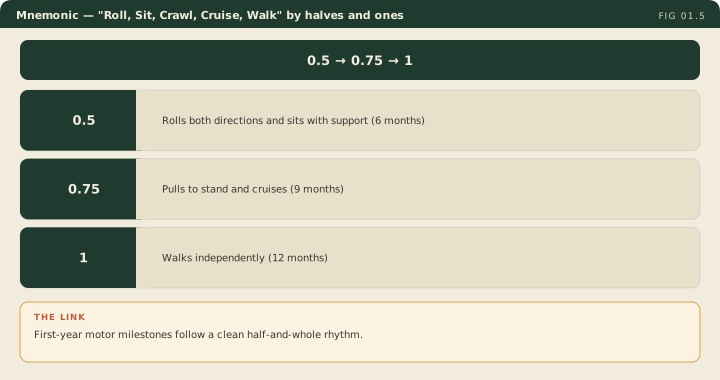
The first-year motor checkpoints fall on a clean half-and-whole rhythm: rolls both directions and sits with support at 0.5 year (6 months); pulls to stand and cruises at 0.75 year (9 months); walks independently at 1 year (12 months). After the first birthday, milestones spread further apart and become the 2-3-4 stair rule and the 5-year skip.
What the WHO data teaches us is that the order of the skills is tightly conserved by the cortex across every population on Earth, but the timing is highly variable.
— PEDS-01 podcast, ~8:55
The cortex cannot effectively drive a precision grip in the hand if it has not yet myelinated the proximal pathways required to lock the shoulder girdle securely in space.
— PEDS-01 podcast, ~3:18