Before You Listen
Episode Setup
- Topic in one line: the assessment apparatus that turns the developmental ruler of Part 1 into clinical action, including the American Academy of Pediatrics (AAP) surveillance and screening schedule, the screening-versus-diagnostic distinction across the Denver II, Ages and Stages Questionnaire Third Edition (ASQ-3), Parents’ Evaluation of Developmental Status (PEDS), Bayley Scales of Infant and Toddler Development Fourth Edition (Bayley-4), and Modified Checklist for Autism in Toddlers, Revised with Follow-Up (M-CHAT-R/F); the domain-by-domain red flags that demand referral; the Diagnostic and Statistical Manual Fifth Edition (DSM-5) criteria for autism spectrum disorder (ASD), intellectual disability, and global developmental delay; the federal scaffold of the Individuals with Disabilities Education Act (IDEA) Part C and Part B with the Individualized Family Service Plan (IFSP) and Individualized Education Program (IEP); and the prematurity gradient that frames developmental risk.
- Prerequisites: Part 1 of PEDS-01 (gross motor and fine motor milestones, language and social-emotional anchors, primitive reflexes and postural reactions); working comfort with the concepts of corrected age, the cephalocaudal and proximal-to-distal maturation gradients, and cortical inhibition of brainstem reflexes.
- Runtime: 1 hour 14 minutes.
Vignette. A 14-month-old former 28-week preterm infant is referred to pediatric rehabilitation. His mother reports he is not pulling to stand, has never crawled reciprocally, and reaches only with the right hand. On exam he sits independently and bears partial weight with two-hand support. Both palmar grasp reflexes are still elicitable. He babbles “ba-ba-ba,” says “mama” nonspecifically, points, and turns to his name half the time. The left hand stays fisted during reach with mild flexor posturing.
What is his corrected age, which red flag is most concerning, what screening and diagnostic workup is indicated, and what federal program governs the early intervention services?
(Answer at the end of this chapter)
Section 5: Developmental Surveillance, Screening, and the Diagnostic Toolkit
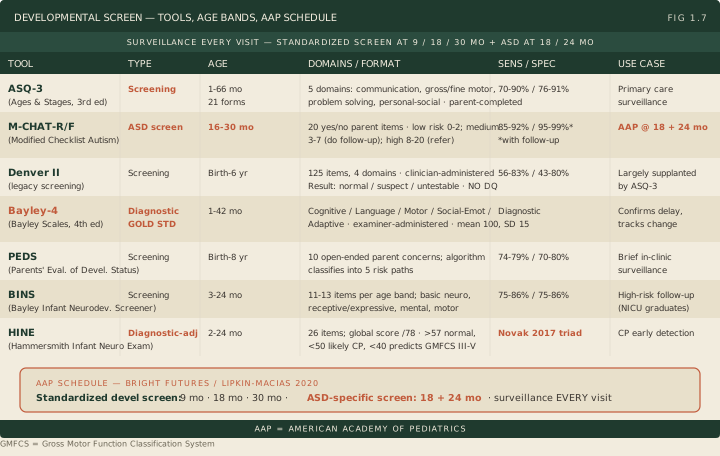
Bottom line: developmental surveillance is a continuous longitudinal process at every well-child visit, while standardized screening uses a validated instrument at the AAP anchor visits of 9, 18, and 30 months with autism-specific screening at 18 and 24 months; the Denver II, the Ages and Stages Questionnaire Third Edition (ASQ-3), the Parents’ Evaluation of Developmental Status (PEDS), and the Modified Checklist for Autism in Toddlers, Revised with Follow-Up (M-CHAT-R/F) are screening instruments designed to identify children who need further evaluation, while the Bayley Scales of Infant and Toddler Development Fourth Edition (Bayley-4) is the diagnostic gold standard with composite scores set at mean 100 and standard deviation 15; the developmental quotient equals developmental age divided by chronological age multiplied by 100 and uses corrected age in preterm infants; and the 2022 CDC and AAP milestone revision shifted from the 50th-percentile cutoff to the 75th-percentile cutoff with binary, observable criteria.
The American Academy of Pediatrics (AAP) framework draws a sharp line between two distinct activities. Developmental surveillance is the ongoing longitudinal process of eliciting parental concerns, observing the child, identifying risk and protective factors, and documenting developmental progress at every well-child visit from birth onward. It does not require a validated instrument. Developmental screening, by contrast, is the administration of a standardized validated instrument at predetermined anchor visits, with a defined cutoff that triggers further evaluation. The AAP schedule sets standardized developmental screening at 9, 18, and 30 months and autism-specific screening at 18 and 24 months. The 18-month visit is the only anchor where both general developmental and autism-specific screening occur simultaneously.
The Denver Developmental Screening Test, Second Edition (Denver II) is a clinician-administered screening tool spanning birth to 6 years across 4 domains: gross motor, fine motor-adaptive, language, and personal-social. It contains 125 items. Results are classified as normal, suspect, or untestable. A normal result requires no delays and at most 1 caution. A suspect result reflects 1 or more delays and/or 2 or more cautions. An untestable result reflects too many refusals to interpret. A caution is failure on an item passed by 75 to 90 percent of children at that age; a delay is failure on an item passed by more than 90 percent of children at that age, meaning the item line lies entirely to the left of the child’s chronological age. The Denver II does not generate a developmental quotient. Sensitivity ranges from 56 to 83 percent and specificity from 43 to 80 percent. It is a screening tool, not a diagnostic tool.
The Ages and Stages Questionnaire, Third Edition (ASQ-3) is a parent-completed screening tool covering 5 domains (communication, gross motor, fine motor, problem solving, and personal-social) across 21 age-specific forms spanning 1 to 66 months. Parent completion takes 10 to 15 minutes; clinician scoring takes 2 to 3 minutes. Sensitivity is 70 to 90 percent and specificity 76 to 91 percent. The ASQ-3 has largely supplanted the Denver II in many clinical settings because of better psychometric properties, lower clinician burden, and the inclusion of a “monitoring zone” between clear pass and clear referral that prompts close follow-up without immediate referral. The Parents’ Evaluation of Developmental Status (PEDS) is a 10-item parent interview tool for birth to 8 years that captures parental concerns rather than directly testing the child, with sensitivity 74 to 79 percent and specificity 70 to 80 percent.
The Bayley Scales of Infant and Toddler Development, Fourth Edition (Bayley-4) is the diagnostic gold standard for ages 1 to 42 months. It is clinician-administered and covers 5 scales: Cognitive, Language, Motor, Social-Emotional, and Adaptive Behavior. Composite scores are scaled to mean 100, standard deviation 15; subtest scaled scores have mean 10, standard deviation 3. The Bayley-4 added digital administration for selected components. The contrast with the Denver II is a classic board distinction: Denver II screens, Bayley diagnoses. The shorter Bayley Infant Neurodevelopmental Screener (BINS) covers 3 to 24 months across 4 conceptual areas (neurological, receptive, expressive, cognitive) with risk categorized as low, moderate, or high, serving as a faster office screener.
The developmental quotient (DQ) equals (developmental age divided by chronological age) multiplied by 100. A DQ below 70 corresponds roughly to performance more than 2 standard deviations below the mean. In preterm infants the denominator must use corrected age until at least 24 months of age, and many experts continue correcting until 36 months for infants born before 28 weeks of gestation.
The 2022 CDC and AAP milestone revision was a significant methodologic shift. The updated checklists now reflect behaviors that at least 75 percent of children demonstrate at a given age, replacing the previous 50th-percentile standard. The revision eliminated vague qualifiers such as “may” and “begins” in favor of observable, binary criteria. The checklists span 12 age-specific forms covering every recommended well-child visit from 2 months through 5 years, with newly added 15-month and 30-month checklists. Of the final 159 milestones, about 59 percent were retained from the original set with modifications and about 41 percent were newly added (94 of the 216 original entries were retained).
High Yield — Surveillance and screening
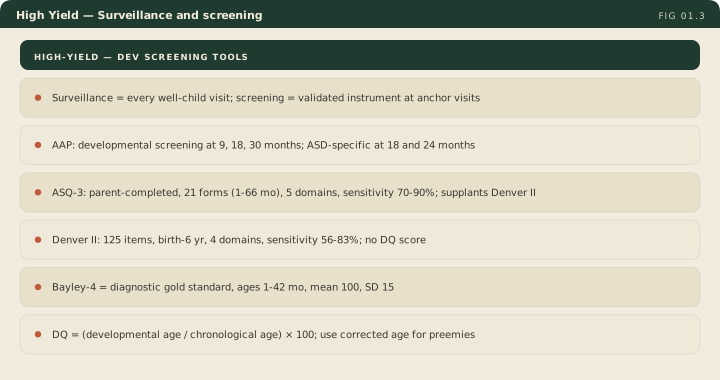
- Surveillance = ongoing, every well-child visit; screening = validated instrument at anchor visits.
- AAP schedule: developmental screening at 9, 18, 30 months; ASD-specific at 18 and 24 months.
- Denver II: 125 items, birth-6 yr, 4 domains, clinician-administered, sensitivity 56-83%; no DQ.
- ASQ-3: parent-completed, 21 forms (1-66 mo), 5 domains, sensitivity 70-90%; supplants Denver II.
- Bayley-4 = diagnostic gold standard, ages 1-42 mo, mean 100, SD 15.
- DQ = (developmental age / chronological age) × 100; use corrected age for preemies.
- 2022 CDC/AAP revision: 75th-percentile cutoff, binary criteria, new 15 and 30-month checklists.
Mnemonic — “Denver screens, Bayley diagnoses”
Three pairs anchor the toolkit: Denver II / ASQ-3 = screening (find children who need a longer look). Bayley-4 = diagnosis (quantify the gap with a composite). M-CHAT-R/F = autism screen (a different question entirely). When a vignette asks “what test confirms developmental delay,” the answer is Bayley; when it asks “what test identifies children at risk for delay,” the answer is Denver II or ASQ-3.
If you test 100 perfectly typical children, up to 57 of them might get flagged as “suspect.”
— PEDS-01 podcast, ~11:10