Before You Listen
Episode Setup
- Topic in one line: the definitional and diagnostic foundation of cerebral palsy (CP) — the Rosenbaum 2007 consensus that frames CP as a permanent, non-progressive disturbance of the developing fetal or infant brain; the epidemiology dominated by prematurity rather than birth asphyxia (only about 10 percent attributable to asphyxia); the timing-driven map from injury to magnetic resonance imaging (MRI) signature to motor phenotype (periventricular leukomalacia (PVL) → spastic diplegia; basal ganglia / thalamic injury → dyskinetic or quadriplegic CP; focal middle cerebral artery (MCA) infarct → hemiplegia); the two neuroprotective interventions that have changed practice (antenatal magnesium sulfate and therapeutic hypothermia); the Novak 2017 early detection battery (General Movements Assessment (GMA), MRI at term-equivalent age, and the Hammersmith Infant Neurological Examination (HINE)); and the five-level Gross Motor Function Classification System (GMFCS) plus its parallel cousins Manual Ability Classification System (MACS), Communication Function Classification System (CFCS), and Eating and Drinking Ability Classification System (EDACS).
- Prerequisites: the upper motor neuron syndrome (positive and negative signs), the corticospinal tract anatomy that explains why preterm white-matter injury preferentially affects the legs, and the primitive reflex framework from PEDS-01.
- Runtime: 44 minutes.
Vignette. A 4-year-old former 26-week preterm boy presents to clinic. His mother reports that he walks with crouched posture, scissors his legs, and falls frequently. He uses a posterior walker indoors and a manual wheelchair for community distances. On exam, lower extremity tone is increased with bilateral ankle clonus and bilateral upgoing toes. Hip abduction is limited to 30 degrees on the right and 35 degrees on the left. The Modified Ashworth Scale (MAS) score is 3 in bilateral hamstrings and gastrocnemius. Speech is dysarthric but understandable to family. He uses both hands for eating with awkward grasp. A pelvis radiograph at the most recent surveillance visit showed right hip migration percentage (MP) of 38 percent and left of 22 percent.
What is his most likely cerebral palsy subtype and MRI pattern, what GMFCS level fits, and what early detection finding would have predicted this trajectory at 4 months corrected age?
(Answer at the end of this chapter)
Section 1: Definition and Epidemiology
Bottom line: the 2007 Rosenbaum consensus defines cerebral palsy as a group of permanent disorders of movement and posture causing activity limitation, attributed to non-progressive disturbances in the developing fetal or infant brain. Three words carry the testable weight: permanent (lifelong), non-progressive (the lesion does not worsen, even though the clinical picture changes as bones grow faster than spastic muscles), and developing brain (the consensus names the developing fetal or infant brain; age 2 is the common teaching convention). Population prevalence sits at 2.0 to 3.5 per 1000 live births, making cerebral palsy the most common motor disability of childhood. Overall prevalence held near 2 to 3 per 1000 for decades; registry data from high-income regions now show a decline in pre- and perinatal cerebral palsy in most European and Australian regions, with high-income prevalence about 1.6 per 1000.
The 2007 Rosenbaum consensus definition is the operative international standard. It describes cerebral palsy as a group of permanent disorders of the development of movement and posture, causing activity limitation, attributed to non-progressive disturbances that occurred in the developing fetal or infant brain. The motor disorder is often accompanied by disturbances of sensation, perception, cognition, communication, behavior, by epilepsy, and by secondary musculoskeletal problems. Three features in this single sentence carry every board question on the definition. First, “permanent”: cerebral palsy is lifelong, with no expectation of resolution. Second, “non-progressive disturbance”: the brain lesion itself does not worsen, but the clinical picture absolutely changes over time as contractures evolve, hips migrate, and scoliosis advances. Third, “developing fetal or infant brain”: the inciting injury must have occurred during the prenatal, perinatal, or early postnatal period, generally accepted as before age 2.
The non-progressive / dynamic-clinical-picture distinction is the conceptual hinge of the chapter. A static brain lesion can still produce a child whose function gets worse year over year, because growth itself is destabilizing. Bones lengthen on a typical schedule, but spastic muscles lengthen far more slowly, and that mismatch produces the contractures, hip displacement, and gait deterioration that dominate clinical management. A board examiner who frames cerebral palsy as a “progressive disease” is testing the wrong vocabulary; the disease is static but its expression is not.
Epidemiology. Population prevalence is 2.0 to 3.5 per 1000 live births, most commonly cited as 2 to 2.5 per 1000. Cerebral palsy is the most common motor disability of childhood. Overall prevalence held near 2 to 3 per 1000 for decades; registry data from high-income regions now show a decline in pre- and perinatal cerebral palsy in most European and Australian regions, with high-income prevalence about 1.6 per 1000. Therapeutic hypothermia, antenatal magnesium sulfate, and surfactant have each lowered the per-infant risk of cerebral palsy. Population-based registries provide the surveillance data behind these numbers: the Australian Cerebral Palsy Register, the European Surveillance of Cerebral Palsy (SCPE), and the Swedish Cerebral Palsy Follow-Up Program (CPUP).
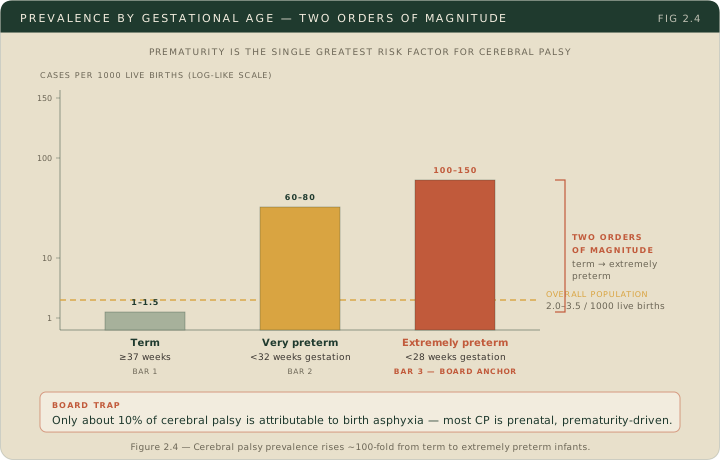
The single most important epidemiologic gradient is the relationship between prematurity and cerebral palsy prevalence. In term infants the prevalence is approximately 1 to 1.5 per 1000. In very preterm infants (under 32 weeks gestation) prevalence rises to 60 to 80 per 1000. In extremely preterm infants (under 28 weeks gestation) prevalence reaches 100 to 150 per 1000. The gradient spans two orders of magnitude. A neonatal intensive care unit graduate born at 25 weeks carries roughly a one-in-ten lifetime probability of cerebral palsy; a typical term infant carries roughly a one-in-a-thousand probability.
 ::: {.callout-important}
## High Yield — Definition and epidemiology
::: {.callout-important}
## High Yield — Definition and epidemiology
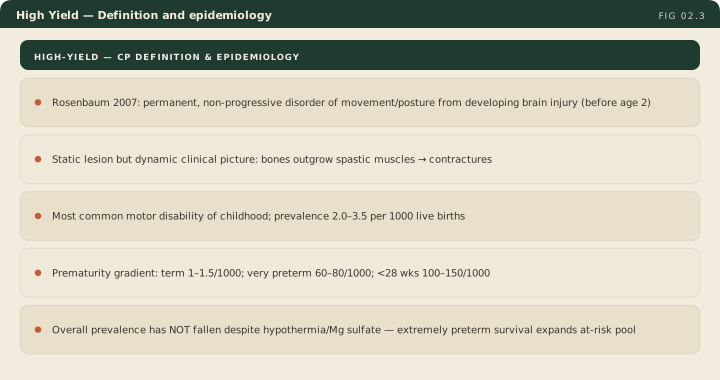
- Rosenbaum 2007: permanent disorders of movement and posture, non-progressive disturbance, developing fetal or infant brain.
- Three definitional words: permanent, non-progressive, developing brain (consensus wording: developing fetal or infant brain; age 2 is the common teaching convention).
- Static lesion, dynamic clinical picture — bones grow faster than spastic muscles → contractures.
- Most common motor disability of childhood; prevalence 2.0 to 3.5 per 1000 live births.
- Prematurity gradient: term 1 to 1.5 per 1000; very preterm 60 to 80 per 1000; extremely preterm under 28 weeks 100 to 150 per 1000.
- Overall prevalence held near 2 to 3 per 1000 for decades; high-income registries now show a decline in pre- and perinatal cerebral palsy in most European and Australian regions (high-income prevalence about 1.6 per 1000). :::
Mnemonic — “Permanent, Non-progressive, Pre-2” for the Rosenbaum definition
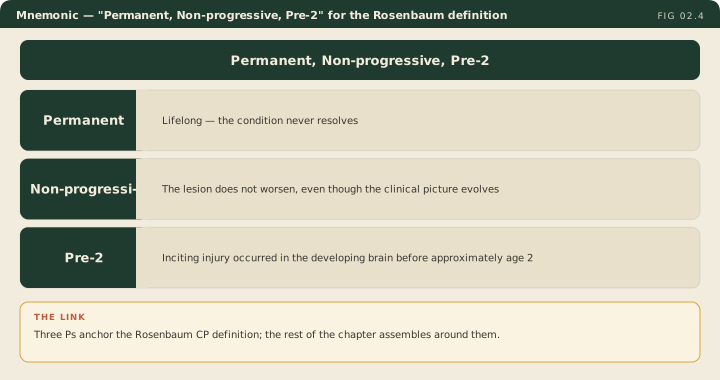
Three Ps capture the definition: Permanent (lifelong, never resolves), Non-progressive (the lesion does not worsen, even though the clinical picture evolves), and Pre-2 (the inciting injury occurred in the developing fetal or infant brain; age 2 is the common teaching convention). Memorize the three Ps and the rest of the chapter assembles around them.
Think of it like a young rapidly growing tree that has been tied down by a thick unyielding bungee cord. The tree wants to grow upward and outward, driven by its natural biology. The bungee cord isn’t getting shorter, it is static, but because the tree is growing, the tension between the two becomes immense.
— PEDS-02 podcast, ~3:58