Before You Listen
Episode Setup
- Topic in one line: Part 2 of cerebral palsy covers the clinical phenotype distinctions that drive therapy (spastic versus dyskinetic versus ataxic; the velocity-dependent versus velocity-independent tone distinction; Modified Ashworth versus Tardieu), the seven-step spasticity management ladder from removal of noxious stimuli and rehabilitation through oral antispasticity drugs, chemodenervation, intrathecal baclofen, and surgery (single-event multilevel orthopedic surgery and selective dorsal rhizotomy), and the gait and hip-surveillance framework (Winters-Gage hemiplegic types I-IV, Rodda diplegic phenotypes, Reimers migration percentage) that prevents painful hip dislocation.
- Prerequisites: Part 1 (definition, etiology, Novak 2017 early detection battery, GMFCS-MACS-CFCS-EDACS five-level classifications) and the upper motor neuron syndrome (positive and negative signs) from PEDS-01.
- Runtime: 45 minutes.
Vignette. A 4-year-old former 26-week preterm boy presents to clinic. His mother reports that he walks with crouched posture, scissors his legs, and falls frequently. He uses a posterior walker indoors and a manual wheelchair for community distances. On exam, lower extremity tone is increased with bilateral ankle clonus and bilateral upgoing toes. Hip abduction is limited to 30 degrees on the right and 35 degrees on the left. The Modified Ashworth Scale score is 3 in bilateral hamstrings and gastrocnemius. Speech is dysarthric but understandable to family. He uses both hands for eating with awkward grasp. A pelvis radiograph at the most recent surveillance visit showed right hip migration percentage of 38 percent and left of 22 percent.
What is his most likely cerebral palsy subtype, what GMFCS level fits, what does the migration percentage signify, what spasticity management options are appropriate now, and what hip surveillance step is required?
(Answer at the end of this chapter)
Section 3: Motor Phenotypes, Spasticity vs Dystonia, and Associated Conditions
Bottom line: spastic cerebral palsy accounts for 80 to 85 percent of cases and is subtyped topographically as hemiplegia (about 30 percent, term focal infarct), diplegia (about 35 percent, preterm periventricular leukomalacia), or quadriplegia (15 to 20 percent, severe term hypoxic-ischemic encephalopathy); dyskinetic (10 to 15 percent) and ataxic (5 to 6 percent) round out the phenotypes; spasticity is velocity-dependent stretch reflex hyperactivity, dystonia is sustained involuntary contractions, and the Tardieu Scale separates them better than the Modified Ashworth Scale because it isolates the dynamic catch (R1) from the passive range of motion (R2); cerebral palsy is not just a motor disorder, with chronic pain (50-75 percent), intellectual disability (~50 percent), epilepsy (25-45 percent), feeding difficulties (40-90 percent), and hip displacement (~35 percent overall, up to 90 percent in GMFCS V) the dominant comorbidities.
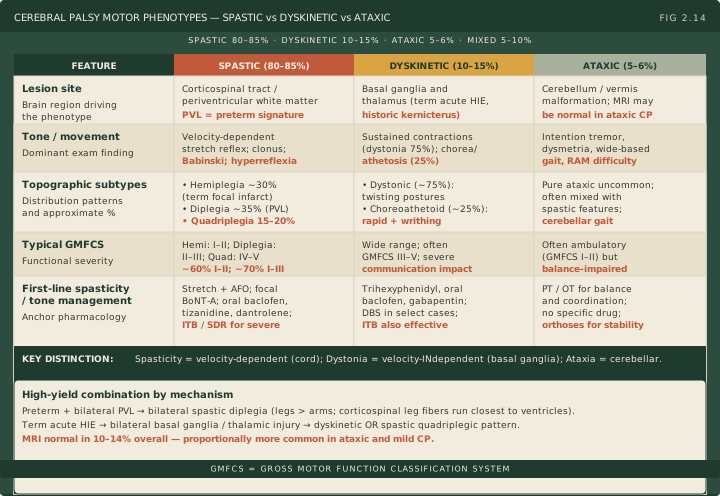
Motor phenotype distribution. Spastic cerebral palsy accounts for 80 to 85 percent of cases, dyskinetic for 10 to 15 percent, ataxic for 5 to 6 percent, and mixed forms for 5 to 10 percent. Each phenotype maps onto a different neuroanatomic lesion, which means the imaging pattern, the topographic distribution of motor deficit, and the first-line tone strategy all track together.
Spastic cerebral palsy is the clinical expression of the upper motor neuron syndrome. The lesion is anywhere along the corticospinal tract, and the resulting clinical picture has two halves. The positive UMN signs are what the brain injury adds: spasticity, hyperreflexia, clonus, and the extensor plantar response (also called the Babinski sign). The negative UMN signs are what the injury takes away: muscle weakness, loss of selective motor control, and rapid fatigability. The negative signs are often more functionally limiting than the positive signs, which is why aggressive eradication of spasticity in a child whose extensor tone is the only thing holding them upright during a standing-pivot transfer can be a disaster.
Spastic cerebral palsy is subtyped topographically. Unilateral / hemiplegic cerebral palsy accounts for about 30 percent of cases; one side of the body is affected, the arm is typically more involved than the leg, and the underlying lesion is most often a focal infarct in the middle cerebral artery territory (or a unilateral periventricular pattern) sustained around term. Bilateral diplegic cerebral palsy accounts for about 35 percent; both legs are affected significantly more than the arms, and the lesion is the bilateral preterm periventricular leukomalacia pattern described in Part 1. Bilateral quadriplegic cerebral palsy accounts for 15 to 20 percent; all four limbs, the trunk, and the oromotor apparatus are involved, the underlying lesion is severe term hypoxic-ischemic injury with deep gray matter damage, and most children fall into GMFCS IV or V. Monoplegia (usually a mild hemiplegia) and triplegia are the less common patterns.
Dyskinetic cerebral palsy is the clinical signature of basal ganglia and thalamic injury, historically from term acute asphyxia and from kernicterus when bilirubin crossed the blood-brain barrier and stained the deep gray matter. The dyskinetic phenotype is itself subdivided. Dystonic dyskinetic cerebral palsy (about 75 percent of dyskinetic cases) features sustained involuntary contractions that lock joints into twisting, abnormal postures, often triggered or worsened by intentional movement and emotional stress. Choreoathetoid dyskinetic cerebral palsy (about 25 percent) features chorea (rapid, irregular, dance-like movements) and athetosis (slow, continuous writhing), often most pronounced in the distal limbs.
Ataxic cerebral palsy is the rarest phenotype at 5 to 6 percent. The clinical picture is cerebellar: intention tremor, dysmetria on finger-to-nose and heel-to-shin, a wide-based unsteady gait, and impaired rapid alternating movements. The imaging pearl is that a normal MRI is more common in ataxic cerebral palsy than in any other subtype, and a normal MRI in this presentation should prompt genetic and metabolic workup.
Basal ganglia / thalamic injury in term HIE — radiographic reference (open-source image pending)
T2-weighted brain MRI in term hypoxic-ischemic encephalopathy shows bilateral hyperintensity in the putamen and ventrolateral thalamus, the classic radiographic signature of dyskinetic cerebral palsy. Contrast with the periventricular white-matter pattern of preterm PVL described in Part 1: PVL is periventricular (legs > arms phenotype), basal ganglia injury is deep gray (dyskinetic / quadriplegic phenotype). Search Radiopaedia or PMC for open-license T2 MRI of “neonatal HIE basal ganglia” for board-review use.
Spasticity versus dystonia is the single most important diagnostic distinction in cerebral palsy because therapy diverges sharply at that fork. Spasticity is velocity-dependent: fast passive stretch of the muscle produces forceful resistance, while slow stretch produces little or none. The mechanism is the spinal monosynaptic stretch reflex arc operating without normal descending inhibition from corticospinal and reticulospinal tracts. Dystonia is velocity-independent: the contraction is sustained or intermittent regardless of stretch speed and produces twisting, abnormal posturing driven by basal ganglia dysfunction. Rigidity is also velocity-independent but feels uniformly thick (a lead-pipe quality) at all speeds. Many children with cerebral palsy have mixed hypertonia, which means therapy must be matched to the dominant component.
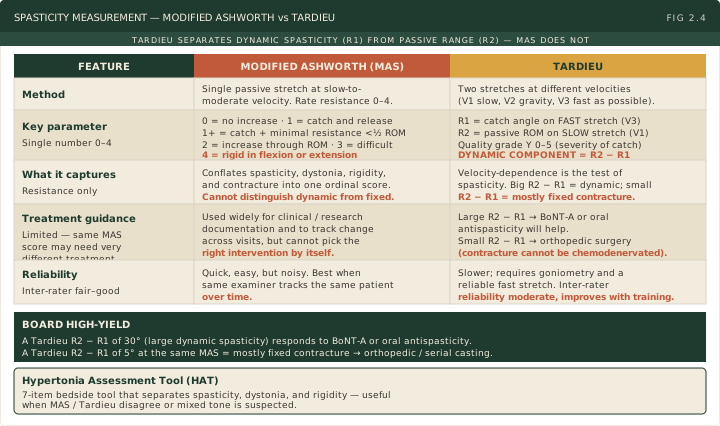
The Modified Ashworth Scale (MAS) quantifies resistance to passive stretch on a 6-point ordinal scale (0, 1, 1+, 2, 3, 4). It is fast, widely used, and deeply flawed for cerebral palsy because it cannot tell you why the joint feels stiff. A 3 on the MAS could be hyperactive stretch reflex, dystonic co-contraction, rigidity, or a fixed muscle-tendon contracture, and the treatment for each is different. The Tardieu Scale solves this by measuring the same joint at two distinct velocities. R1 is the angle at which the muscle first “catches” during fast passive stretch (the reflex threshold). R2 is the passive range of motion at slow stretch (the true tissue length). The dynamic spastic window is R2 minus R1. A large R2-R1 means the muscle tissue itself is long but the reflex is firing too early; chemodenervation will restore the range. A small or zero R2-R1 means the muscle fibers have physically shortened into a fixed contracture, and botulinum toxin will do little; the child needs serial casting or surgical lengthening. The Hypertonia Assessment Tool (HAT) further differentiates spasticity, rigidity, and dystonia at the bedside.
Associated conditions. Cerebral palsy is a multisystem condition, and the comorbidities are frequently more functionally limiting than the motor impairment itself. Sensorineural hearing loss is characteristic, especially in dyskinetic cerebral palsy after kernicterus. Chronic pain affects 50 to 75 percent of patients, is consistently underrecognized, and worsens with age as musculoskeletal deformity progresses; a formal pain assessment belongs in every clinic visit. Intellectual disability is present in approximately 50 percent overall (range 30 to 65 percent), concentrated in quadriplegic and severe forms. Speech and language disorders affect 40 to 60 percent; dysarthria and language delay are common but cognition is often preserved. Feeding and swallowing difficulties affect 40 to 90 percent and rise sharply at GMFCS IV-V, with silent aspiration and recurrent pneumonia the dominant risks; gastrostomy tube placement becomes appropriate when oral intake is unsafe. Epilepsy affects 25 to 45 percent and is most common in hemiplegic and quadriplegic phenotypes. Visual impairment affects 20 to 40 percent, with cortical visual impairment (intact eye, impaired central processing) the most common subtype. Hip displacement affects approximately 35 percent of children with cerebral palsy overall and up to 90 percent of those at GMFCS V. Gastroesophageal reflux affects 50 to 70 percent, constipation 50 to 75 percent, and scoliosis 25 to 50 percent overall, rising to 60 to 70 percent in non-ambulatory children.
Bone health deserves special emphasis. Up to 77 percent of children with moderate-to-severe cerebral palsy have low bone density, driven by reduced weight-bearing, poor baseline nutrition, and bone-depleting anti-epileptic drugs (valproic acid, phenytoin). Lifetime fragility-fracture prevalence is 9 to 16 percent, mostly in the lower limb, and femurs can fracture during routine caregiver transfers. Prevention combines mechanical loading (supportive standing programs for non-ambulatory children), routine calcium and vitamin D supplementation, and bisphosphonates for children with prior fragility fractures or established osteoporosis.
Drooling (sialorrhea) affects 20 to 40 percent of children with cerebral palsy. The mechanism is impaired oral motor coordination of saliva, not hypersalivation. The salivary glands are not overproducing. First-line oral pharmacotherapy is glycopyrrolate, preferred over scopolamine and atropine because it is a quaternary ammonium compound that crosses the blood-brain barrier poorly and therefore causes fewer central nervous system side effects. Peripheral anticholinergic effects (dry mouth, constipation, urinary retention) still require monitoring. Second-line options are botulinum toxin injection into the parotid and submandibular glands and surgical duct ligation or rerouting.
High Yield — Phenotypes, tone, and comorbidities
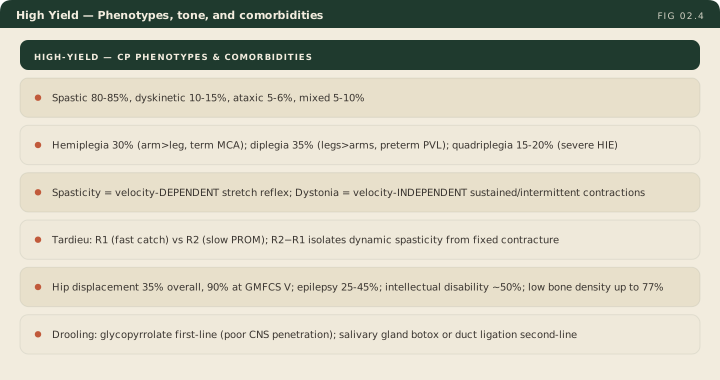
- Spastic 80-85% / dyskinetic 10-15% / ataxic 5-6% / mixed 5-10%.
- Hemiplegia 30% (term focal MCA infarct, arm > leg); diplegia 35% (preterm PVL, legs > arms); quadriplegia 15-20% (severe term HIE, all four limbs + trunk + oromotor; usually GMFCS IV-V).
- Positive UMN signs (spasticity, hyperreflexia, clonus, Babinski) versus negative UMN signs (weakness, loss of selective control, fatigability).
- Spasticity = velocity-dependent stretch reflex (spinal cord, descending tract loss).
- Dystonia = velocity-independent sustained/intermittent contractions (basal ganglia).
- Tardieu Scale: R1 (fast catch) and R2 (slow PROM); R2-R1 isolates dynamic spasticity from fixed contracture.
- Comorbidities: chronic pain 50-75%; intellectual disability ~50%; epilepsy 25-45%; feeding difficulty 40-90%; hip displacement 35% overall (90% at GMFCS V); GERD 50-70%; scoliosis 25-50%; low bone density up to 77% in moderate-severe CP; sensorineural hearing loss characteristic of dyskinetic CP after kernicterus.
- Drooling: glycopyrrolate first-line (poor CNS penetration); salivary gland botulinum toxin or duct ligation second-line.
The gap between those two numbers, R2 minus R1, is your window of therapeutic opportunity.
— PEDS-02 podcast, ~14:27
I always say a former extremely preterm child whose legs barely function, but whose hands can manipulate a feeding utensil, is a literal walking map of which corticospinal fibers set closest to the ventricle.
— PEDS-02 podcast, ~6:46
If you aggressively strip away all of that extensor tone without a very clear, deliberate, functional plan for what comes next, it’s exactly like taking out a load-bearing wall.
— PEDS-02 podcast, ~4:04