Before You Listen
Episode Setup
- Topic in one line: the leading cause of death and disability in children, with a bimodal age curve (falls in toddlers, motor vehicle collisions and sports in adolescents), the pediatric Glasgow Coma Scale modifications for preverbal infants, the PECARN clinical decision rules that decide who gets a head computed tomography (CT), abusive head trauma’s classic triad, the Amsterdam 2022 concussion consensus that retired prolonged rest, second impact syndrome, post-traumatic epilepsy, neuroendocrine dysfunction, and the unique pediatric phenomenon of “growing into deficits.”
- Prerequisites: standard adult Glasgow Coma Scale (covered in TBI-01), Monro-Kellie doctrine and intracranial pressure (ICP) physiology, primary versus secondary brain injury distinction, and the Wallerian degeneration timeline that shapes diffuse axonal injury imaging.
- Runtime: 48 minutes.
Vignette. An 11-month-old boy is brought to the emergency department after his mother reports “he rolled off the couch.” On arrival he is somnolent and lethargic with a Glasgow Coma Scale of 11 (eyes open to voice, irritable cry that is consolable, withdraws to pain). Head circumference is at the 90th percentile and the anterior fontanelle is bulging. Skin examination shows bruising over the left flank and a fingertip-pattern bruise over the chest. Skeletal survey reveals a metaphyseal corner fracture of the distal tibia and a posterior rib fracture. Non-contrast head CT shows bilateral subdural hematomas of differing densities and diffuse cerebral swelling. Funduscopic examination demonstrates multilayered retinal hemorrhages extending to the periphery in both eyes.
What is the diagnosis, what classic triad does this patient demonstrate, what is the mandatory reporting obligation, and what neuroimaging modality should be added within 24 to 72 hours?
(Answer at the end of this chapter)
Section 1: Epidemiology, Mechanism, and Pediatric Glasgow Coma Scale
Bottom line: traumatic brain injury (TBI) is the leading cause of death and acquired disability in children younger than 14 years; the bimodal incidence curve peaks in toddlers (falls, abusive head trauma) and adolescents (motor vehicle collisions, sports, assault); severity distribution is approximately 80 percent mild concussion, 10 percent moderate, 10 percent severe; the Glasgow Coma Scale ranges 3-15 with verbal and motor subscales modified for preverbal children; severity classification is mild 13-15, moderate 9-12, severe 3-8.
Traumatic brain injury is the leading cause of death and acquired disability among children and adolescents in developed nations. The Centers for Disease Control and Prevention (CDC) estimates approximately 475,000 TBIs per year in children younger than 14 years (emergency department visits, hospitalizations and deaths combined), including approximately 35,000 hospitalizations and 2,200 deaths annually. Overall pediatric TBI mortality is approximately 2 to 5 per 100,000 children, with mortality from severe TBI approaching 15 to 25 percent.
The age curve is bimodal: incidence peaks in infants and toddlers (birth to 4 years) and again in adolescence (15-19 years). Males sustain TBI at 1.5 to 2 times the rate of females across all ages. Mechanism varies by age:
| Age Group | Primary Mechanisms |
|---|---|
| Infants (<1 year) | Falls; abusive head trauma (a major cause of severe TBI in this age) |
| Toddlers/preschool (1-4 years) | Falls (most common mechanism overall) |
| School age (5-14 years) | Falls, sports/recreation, bicycle injuries, motor vehicle collisions |
| Adolescents (15-19 years) | Motor vehicle collisions (driver/passenger), sports, assaults |
Sport-related concussion accounts for an estimated 1.1 to 1.9 million injuries annually in individuals younger than 18 years. The severity distribution of pediatric TBI is approximately 80 percent mild (concussion), 10 percent moderate, and 10 percent severe.
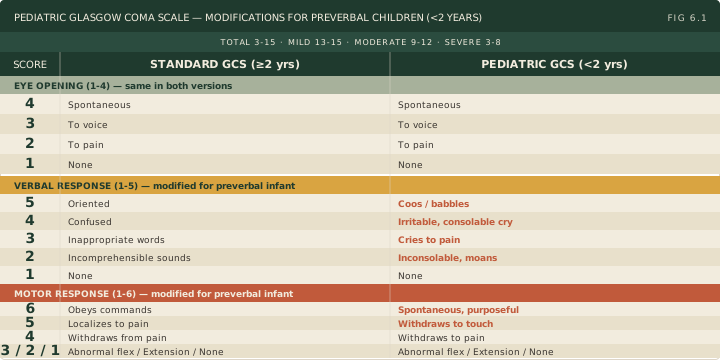
The Glasgow Coma Scale (GCS) quantifies consciousness across three domains and yields a composite score from 3 (worst) to 15 (best). The standard scale (children 2 years and older and adults) uses eye opening 1-4, verbal response 1-5, and motor response 1-6. Because infants and young toddlers cannot produce oriented speech, the pediatric modification for preverbal children replaces the verbal and motor subscales with developmentally appropriate responses.
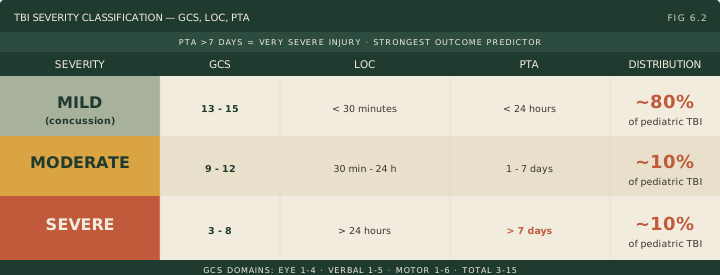
TBI severity classification integrates GCS, loss of consciousness (LOC), and post-traumatic amnesia (PTA):
| Severity | GCS | LOC | PTA |
|---|---|---|---|
| Mild (concussion) | 13-15 | <30 minutes | <24 hours |
| Moderate | 9-12 | 30 minutes to 24 hours | 1-7 days |
| Severe | 3-8 | >24 hours | >7 days |
PTA duration is among the strongest single predictors of long-term outcome. PTA longer than 7 days indicates very severe injury and signals poorer neurocognitive recovery.
High Yield — Epidemiology and severity
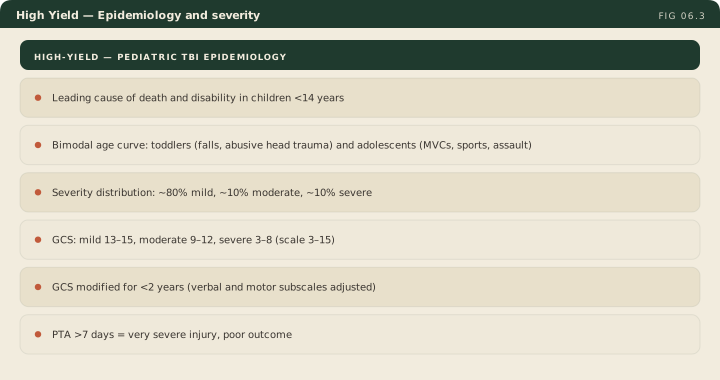
- Leading cause of death and disability in children <14 years.
- Bimodal age curve: toddlers (falls, abusive head trauma) and adolescents (motor vehicle collisions, sports, assault).
- Severity distribution: ~80% mild, ~10% moderate, ~10% severe.
- GCS: 3 (worst) to 15 (best). Standard scale ≥2 years; pediatric modification <2 years (modifies verbal and motor subscales).
- Severity: mild 13-15, moderate 9-12, severe 3-8.
- PTA >7 days = very severe injury, poor outcome.