Before You Listen
Episode Setup
- Topic in one line: the pediatric spinal cord and column, where a large head, ligamentous laxity, and a high cervical fulcrum at C2-C3 produce upper cervical injuries and the uniquely pediatric entity of spinal cord injury without radiographic abnormality (SCIWORA), the atlantoaxial instability (AAI) of Down syndrome and Morquio syndrome that mandates Special Olympics screening, and the lifelong rehabilitation arc of neurogenic bladder and bowel, autonomic dysreflexia, paralytic neuromuscular scoliosis (~100% in injuries before age 10), heterotopic ossification, and transition to adult care.
- Prerequisites: ASIA International Standards for Neurological Classification of Spinal Cord Injury (ISNCSCI) and complete-versus-incomplete cord syndromes (covered in SCI-01), upper motor neuron versus lower motor neuron physiology, and the Wallerian degeneration timeline.
- Runtime: 43 minutes.
Vignette. A 6-year-old girl is brought to the emergency department after a motor vehicle collision in which she was restrained only by a lap belt. She is unable to move her legs. On examination, she has flaccid lower extremity weakness with absent reflexes and a sensory level at T10. Plain radiographs and computed tomography (CT) of the cervical, thoracic, and lumbar spine show no fracture, dislocation, or ligamentous instability. Vital signs include heart rate 58, blood pressure 78/40 mmHg, and warm dry extremities. Six hours later, she becomes more alert and reports brief return of bilateral leg paresthesias before they fade again. Magnetic resonance imaging (MRI) shows mid-thoracic cord edema without intramedullary hemorrhage.
What is the diagnosis, what Pang MRI pattern does this represent, what is the prognosis, what management is required including duration of immobilization, and what unique pediatric injury phenomenon must the team monitor for over the next 48 hours?
(Answer at the end of this chapter)
Section 1: Pediatric Spine Anatomy and Age-Specific Injury Patterns
Bottom line: pediatric spinal cord injury (SCI) is rare (3-5 percent of all SCI) with a bimodal age distribution; the pediatric spine has a large head, ligamentous laxity, horizontal facets, underdeveloped uncinate processes, and a cervical fulcrum at C2-C3 (vs C5-C6 in adults), so injuries before age 8 are upper cervical (C1-C4), while injuries 8 years and older follow adult lower cervical (C5-C7) patterns; the spinal column can stretch ~5 cm but the cord tolerates only ~6 mm — the structural foundation of SCIWORA.
Pediatric SCI is uncommon, comprising approximately 3-5 percent of all spinal cord injuries. In the United States, an estimated 1,200 to 1,400 new pediatric SCIs occur annually. The age distribution is bimodal, with peaks at 0-4 years and again at 15-18 years. Males predominate overall (60-70 percent) and especially in adolescents (>80 percent). In-hospital mortality is approximately 10-15 percent and is higher in very young children and in complete injuries.
Mechanisms vary by age. Children younger than 8 years sustain SCI primarily from motor vehicle collisions (passenger or pedestrian), falls, and non-accidental trauma (an important and sometimes overlooked cause in infants). Children 8-14 years sustain motor vehicle collisions, sports (diving, football, gymnastics, trampoline), and bicycle accidents. Adolescents 15-18 years sustain motor vehicle collisions (driver), sports, violence (gunshot wounds), and diving. Birth-related cervical cord injuries are rare and arise from difficult deliveries (forceps, breech). That birth-trauma category is worth contrasting with the injury it gets confused with, because board writers love to see if you’ll mix them up: traction on the head and shoulder during a difficult delivery produces Erb-Duchenne palsy, the most common brachial plexus birth injury, with the classic waiter’s tip posture and the hand grip itself preserved — a peripheral nerve stretch at the plexus level, not a cord injury at all.
The pediatric spinal column is anatomically distinct from the adult spine in several ways that matter for injury mechanics and imaging:
| Feature | Pediatric Characteristic | Clinical Implication |
|---|---|---|
| Head-to-body ratio | Head ~25% of body weight at birth (~6% in adults) | Higher fulcrum point; greater leverage on upper cervical spine |
| Ligamentous laxity | Greater elasticity of spinal ligaments | Allows column displacement without fracture; predisposes to SCIWORA |
| Facet joint orientation | More horizontal, especially C1-C3 | Permits greater translational sliding |
| Uncinate processes | Underdeveloped | Less bony restraint on lateral flexion |
| Vertebral body shape | Anterior wedging | Promotes forward sliding |
| Paraspinal musculature | Immature | Less muscular stabilization |
| Ossification centers | Multiple, incompletely fused | Can mimic fractures on imaging |
The fulcrum of cervical motion in young children is at C2-C3, in contrast to C5-C6 in adults. This higher fulcrum, combined with the disproportionately large head, explains the marked predilection for upper cervical (C1-C4) injuries in children younger than 8 years. The transition to adult biomechanics occurs at approximately 8-10 years of age as head-body proportions normalize, facets become more vertical, ossification progresses, and paraspinal muscles strengthen.
The most testable single fact in this chapter is the column-versus-cord stretch tolerance: the pediatric spinal column can stretch up to 5 centimeters (2 inches) without structural disruption, while the spinal cord can tolerate only approximately 6 millimeters (0.25 inches) of distraction before sustaining injury. This discrepancy is the structural foundation of SCIWORA.
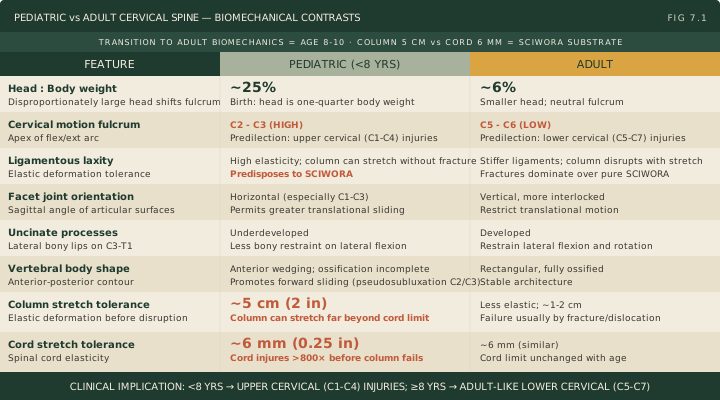
High Yield — Pediatric spine anatomy
- Pediatric SCI = ~3-5% of all SCI; bimodal (0-4 and 15-18 years).
- Head ~25% body weight at birth (~6% in adults) — biomechanical fulcrum higher.
- Cervical fulcrum: C2-C3 in children vs C5-C6 in adults.
- Transition to adult biomechanics: age 8-10 years.
- <8 years: upper cervical (C1-C4) predominate.
- ≥8 years: lower cervical (C5-C7), adult-like.
- Column stretch tolerance: ~5 cm; cord stretch tolerance: ~6 mm.
The uncinate processes, which are those little bony hooks on the lateral edges of the vertebral bodies that normally restrain lateral side bending, are severely underdeveloped in kids.
— PEDS-07 podcast, ~7:40