Before You Listen
Episode Setup
- Topic in one line: the high-yield chromosomal aneuploidies (Down, Edwards, Patau, Turner, Klinefelter), the imprinting paradigm of Prader-Willi and Angelman at 15q11-q13, the X-linked dominant Rett syndrome, the elastin-deletion Williams syndrome at 7q11.23, the trinucleotide-repeat Fragile X (FMR1), the TORCH infections with periventricular versus diffuse calcifications, the VACTERL association, fetal alcohol spectrum disorders, and the genetic testing hierarchy (chromosomal microarray replaced karyotype as first tier in 2010; exome or genome sequencing is now first tier for global developmental delay, with karyotype reserved for suspected aneuploidy or balanced rearrangements).
- Prerequisites: basic Mendelian inheritance (autosomal dominant, autosomal recessive, X-linked), the concept of chromosomal aneuploidy and translocation, and the developmental milestones framework (covered in PEDS-01).
- Runtime: 1 hour 12 minutes.
Vignette. A 4-year-old boy with global developmental delay is referred for evaluation. He has central hypotonia in infancy that improved with growth hormone (GH) therapy. Beginning around age 3 he developed insatiable hyperphagia, food-seeking behavior, and progressive obesity despite caloric restriction. His parents describe high pain threshold and temperature instability. Examination shows small hands and feet, almond-shaped eyes, downturned corners of the mouth, cryptorchidism, and skin picking. Cognitive testing is in the mild intellectual disability range. The geneticist has not yet performed confirmatory testing.
What is the diagnosis, what genetic mechanism is most likely, what is the gold-standard diagnostic test that detects more than 99 percent of cases regardless of mechanism, and what genetic principle distinguishes this condition from the syndrome at the same chromosomal locus that produces a “happy puppet” phenotype?
(Answer at the end of this chapter)
Section 1: Down Syndrome (Trisomy 21)
Bottom line: Down syndrome is the most common chromosomal cause of intellectual disability (1:700), with 95 percent from nondisjunction trisomy 21, 3-4 percent from Robertsonian translocation, and 1-2 percent mosaic; congenital heart disease in 40-50 percent (atrioventricular septal defect (AVSD) is the most common); the AAP 2022 health-supervision schedule mandates echocardiogram in all newborns, thyroid screening, hearing/vision evaluations, no routine screening cervical spine radiographs in asymptomatic children (clinical myelopathy screening at every visit, neutral films only if signs/symptoms develop), and a 10-20x increased overall risk of leukemia (myeloid leukemia roughly 150x before age 5).
Down syndrome is the most common chromosomal cause of intellectual disability, occurring in approximately 1 in 700 live births. Approximately 95 percent result from nondisjunction producing full trisomy 21, 3-4 percent involve Robertsonian translocation (most commonly between chromosomes 14 and 21), and 1-2 percent are mosaic. The risk increases with maternal age: approximately 1 in 1,500 at age 20, 1 in 350 at age 35, 1 in 100 at age 40, and 1 in 25 at age 45. Life expectancy has improved dramatically, from approximately 25 years in 1983 to approximately 60 years currently.
Cardinal features. Newborns demonstrate central hypotonia in nearly 100 percent, upslanting palpebral fissures, epicanthal folds, flat nasal bridge, small ears, protruding tongue, Brushfield spots (white speckles on the iris periphery, 21 percent with standard white light; 67 percent with near-infrared detection), single palmar crease (“simian crease,” approximately 45 percent), sandal gap (wide space between first and second toes), and intellectual disability with average IQ 40-55 (moderate range; DSM-5 emphasizes adaptive functioning over IQ scores).
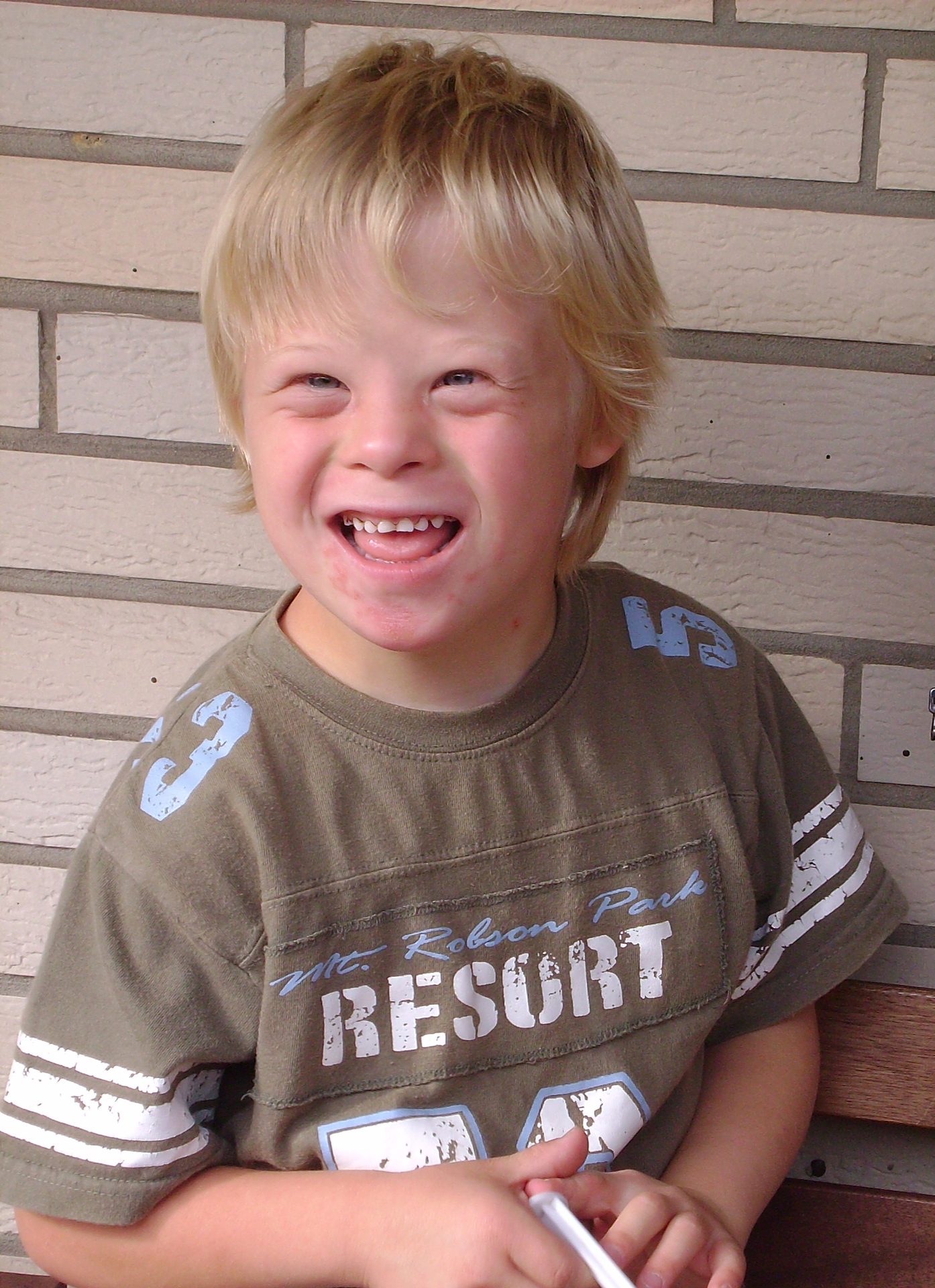
Source: Vanellus Foto, “Boy with Down Syndrome”, via Wikimedia Commons, CC BY-SA 3.0 / GFDL. https://commons.wikimedia.org/wiki/File:Boy_with_Down_Syndrome.JPG
Cardiac disease affects 40-50 percent. The distribution among Down syndrome with congenital heart disease is AVSD 40-45 percent (most common — the classic board association), ventricular septal defect (VSD) ~35 percent, atrial septal defect (ASD) ~8 percent, patent ductus arteriosus (PDA) ~7 percent, and tetralogy of Fallot ~4 percent. Echocardiography is recommended in all newborns regardless of murmur.
AAP 2022 health supervision schedule:
| Screening | Schedule |
|---|---|
| Cardiac | Echocardiogram in all newborns |
| Thyroid | Confirm the newborn thyroid screen result (add a thyroid stimulating hormone (TSH) if the state screen measures only T4), then TSH at 6 and 12 months, then annually |
| Hearing | Auditory brainstem response (ABR) at birth or by 1 month; audiology every 6 months until bilateral ear-specific normal hearing is established (usually after age 4), then annually |
| Vision | Ophthalmologic evaluation by 6 months, then annually from 1 to 5 years, then every 2 years from 5 to 12 years (photoscreening at visits or specialist examination); refractive errors in 50-70% |
| Cervical spine | No routine screening radiographs in asymptomatic children (2022 AAP); myelopathy history/exam at every visit, neutral films only if signs/symptoms |
| Hematology | Complete blood count (CBC) at birth (polycythemia, transient myeloproliferative disorder ~10%) |
| Celiac | Symptom review at every visit; tissue transglutaminase IgA with total IgA when symptoms appear |
| Sleep | Polysomnography by age 4 (obstructive sleep apnea (OSA) in 50-75%) |
| Growth | Down-syndrome-specific growth charts |
| Mental health | Screening in adolescents and adults (2022 emphasis) |
Associated medical conditions include hearing loss 75 percent (conductive, sensorineural, or mixed), OSA 50-75 percent, hypothyroidism 15-20 percent, radiographic atlantoaxial instability 10-30 percent (symptomatic 1-2 percent), leukemia risk 10-20x increased overall (acute lymphoblastic leukemia (ALL) and acute megakaryoblastic leukemia (AMKL)), with myeloid leukemia roughly 150x more likely before age 5, transient myeloproliferative disorder ~10 percent in neonates, celiac disease 5-16 percent, duodenal atresia ~5 percent (and 30 percent of all duodenal atresia has Down syndrome — the “double bubble sign” on abdominal radiograph), Hirschsprung disease in about 2.6 percent of children with Down syndrome in a meta-analysis (the AAP schedule lists it as under 1 percent), and Alzheimer disease in 50-70 percent by age 60.
Clinical Pearl — AAI in Down syndrome
Radiographic atlantoaxial instability occurs in 10-30 percent of individuals with Down syndrome, but symptomatic cord compression occurs in only 1-2 percent. The 2022 American Academy of Pediatrics guideline recommends against routine radiographic screening in asymptomatic children — a change from older (2001) guidance — instead advising a myelopathy history and neurologic exam at every well visit, with neutral-position cervical films obtained only if neurologic signs or symptoms develop. Special Olympics general rules require a symptom screen for every athlete with Down syndrome; an athlete with symptoms or signs of atlantoaxial instability needs a physician’s neurological evaluation and certification before neck-loading sports; the older rule keyed on screening cervical spine films. Clinical signs of myelopathy — neck pain, torticollis, gait deterioration, hyperreflexia, clonus, bowel/bladder change — drive management more than radiographic measurements alone. (Reviewed in detail in PEDS-07.)
High Yield — Down syndrome
- Most common chromosomal cause of intellectual disability (1:700).
- 95% nondisjunction trisomy 21; 3-4% translocation; 1-2% mosaic.
- AVSD = most common cardiac defect (40-45%).
- No routine cervical spine films in asymptomatic children (2022 AAP): clinical myelopathy screening at every visit, neutral films only if signs/symptoms; Special Olympics: symptom screen for every athlete, with physician neurological evaluation and certification of symptomatic athletes before neck-loading sports (older rule keyed on screening films).
- Leukemia risk 10-20x overall (ALL and AMKL); myeloid leukemia ~150x before age 5.
- 30% of all duodenal atresia has Down (“double bubble” sign).
- Alzheimer disease in 50-70% by age 60.
- AAP 2022: echo at birth, newborn thyroid screen then TSH at 6/12 months/annual, ABR at 1 month, ophtho by 6 months, polysomnography by age 4.
If a clinician shines a standard white light into the eye They only spot brush field spots in about 21% of patients with Down syndrome just 21% But if they switch their equipment to near infrared detection the detection rate explodes to 67%
— PEDS-08 podcast, ~7:14