Before You Listen
Episode Setup
- Topic in one line: the pediatric musculoskeletal disorders that earn their own ABPMR Part I vignettes — developmental dysplasia of the hip (DDH), Legg-Calvé-Perthes disease (LCPD), and slipped capital femoral epiphysis (SCFE) sorted by age window; the Salter-Harris (SH) physeal fracture grades; the apophysitis family; a small set of high-risk pediatric forearm and elbow injuries; adolescent idiopathic scoliosis (AIS) with Cobb-angle thresholds and the BrAIST bracing-dose trial; congenital and neuromuscular scoliosis; Scheuermann kyphosis; clubfoot and the Ponseti method; congenital muscular torticollis (CMT) with its mandatory DDH screen; osteogenesis imperfecta (OI) versus non-accidental trauma; the limping child by age window; and the pediatric bone tumors organized by intramedullary location.
- Prerequisites: general orthopedic vocabulary (varus, valgus, abduction, adduction, rotation), basic pediatric growth physiology (physis = growth plate; apophysis = secondary ossification center at a tendon insertion), and the limb examination framework from PEDS-01. Memorize them cold.
- Runtime: 1 hour 12 minutes.
Vignette. A 12-year-old boy with a body mass index in the 95th percentile reports four weeks of a dull ache in the left medial thigh and knee. He denies trauma. He walks with the left foot turned out. On examination, when the examiner attempts to flex the left hip, the leg drifts into obligatory external rotation. Internal rotation and abduction are limited and painful. Knee examination is unremarkable. Plain radiographs of the bilateral knees are normal.
What is the most likely diagnosis, what radiographic study and view will confirm it, what radiographic line is used to make the diagnosis, what is the appropriate next step in management, and what is one critical management pitfall the treating team must avoid?
(Answer at the end of this chapter)
Section 1: The Pediatric Hip — DDH, LCPD, and SCFE by Age Window
Bottom line: three hip disorders dominate pediatric orthopedic vignettes, each defined by an age window. Developmental dysplasia of the hip (DDH) sits in the newborn and infant. Legg-Calvé-Perthes disease (LCPD) appears in the 4 to 10 year old (peak 5 to 7, male predominance, Herring lateral pillar grade drives prognosis). Slipped capital femoral epiphysis (SCFE) shows up in the 10 to 16 year old (classically the obese adolescent boy with knee or thigh pain whose radiograph shows the femoral head slipping off the metaphysis like ice cream off a cone).
The pediatric hip yields a disproportionate share of board questions because the same chief complaint of limp or hip pain points at completely different pathology in three age windows. The first move on every stem is to pin down the patient’s age, then narrow the differential by sex, body habitus, and a single radiographic finding. A useful framing is that the same hip can fail in three mechanical ways depending on which structure is still maturing: the acetabulum in DDH, the vascular supply to the capital epiphysis in LCPD, and the proximal femoral physis in SCFE.
Developmental dysplasia of the hip (DDH) spans mild acetabular dysplasia to frank dislocation. It affects 1 to 2 per 1,000 live births for dislocation and 10 to 20 per 1,000 for instability or dysplasia overall. Girls are affected more often, taught as a female-to-male ratio of roughly 4:1 to 8:1; treat that as a teaching range rather than a measured constant, because pooled cohort data give an odds ratio near 7 while pooled ultrasound screening of infants under 3 months gives closer to 2.5, and the steeper ratios come from clinically detected instability and frank dislocation rather than from dysplasia overall. Boys are affected less often but have higher rates of harness failure and of avascular necrosis once treated. The left hip carries 60% of cases because the most common fetal position (left occiput anterior) presses the left hip against the maternal sacrum. Highest-priority risk factors are breech presentation, female sex, firstborn status, positive family history, oligohydramnios, and swaddling with the hips held extended and adducted; hip-safe swaddling — leaving the hips free to flex and spread — is the counseling point. The Barlow test (hip flexed 90 degrees, gentle adduction with a posterior force) dislocates a dislocatable hip; the Ortolani test (hip flexed 90 degrees, gentle abduction with an anterior lift) reduces a dislocated hip with a palpable clunk. The mnemonic is “Barlow is Bad” because it is provocative, and “Ortolani is OK” because it is reductive. The Galeazzi sign (unequal knee heights with both hips and knees flexed) points to unilateral dislocation. Asymmetric skin folds appear in roughly 25% of normal infants and are suggestive but not diagnostic.
Imaging follows a strict age rule. Ultrasound is preferred before 4 to 6 months because the femoral head is largely cartilaginous, and radiographs become useful only after the ossific nucleus appears. The Graf classification grades the alpha angle: Type I greater than 60 degrees (normal); Type IIa 50 to 59 degrees in an infant under 3 months (physiologic immaturity); Type IIb 50 to 59 degrees in an infant over 3 months (delayed ossification, treat); Type IIc 43 to 49 degrees (critical zone, significant dysplasia); Type III under 43 degrees (subluxated); Type IV (dislocated).
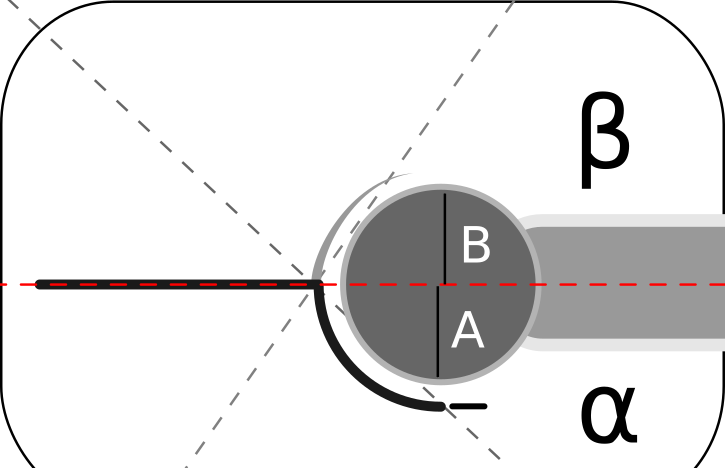
Source: Nevit Dilmen, “Hip dysplasia ultrasound”, via Wikimedia Commons, CC BY-SA 3.0. https://commons.wikimedia.org/wiki/File:Hip_dysplasia_ultrasound.svg
The Pavlik harness is first-line treatment before 6 months, holding the hips at about 90 to 110 degrees of flexion (roughly 100 degrees, set by the anterior straps) with abduction kept inside a comfortable safe zone of about 45 to 60 degrees, the posterior straps limiting adduction rather than forcing abduction; success rates run 85% to 95%. Forced abduction past that safe zone raises avascular necrosis (AVN) risk: wide abduction toward 90 degrees carried up to 15 percent AVN against up to 5 percent under a protocol capping flexion at 100 degrees and abduction at 45 degrees. Seventy degrees is not a target: a hip that stays reduced only in that much abduction is unsuitable for the harness and goes to operative reduction. The harness is contraindicated after 6 months, in teratologic dislocations, or after a 3- to 4-week trial fails. Closed reduction with hip spica casting follows Pavlik failure; open reduction is reserved for hips that will not concentrically reduce, typically presenting after 12 to 18 months. Untreated dislocation leads to progressive acetabular deformation, an abnormal gait, and premature osteoarthritis.
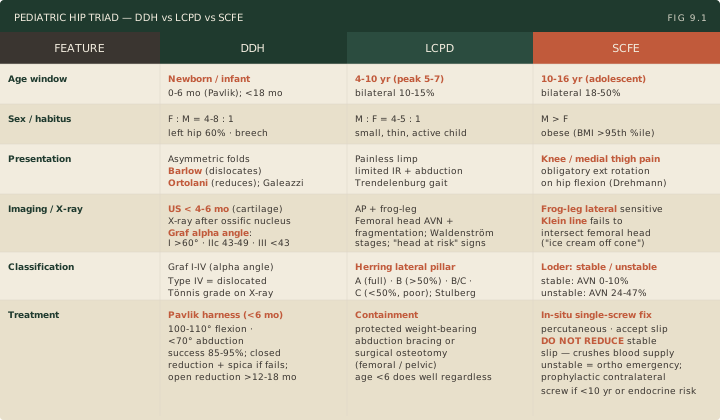
Legg-Calvé-Perthes disease (LCPD) is idiopathic osteonecrosis of the femoral head in children aged 4 to 10 years (peak 5 to 7). Incidence is roughly 1 in 1,200 children; the M:F ratio is 4:1 to 5:1; bilateral involvement runs 10% to 15% and is usually asynchronous. Bilateral synchronous disease should trigger an endocrine workup for hypothyroidism, growth hormone deficiency, or skeletal dysplasia, because true synchronous bilateral Perthes is rare and often points at a systemic cause. The Waldenström stages run from initial (necrosis, increased femoral head density, widened joint space), to fragmentation (mixed lytic and sclerotic), to reossification, to remodeling. The Herring lateral pillar classification, taken at the fragmentation stage, is the most powerful prognosticator: Group A (full height, good); Group B (>50%, intermediate); Group B/C (~50%, guarded); Group C (<50%, poor). The Stulberg classification scores the final femoral head shape at skeletal maturity, from I (spherical, good) to V (flat head with normal acetabulum, poor with early arthritis).
Age at onset is the single strongest prognostic factor: children younger than 6 do well regardless of Herring grade; children older than 8 with Group B or B/C disease do better with surgical containment via femoral or pelvic osteotomy than with nonoperative care, whereas Group C hips do poorly at every age regardless of treatment. “Head at risk” radiographic signs include the Gage sign (a V-shaped lucency on the lateral epiphysis), calcification lateral to the epiphysis, lateral subluxation, and a horizontal physis. Containment (abduction bracing or surgical osteotomy) lets the acetabulum mold the softened head into a spherical form during reossification. Initial management of the painful Perthes hip is rest, protected weight-bearing, range of motion, and NSAIDs as needed for symptom relief.
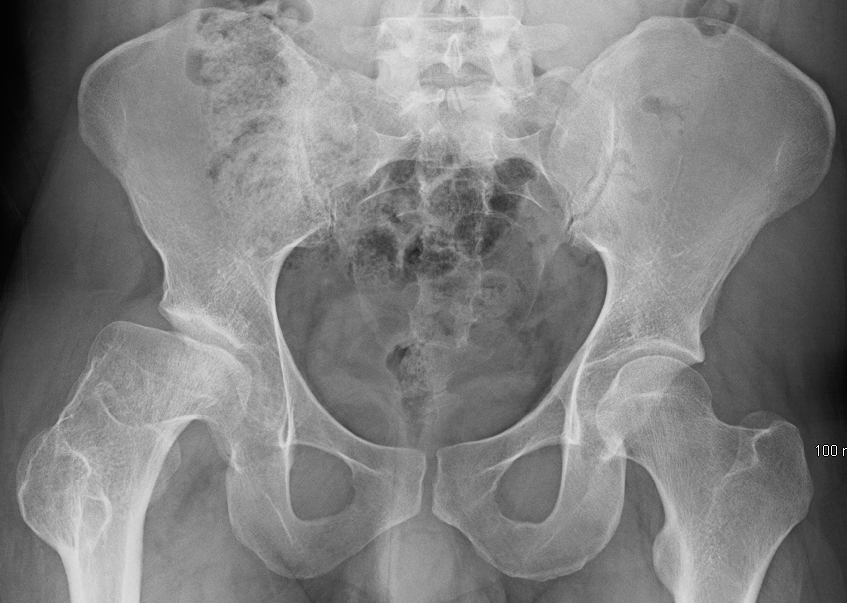
Source: James Heilman, MD, “LCPdisease2015”, via Wikimedia Commons, CC BY-SA 4.0. https://commons.wikimedia.org/wiki/File:LCPdisease2015.png
Slipped capital femoral epiphysis (SCFE) is the most common adolescent hip disorder, incidence 10.8 per 100,000 children, measured across 9- to 16-year-olds in the US Kids’ Inpatient Database (PMID 16670536). The classic patient is an overweight adolescent boy aged 10 to 16, and that window is itself the testable point rather than a rounding: 92 percent of idiopathic slips are diagnosed between 10 and 16, and in a 433-child series a patient who slips younger than 10 or older than 16 was 4.2 times more likely to have an atypical slip driven by renal failure, radiation therapy, or endocrinopathy (PMID 11433161, PMID 24977061). Mean age at diagnosis is about 12.0 years in boys and 11.2 years in girls (PMID 24977061), reproduced at 12.0 years across fifteen studies and 5,467 patients (PMID 40403127). So the band is not decoration; falling outside it is the trigger to hunt for an endocrine or renal cause. Additional risk factors include African American race, hypothyroidism, growth hormone therapy, and renal osteodystrophy. Bilateral involvement is 18% to 50% (PMID 24977061). The mechanism is failure of the hypertrophic zone of the physis under shear stress; the epiphysis displaces posteriorly and inferiorly while the metaphysis moves anteriorly and superiorly. Patients walk with an antalgic gait and externally rotated leg, complain of knee or medial thigh pain (the classic referral pattern that traps unwary clinicians), and demonstrate obligatory external rotation when the examiner flexes the hip (the Drehmann sign). Internal rotation and abduction are limited.
Any adolescent with knee or thigh pain deserves hip radiographs; the frog-leg lateral is the most sensitive view because mild posterior slips become obvious in flexion-abduction. The diagnostic finding is the Klein line, drawn along the superior femoral neck on the AP pelvis (its counterpart on the lateral view runs along the anterior neck), which fails to intersect the femoral head once the epiphysis slips — the classic appearance of a scoop of ice cream sliding backward off its cone. Grade the slip on two separate axes. Severity by displacement: grade I is under 33% of the epiphysis displaced relative to the neck, grade II is 33% to 50%, and grade III is over 50%, measured on the AP and frog-leg lateral views; the head-shaft-angle version of the same scale runs mild under 30 degrees, moderate 30 to 50 degrees, and severe over 50 degrees. Severity guides the surgical discussion, in situ pinning against realignment. Stability by weight bearing is the axis that predicts osteonecrosis, so it is the split to answer with when a question asks about prognosis. The Loder classification splits SCFE by stability: stable SCFE (can bear weight) carries an AVN risk of 0% to 10%; unstable SCFE (cannot bear weight) carries an AVN risk of 24% to 47%. Treatment for stable SCFE is in situ percutaneous single-screw fixation. Do not reduce the slip; forced reduction crushes the already tenuous retinacular blood supply along the femoral neck. Unstable SCFE is an orthopedic emergency requiring urgent operative stabilization. Bilateral prophylactic fixation is favored in patients younger than 10, those with endocrine risk factors, and those with bilateral abnormalities at presentation.
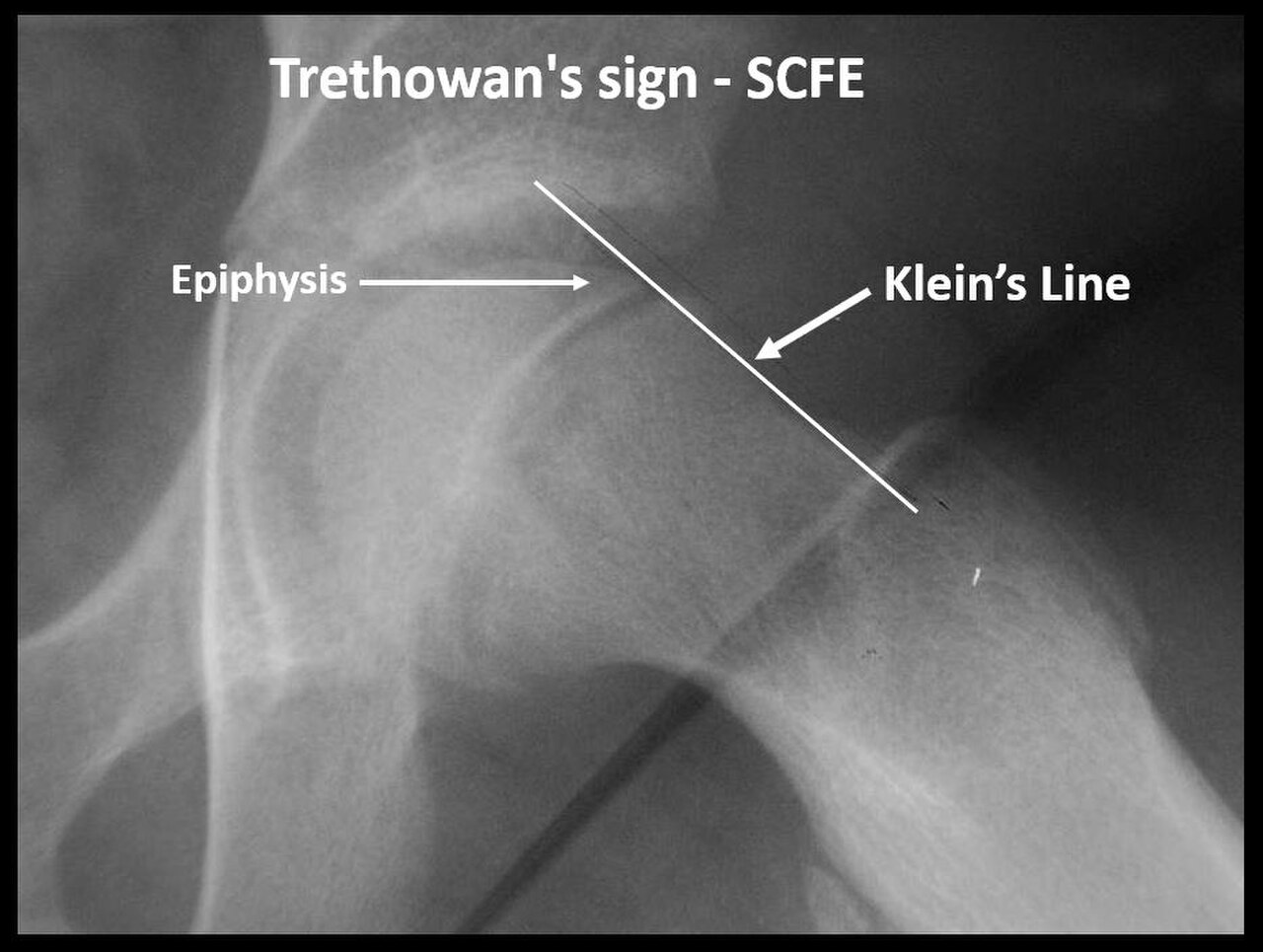
Source: Dr. Vijaya chandar, Wikimedia Commons, CC0 (Public Domain Dedication). https://commons.wikimedia.org/wiki/File:Trethowan%27s_sign_seen_in_SCFE.jpg
High Yield — The pediatric hip triad
- DDH = newborn/infant; F >> M; left hip 60%; Barlow dislocates, Ortolani reduces; ultrasound before 4-6 months, then radiographs; Pavlik harness before 6 months at 90-110 deg flexion (about 100, set by the anterior straps) with abduction inside a safe zone of about 45-60 deg; success 85-95%.
- Graf classification: Type I >60 deg (normal); IIc 43-49 deg (critical); III <43 deg (subluxated); IV (dislocated).
- LCPD = ages 4-10, peak 5-7; M:F 4-5:1; bilateral 10-15% (consider endocrine workup if synchronous); Herring lateral pillar A / B / B-C / C is the single most useful prognostic grade; age <6 does well regardless.
- SCFE = 10-16 yo, obese, M > F; knee or medial thigh pain with obligatory external rotation on hip flexion (Drehmann); Klein line, drawn along the superior femoral neck on the AP pelvis, fails to intersect the head (the frog-leg lateral is the more sensitive view for the slip itself); in situ single-screw fixation; do NOT reduce a stable slip.
- SCFE grading runs on two axes: severity by displacement (grade I <33%, II 33-50%, III >50%; head-shaft-angle version mild <30 deg, moderate 30-50 deg, severe >50 deg) guides pinning versus realignment, while stability by weight bearing is the axis that predicts AVN.
- Unstable SCFE = cannot bear weight = AVN 24-47% = orthopedic emergency.
Mnemonic — Hip pain by age window
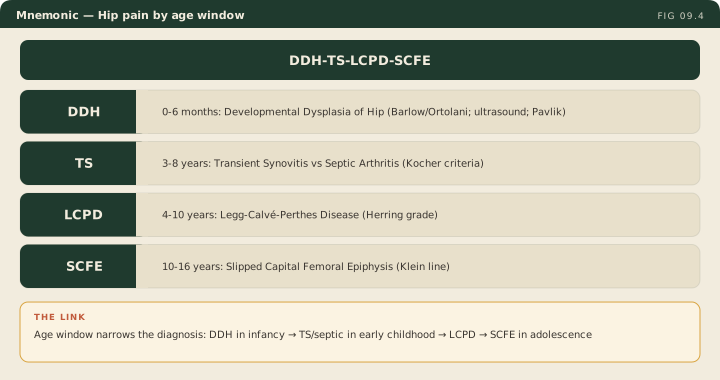
- 0-6 months: DDH (Barlow/Ortolani; ultrasound; Pavlik).
- 3-8 years: transient synovitis (post-viral, self-limited) vs septic arthritis (Kocher criteria; see PEDS-10). The published presentation is a mean age of 6 with a 3-to-8-year band (PMID 24229447, resting on the 275-child prospective cohort at PMID 3818754); the observed spread is wider at both ends, and the validated discriminating age variable in the 2024 diagnostic algorithm is 3 to 10 years (PMID 38366676). Do not narrow this to 3 to 6.
- 4-10 years: LCPD (Herring grade).
- 10-16 years: SCFE (Klein line).
Board Trap — “Just a knee sprain”
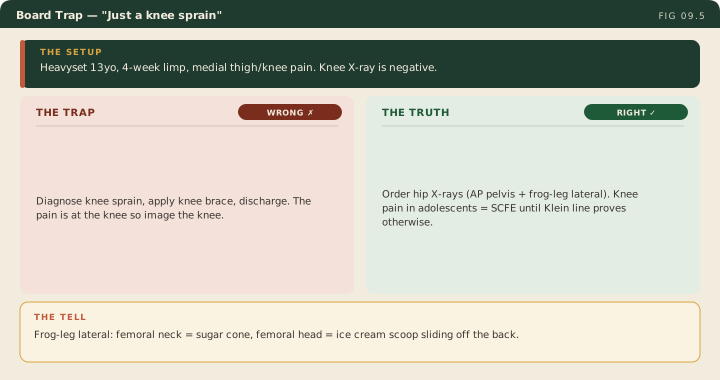
A heavyset 13-year-old presents with a four-week limp and medial thigh or knee pain. The trap is to image the knee, find nothing, and discharge with a knee brace. The correct move (in clinic and on the test) is dedicated hip radiographs (AP pelvis plus frog-leg lateral) every time. Knee pain in an adolescent is an SCFE until the Klein line proves otherwise.
This physically compresses the medial circumflex femoral artery. That artery provides the critical blood supply to the developing femoral head. If you choke it off, you lead directly to iatrogenic avascular necrosis, completely destroying the growing joint you were trying to save.
— PEDS-09 podcast, ~7:52