Before You Listen
Episode Setup
- Topic in one line: Part 2 of the pediatric rheumatology arc, covering the inflammatory myopathies and sclerodermas (juvenile dermatomyositis with its heliotrope rash, Gottron papules, and anti-NXP2 calcinosis; juvenile localized scleroderma and en coup de sabre), the inherited connective tissue disorders (osteogenesis imperfecta cross-referenced from PEDS-09, Ehlers-Danlos with the hypermobile, classical, and vascular subtypes, Marfan syndrome with the FBN1 fibrillin-1 mutation, and Loeys-Dietz syndrome as the transforming growth factor beta receptor look-alike), and the acute pediatric rheumatic and infectious presentations (septic arthritis with the Kocher criteria, Kawasaki disease with the intravenous immunoglobulin (IVIG) window, acute rheumatic fever with the revised Jones criteria, and Lyme disease staged by erythema migrans, facial nerve palsy, atrioventricular block, and knee arthritis).
- Prerequisites: Part 1 of PEDS-10 (the seven International League of Associations for Rheumatology (ILAR) subtypes, antinuclear antibody (ANA) as a uveitis risk marker, the methotrexate (MTX) and biologic ladder, and macrophage activation syndrome (MAS)). Comfort with adult dermatomyositis, scleroderma, and rheumatic fever from MSK-22 and MSK-23 helps but is not required.
- Runtime: 1 hour 20 minutes.
Vignette. A 6-year-old boy is brought in for two months of progressive difficulty climbing stairs, getting up from the floor, and lifting his arms to wash his hair. His mother describes a violaceous, almost purple discoloration over his upper eyelids that she initially thought was a bruise, and erythematous scaly papules over the knuckles of both hands. He has had no fevers, no joint swelling, and no preceding viral illness. On examination there is symmetric proximal muscle weakness at the hip flexors and shoulder abductors with a positive Gower sign, an unmistakable lilac-purple rash over both upper eyelids with mild periorbital edema, and raised erythematous papules overlying the metacarpophalangeal (MCP) and proximal interphalangeal (PIP) joints. Creatine kinase (CK) is 4,200 units per liter, aldolase is elevated, and antinuclear antibody (ANA) is positive at 1:160. Electromyography shows short, small, polyphasic motor unit potentials with fibrillations and positive sharp waves.
What is the most likely diagnosis, which diagnostic criteria does this patient meet, which myositis-specific antibody most strongly associates with the long-term complication of calcinosis cutis, what is the first-line steroid-sparing agent, and why does the question of an associated occult malignancy answer differently in this child than it would in a 60-year-old patient with the same skin findings?
(Answer at the end of this chapter)
Section 1: Juvenile Dermatomyositis and Juvenile Scleroderma
Bottom line: juvenile dermatomyositis (JDM) is the most common pediatric inflammatory myopathy. The heliotrope rash and Gottron papules are pathognomonic. Calcinosis cutis is the JDM-defining complication, driven by anti-NXP2 antibodies and made worse by undertreatment. The Bohan and Peter criteria from 1975 still anchor diagnosis. JDM does not carry the malignancy association of adult dermatomyositis, a crucial age-specific flip. Juvenile scleroderma in children is overwhelmingly localized scleroderma (linear morphea, en coup de sabre, Parry-Romberg) rather than systemic sclerosis. Methotrexate is first-line for both.
Juvenile dermatomyositis (JDM) is the most common pediatric inflammatory myopathy, with an incidence of 2 to 4 per million children per year. The clinical picture is a child who has lost the ability to climb stairs, to get up from the floor without using the Gower maneuver, and to lift the arms above the head to wash the hair, with a characteristic skin eruption that often precedes the muscle weakness by weeks. Unlike adult dermatomyositis, JDM does NOT carry an increased risk of underlying malignancy. This is one of the clean paradigm flips between adult and pediatric rheumatology, and the boards expect the resident to know it cold. The adult dermatomyositis patient warrants an age-appropriate malignancy workup at diagnosis. The pediatric patient does not. Decades of longitudinal cohort data have proven that childhood-onset disease is an isolated primary autoimmune myopathy without an occult cancer driving it.
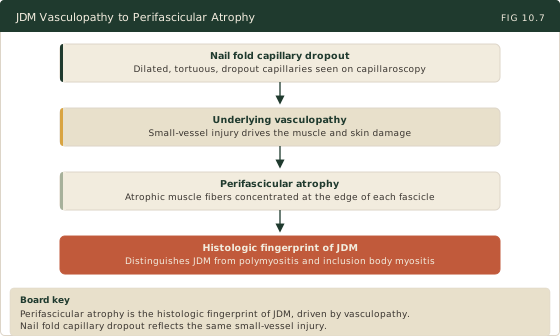
Diagnosis still rests on the Bohan and Peter criteria published in 1975. The criteria require the characteristic skin rash plus three of four muscle features: symmetric proximal muscle weakness; elevated muscle enzymes (creatine kinase, aldolase, aspartate aminotransferase (AST), and lactate dehydrogenase (LDH)); a myopathic electromyography (EMG) pattern of short, small, polyphasic motor unit potentials with fibrillations and positive sharp waves; and a muscle biopsy showing inflammation, necrosis, and characteristic perifascicular atrophy. The perifascicular atrophy is the histologic fingerprint of JDM, distinguishing it from polymyositis and from inclusion body myositis. The skin rash is non-negotiable: without it, the patient does not have dermatomyositis even if every other criterion is met.
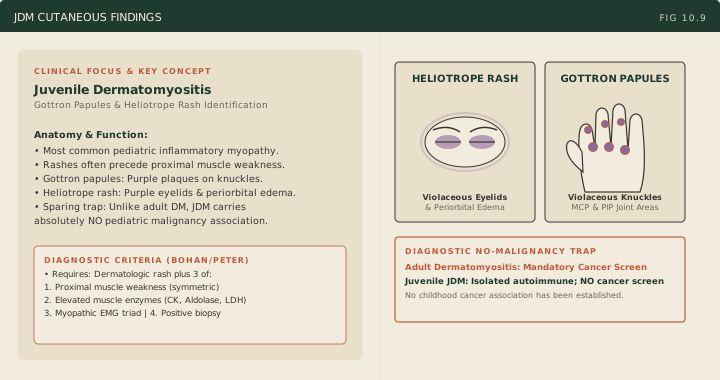
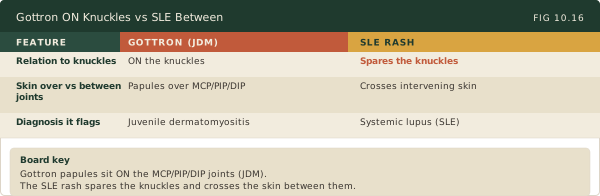
The hallmark skin findings are pathognomonic when present together. The heliotrope rash is a violaceous, purple-lilac discoloration of the upper eyelids, often with periorbital edema, named for the heliotrope flower. Gottron papules are erythematous or violaceous papules overlying the dorsal MCP, PIP, and distal interphalangeal (DIP) joints, knees, and elbows. The papules sit right over the bony prominences of the MCP, PIP, and DIP joints, which is what separates JDM from systemic lupus erythematosus (SLE). In lupus the rash spares the knuckles and crosses the intervening skin; in JDM the rash sits on the knuckles. The V-sign is a photosensitive erythematous rash over the anterior chest in a V distribution. The shawl sign is the same eruption over the upper back and shoulders. Nail fold capillary changes (dilated, tortuous, and dropout capillaries on capillaroscopy) reflect the underlying vasculopathy that drives the muscle and skin damage.
The myositis-specific antibodies in JDM define clinical phenotype and prognosis, and the five tested-favorite associations earn cold memorization. Anti-NXP2 (anti-p140) and anti-TIF1-gamma are the two most common JDM autoantibodies (about 15 and 18 percent in a large UK cohort); anti-NXP2 is the one strongly associated with severe muscle disease and calcinosis cutis. Anti-TIF1-gamma (anti-p155/140) associates with severe cutaneous disease and photosensitivity; in adults the same antibody associates with malignancy, but in children that adult association does not hold. Anti-MDA5 (anti-CADM-140) associates with rapidly progressive interstitial lung disease, amyopathic dermatomyositis, and skin ulceration. Anti-Mi-2 associates with classic dermatomyositis and the best prognosis. Anti-SRP (signal recognition particle) associates with a necrotizing myopathy phenotype and severe disease.
Calcinosis cutis is the JDM-defining late complication. The body literally deposits solid calcium crystals into the skin, subcutaneous tissue, and deep muscle fascial planes. It affects 20% to 40% of JDM patients, strongly associates with the anti-NXP2 antibody, and is particularly common when initial treatment is delayed or disease is undertreated. The deposits cause severe localized pain, joint contracture, and eventual ulceration through the skin with secondary infection. Lipodystrophy, in which the child progressively loses the subcutaneous fat layer in a symmetric pattern, is a second distinctive complication that radically alters body composition and drives severe insulin resistance.
Treatment begins with systemic corticosteroids, typically intravenous methylprednisolone pulse therapy followed by oral prednisone. Methotrexate is the first-line steroid-sparing agent, allowing prednisone taper without disease flare. Intravenous immunoglobulin (IVIG) is an adjunct for resistant disease, particularly with prominent skin disease. Hydroxychloroquine may be added for persistent cutaneous manifestations. Rehabilitation is crucial and timing-dependent: during active disease, gentle active-assisted range of motion is maintained while eccentric exercise is avoided because it can worsen muscle inflammation. As inflammation comes under control, progressive strengthening is introduced. Sun protection with photoprotective clothing and broad-spectrum sunscreen is essential because ultraviolet light drives flares. Calcinosis prevention through early aggressive immunosuppression is the most strongly supported strategy. Established calcinosis can be treated with colchicine, diltiazem, aluminum hydroxide, sodium thiosulfate, minocycline, or surgical excision for symptomatic deposits; no single medical therapy reliably dissolves deposits once formed, but several agents — including sodium thiosulfate and vasodilators — have evidence for benefit.
Juvenile scleroderma in children flips the adult ratio. In adults, systemic sclerosis (the visceral form) is comparatively common. In children, localized scleroderma (juvenile localized scleroderma, JLS) dominates. JLS subtypes include circumscribed (plaque) morphea, linear scleroderma (the most common pediatric form), generalized morphea, and pansclerotic morphea. The linear scleroderma of the face is called en coup de sabre, French for “stroke of the saber,” and produces a vertical depressed band on the forehead that can extend into the scalp and cause hair loss along the band. En coup de sabre may be associated with Parry-Romberg syndrome (progressive hemifacial atrophy), in which one side of the face progressively wastes. Linear scleroderma crossing a joint produces growth disturbance and contracture in the affected limb.
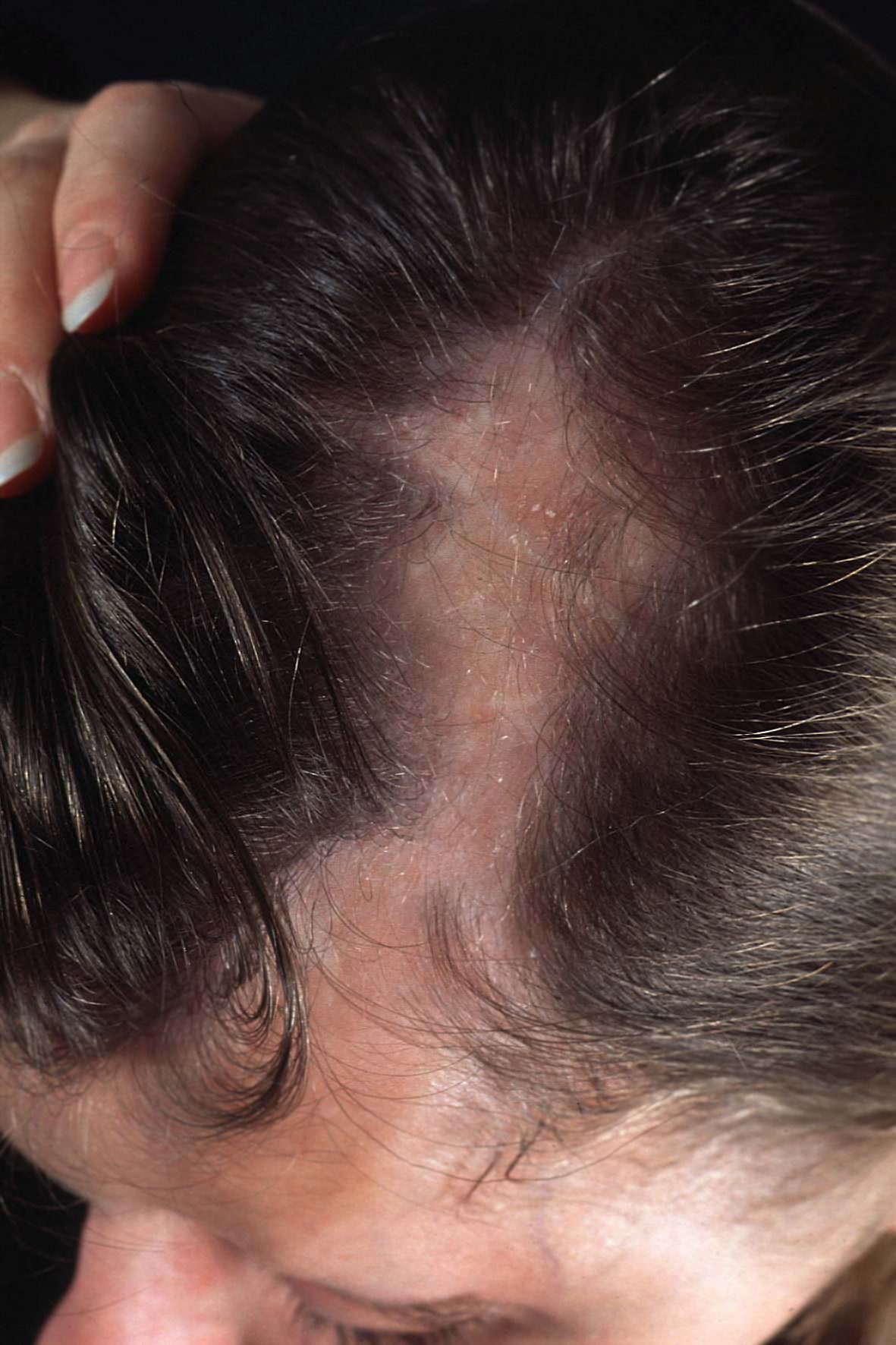
Source: Gambichler et al., “Frontal linear scleroderma 1”, BMC Dermatology 2001;1:9 (doi:10.1186/1471-5945-1-9), via Wikimedia Commons, CC BY-SA 2.0.
Methotrexate is first-line systemic therapy, with corticosteroids added for active inflammation. Juvenile systemic sclerosis is rare (roughly 5% of pediatric scleroderma) and presents like adult systemic sclerosis with Raynaud phenomenon, sclerodactyly, and possible visceral involvement (interstitial lung disease, pulmonary hypertension, esophageal dysmotility, scleroderma renal crisis); treatment overlaps with adult protocols.
High Yield — JDM and juvenile scleroderma
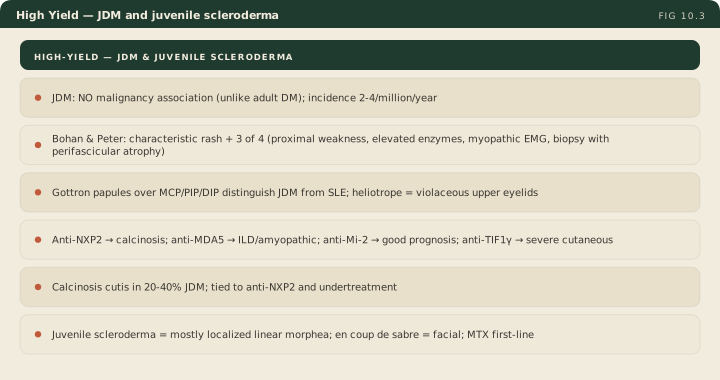
- JDM = most common pediatric inflammatory myopathy; incidence 2-4/million/year; NO malignancy association (unlike adult DM).
- Bohan and Peter criteria = characteristic rash + 3 of 4 muscle criteria (proximal weakness, elevated enzymes, myopathic EMG, biopsy with perifascicular atrophy).
- Hallmark rashes: heliotrope (violaceous upper eyelids) and Gottron papules (over MCP/PIP/DIP, knees, elbows). Gottron over the knuckles distinguishes JDM from SLE.
- Antibodies: anti-NXP2 (calcinosis; with anti-TIF1-gamma one of the two most common), anti-TIF1-gamma (severe cutaneous), anti-MDA5 (interstitial lung disease, amyopathic), anti-Mi-2 (classic, good prognosis), anti-SRP (necrotizing).
- Calcinosis cutis = 20-40% of JDM; tied to anti-NXP2 and undertreatment.
- JDM treatment: corticosteroids → methotrexate as steroid-sparing → IVIG or hydroxychloroquine for refractory disease.
- Juvenile scleroderma = mostly localized (JLS), especially linear morphea; en coup de sabre = facial linear morphea (with or without Parry-Romberg).
- JLS treatment: methotrexate first-line; corticosteroids for active inflammation.
Mnemonic — JDM rashes
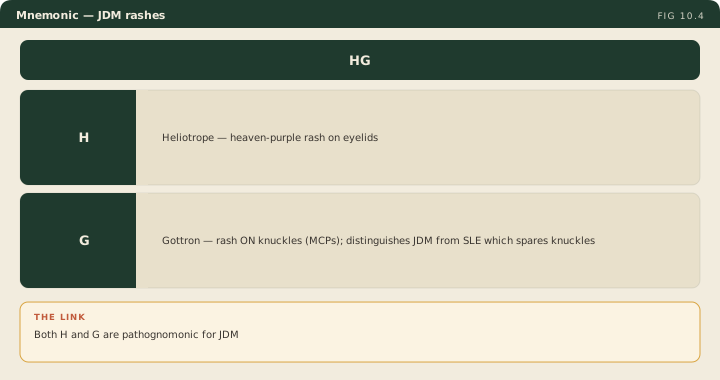
Heliotrope (eyelids, Heaven-purple) and Gottron (over Getting-into-fists knuckles). Both are pathognomonic. Gottron sits ON the MCP, PIP, and DIP joints and distinguishes JDM from SLE, where the lupus rash spares the knuckles.
We are so heavily trained in medical school to associate AST and ALT exclusively with liver function. But those enzymes are not uniquely confined to the liver. They are also packed inside healthy muscle tissue.
— PEDS-10 podcast, ~9:34