Before You Listen
Episode Setup
- Topic in one line: the pediatric oncology framework that ABPMR Part I tests cold, covering posterior-fossa brain tumors (medulloblastoma, pilocytic astrocytoma, craniopharyngioma, ependymoma, diffuse intrinsic pontine glioma), the major pediatric solid tumors and leukemias (acute lymphoblastic leukemia, acute myeloid leukemia, neuroblastoma, Wilms tumor, rhabdomyosarcoma, Hodgkin and non-Hodgkin lymphoma), the Van Ness rotationplasty that converts an ankle into a biological knee, the impairment-driven cancer rehabilitation model, the Children’s Oncology Group long-term follow-up framework, and sickle cell disease rehabilitation.
- Prerequisites: Part 1 of this episode (Lund-Browder TBSA, the Parkland formula, anti-deformity positioning, and non-accidental trauma burn patterns), basic pediatric oncology vocabulary (induction, consolidation, maintenance, intrathecal prophylaxis), and the rehabilitation framework introduced in MEDREH.
- Runtime: 32 minutes.
Vignette. A 7-year-old boy presents to his pediatrician with three weeks of morning headaches, two episodes of early-morning vomiting, and progressive unsteady gait. Examination shows truncal ataxia, bilateral papilledema, and a wide-based gait. MRI demonstrates a midline cerebellar mass filling the fourth ventricle with associated obstructive hydrocephalus. He undergoes maximal safe resection. On post-operative day three he becomes mute and emotionally labile, with worsened ataxia and dysphagia. Eight months later he is in your outpatient rehabilitation clinic for residual dysarthria, mild ataxia, and a new foot drop after completion of his post-resection chemotherapy regimen.
What is the most likely tumor and the most likely cause of the mutism, ataxia, and emotional lability on post-operative day three? What chemotherapy agent is the most likely cause of the new foot drop? What two CNS-directed staging studies should have been performed at diagnosis, and what is the role of craniospinal irradiation in his treatment plan?
(Answer at the end of this chapter)
Section 3: Pediatric Brain Tumors and the Posterior Fossa
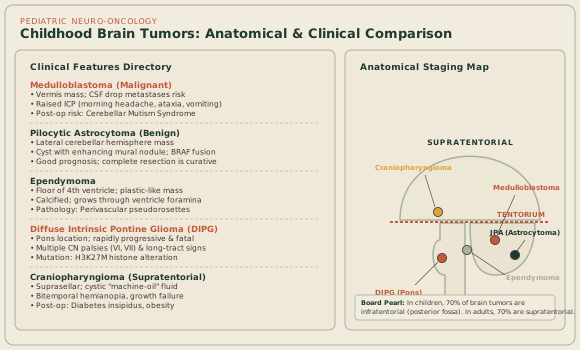
Bottom line: central nervous system (CNS) tumors are the most common solid tumor of childhood, accounting for approximately 25% of pediatric cancers. Pediatric brain tumors favor the posterior fossa (cerebellum and brainstem) rather than the supratentorial structures that dominate in adults. Medulloblastoma is the most common malignant pediatric brain tumor, arising from the cerebellar vermis and seeding the cerebrospinal fluid (CSF) with drop metastases. Pilocytic astrocytoma is the most common benign pediatric brain tumor, with a cystic mass plus mural nodule and an excellent prognosis after resection. Craniopharyngioma arises from the Rathke pouch in the suprasellar region with calcifications, bitemporal hemianopia, and post-operative diabetes insipidus. Ependymoma fills the fourth ventricle. Diffuse intrinsic pontine glioma (DIPG, now classified as diffuse midline glioma, H3 K27-altered) infiltrates the pons with a uniformly fatal prognosis.
CNS tumors account for approximately 25% of pediatric cancers and are the most common pediatric solid tumor. The pediatric distribution favors the posterior fossa (cerebellum and brainstem), in striking contrast to adult brain tumors which favor supratentorial structures. The five board-favorite pediatric brain tumors are medulloblastoma, pilocytic astrocytoma, craniopharyngioma, ependymoma, and diffuse intrinsic pontine glioma. Each carries a signature anatomic location, a signature imaging finding, and a signature rehabilitation problem after treatment.
Medulloblastoma is the most common malignant pediatric brain tumor, with a peak age of 5 to 10 years and a slight male predominance. It arises from primitive neuroectodermal cells in the cerebellar vermis, producing a midline posterior fossa mass that frequently obstructs the fourth ventricle and produces obstructive hydrocephalus. Classic presentation includes morning headache, vomiting, ataxia, and papilledema (the four-finding cluster of raised intracranial pressure in a child). Drop metastases through the CSF to the spinal cord are characteristic; staging requires both brain MRI and total-spine MRI plus CSF cytology. Histology shows small round blue cells with Homer Wright rosettes. Molecular subgroups (WNT, SHH, Group 3, and Group 4) increasingly drive prognosis and risk-stratified therapy. Treatment combines maximal safe surgical resection, craniospinal irradiation (CSI; restricted to patients aged 3 and older to limit neurocognitive damage), and chemotherapy. Five-year survival approaches 70% to 80% in average-risk disease.
The PM&R-relevant complication of medulloblastoma surgery is posterior fossa syndrome, also called cerebellar mutism syndrome. It follows resection in roughly 25% of cases. One to four days after surgery the child becomes mute, ataxic, dysphagic, and emotionally labile (sudden outbursts of crying or rage are characteristic). Partial recovery typically occurs over months, but residual dysarthria, ataxia, and emotional dysregulation often persist for years. Inpatient and outpatient rehabilitation addresses speech-language pathology for mutism and dysphagia, physical therapy for truncal and appendicular ataxia, occupational therapy for fine-motor restoration, and behavioral health for the emotional lability that families often find more disabling than the motor deficits.
Pilocytic astrocytoma (juvenile pilocytic astrocytoma, JPA) is the most common benign pediatric brain tumor and the most common cerebellar tumor of childhood. Peak age is 5 to 14 years. Pilocytic astrocytomas typically arise in the cerebellum (most common), optic pathway, hypothalamus, or brainstem. The classic radiographic appearance is a cystic mass with an enhancing mural nodule sitting on the cyst wall. Histology shows piloid (hair-like) cells with Rosenthal fibers and eosinophilic granular bodies. The driver mutation in most sporadic cases is a BRAF-KIAA1549 fusion. Treatment is gross total resection, which is curative in most cerebellar lesions; 10-year survival exceeds 90%. Optic pathway gliomas are a clinically important subset of pilocytic astrocytomas strongly associated with neurofibromatosis type 1 (NF1). They may produce visual loss, and management is more conservative because complete resection rarely spares vision; observation, chemotherapy, or focal radiation are preferred over aggressive surgery.
Craniopharyngioma arises from squamous cell rests of the Rathke pouch in the suprasellar region, with a peak age of 5 to 14 years and a second peak in adulthood. The classic presentation is the triad of growth failure (height velocity falls off the curve), visual field deficit (bitemporal hemianopia from compression of the optic chiasm), and hypopituitarism. Imaging shows a suprasellar mass with calcifications visible on CT, cystic and solid components, and a characteristically high T1 signal on MRI from the proteinaceous “machine oil” cyst contents. Treatment is surgical resection, often subtotal because adherence to the optic chiasm and hypothalamus precludes complete removal; adjuvant radiation reduces recurrence. Diabetes insipidus is common postoperatively from posterior pituitary disruption. Lifelong endocrine replacement (growth hormone, thyroxine, glucocorticoids, sex steroids, and desmopressin) is typically required. Hypothalamic obesity from hypothalamic injury is a notorious quality-of-life complication and an active rehabilitation problem because conventional diet and exercise interventions are blunted by the disrupted satiety circuitry.
Ependymoma arises from ependymal cells lining the ventricular system, most commonly in the fourth ventricle in children, with a peak in early childhood. Tumors fill the fourth ventricle and extend through the foramina of Luschka and Magendie. Histology shows perivascular pseudorosettes. Treatment is maximal safe resection plus focal radiation; chemotherapy plays a smaller role. Prognosis depends heavily on the extent of resection, with gross total resection conferring the best outcomes.
Diffuse intrinsic pontine glioma (DIPG) is a high-grade glioma of the pons with a peak age of 5 to 9 years and a uniformly grim prognosis (median survival 9 to 12 months). Presentation includes the classic triad of cranial nerve deficits (often cranial nerve VI and VII palsies), long-tract signs, and ataxia. MRI shows a diffuse, infiltrative pontine mass that is hypointense on T1, hyperintense on T2, and minimally enhancing. Biopsy is increasingly performed and frequently shows the H3 K27M histone mutation; the WHO 2021 classification now places these tumors within diffuse midline glioma, H3 K27-altered, with DIPG retained as the anatomic and clinical designation. Treatment is palliative radiation; chemotherapy has not improved outcomes; clinical trials are the standard of care. The rehabilitation focus is symptom-directed (positioning, communication, dysphagia management) and palliative.
High Yield — Pediatric brain tumors
- CNS tumors = ~25% of pediatric cancers; most common pediatric solid tumor.
- Pediatric tumors favor posterior fossa (cerebellum/brainstem); adult tumors favor supratentorial.
- Medulloblastoma = most common MALIGNANT, cerebellar vermis, drop metastases via CSF, requires craniospinal irradiation (age ≥3); posterior fossa syndrome in 25% post-resection.
- Pilocytic astrocytoma (JPA) = most common BENIGN, cerebellum, cystic with enhancing mural nodule, BRAF-KIAA1549 fusion, gross total resection often curative.
- Optic pathway glioma = associated with NF1.
- Craniopharyngioma = Rathke pouch, suprasellar, calcifications, bitemporal hemianopia, post-op diabetes insipidus, hypothalamic obesity.
- Ependymoma = fourth ventricle, perivascular pseudorosettes; resection extent drives prognosis.
- DIPG (diffuse midline glioma, H3 K27-altered) = pons, cranial nerve palsies plus long-tract signs plus ataxia; uniformly fatal, median survival 9 to 12 months.
Mnemonic — Three signature images, three tumors
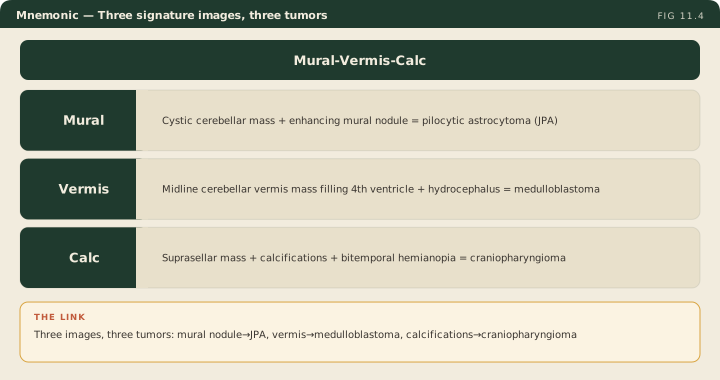
The boards reduce pediatric brain tumors to three signature images. Cystic mass with an enhancing mural nodule in the cerebellum = pilocytic astrocytoma. Midline cerebellar vermis mass filling the fourth ventricle with hydrocephalus = medulloblastoma. Suprasellar mass with calcifications and bitemporal hemianopia = craniopharyngioma. Mural nodule equals JPA. Vermis equals medulloblastoma. Calcifications equal craniopharyngioma.
I always think of craniopharyngioma as an anatomical hostage situation. Because the surgical problem is sheer adherence to the optic chiasm and the hypothalamus.
— PEDS-11 podcast, ~9:34
The child wakes up from the resection, they might be talking, they seem neurologically intact, and then a few days later, it hits.
— PEDS-11 podcast, ~6:22
Recumbency overnight increases intracranial pressure, and vomiting hyperventilates the child enough to drop their carbon dioxide, temporarily constricting the cerebral vessels and easing the pressure.
— PEDS-11 podcast, ~3:49