Before You Listen
Episode Setup
- Topic in one line: the pediatric pharmacology toolkit and the seven-step spasticity management ladder, focusing on the rationale for weight-based dosing in immature physiology, the four oral antispasticity agents and their American Academy of Neurology (AAN) evidence levels, botulinum toxin type A (BoNT-A) dosing limits and the FDA black box warning, intrathecal baclofen (ITB) trial and pump physiology, the dual emergencies of ITB withdrawal and ITB overdose, the selective dorsal rhizotomy (SDR) candidate profile, and the antiepileptic drug (AED) side effects most often tested.
- Prerequisites: cerebral palsy GMFCS levels and topographic patterns from PEDS-04, the basic Modified Ashworth Scale and Tardieu Scale framework, and the hypertonia distinction between spasticity and dystonia.
- Runtime: 48 minutes.
Vignette. A 5-year-old boy with spastic diplegic cerebral palsy at GMFCS level III is followed in your pediatric rehabilitation clinic. He ambulates with a posterior walker and bilateral hinged ankle-foot orthoses. His tone has progressed despite oral baclofen titrated to 1.5 mg/kg/day; his mother reports that he is too sedated at higher doses to participate in school. Examination shows symmetric Modified Ashworth Scale 1+ at both gastrocnemii, scissoring at the hip adductors, and a Tardieu R2-R1 difference of approximately 25 degrees at both ankles. Selective motor control is preserved; there are no fixed contractures. Brain magnetic resonance imaging (MRI) shows periventricular leukomalacia (PVL). The mother asks what the next reasonable step in his spasticity management ladder would be.
Where does this child sit on the spasticity management ladder, what oral medication has the strongest evidence base in pediatric cerebral palsy and why is it not the right answer here, what botulinum toxin type A dose limits would govern injection of his gastrocnemii and adductors, what is the candidate profile that would ultimately make him a strong selective dorsal rhizotomy candidate, and what is the single most important short-window emergency that any clinician implanting an intrathecal baclofen pump must be able to recognize?
(Answer at the end of this chapter)
Section 1: Pediatric Pharmacokinetics and the Spasticity Ladder
Bottom line: pediatric drug dosing is weight-based because clearance scales with size, but pharmacokinetic parameters change non-linearly with maturation; the spasticity management ladder progresses through seven steps from removal of noxious stimuli to surgery, and the oral antispasticity rung is dominated by four agents (baclofen, dantrolene, tizanidine, diazepam) of which only diazepam carries a Level B American Academy of Neurology recommendation.
Pediatric pharmacology is not adult pharmacology with smaller numbers. Children differ from adults across every pharmacokinetic compartment. Total body water is approximately 75-80% in neonates and falls toward the adult value of 60% during the first year. This expanded volume of distribution dilutes hydrophilic drugs and changes the loading dose of weight-based regimens. Albumin and alpha-1-acid glycoprotein binding capacity is reduced in neonates, raising the free fraction of highly bound drugs such as phenytoin and lorazepam. Hepatic cytochrome P450 (CYP450) enzymes mature on different timetables: CYP3A4 reaches adult activity by approximately 12 months, while CYP2D6 follows a slower trajectory, producing variable metabolism of substrates such as codeine and dextromethorphan during the first years. Glomerular filtration rate (GFR) at birth is roughly 15-20% of adult values, about doubles by day 5, and reaches adult levels (corrected for body surface area) by 6-12 months, governing clearance of renally eliminated drugs such as gentamicin and vancomycin. The clinical consequence is that dosing intervals and absolute doses shift with age, and weight-based dosing must be coupled with developmental knowledge.
Board answer vs. current evidence — CYP3A4 matures early in infancy — this is likely the board-tested answer, but more recent evidence indicates CYP3A4 reaches ~50% of adult activity by 6–12 months and does not attain full adult levels until approximately 15–16 months of age. Answer the board-canonical version on the test.
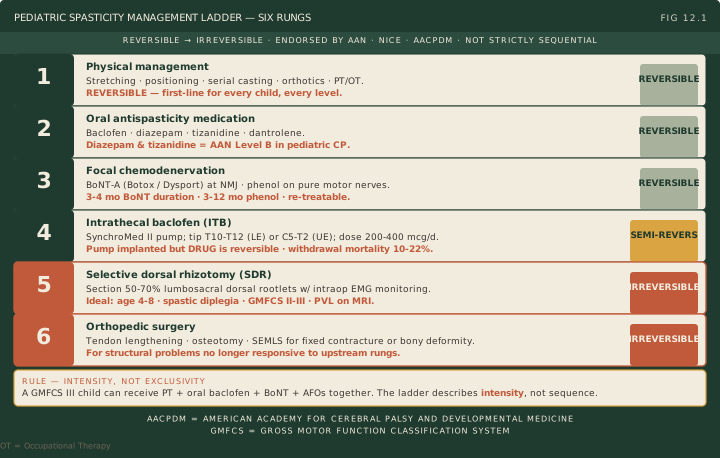
The spasticity management ladder, endorsed by the American Academy of Neurology (AAN), the National Institute for Health and Care Excellence (NICE), and the American Academy for Cerebral Palsy and Developmental Medicine (AACPDM), provides the framework for matching intervention intensity to spasticity severity and distribution. Step 1 is removal of noxious stimuli: a sudden rise in tone should prompt a search for urinary tract infection, constipation or fecal impaction, pressure injury, ingrown toenail, or an ill-fitting orthosis before any escalation. Step 2 is physical management with stretching and positioning. Step 3 is splinting, serial casting, orthotics, and modalities. Step 4 is oral antispasticity medication. Step 5 is focal chemodenervation with botulinum toxin or phenol. Step 6 is intrathecal baclofen for severe generalized spasticity. Step 7 is surgery: selective dorsal rhizotomy for the carefully selected ambulatory diplegic child, and orthopedic surgery for fixed contracture or bony deformity. In cerebral palsy the surgical rung carries more weight than in any adult population and selective dorsal rhizotomy is its signature procedure, but it is one rung, not two. The ladder is not strictly sequential. Many children receive interventions from multiple rungs simultaneously; oral baclofen for generalized tone may coexist with botulinum toxin for focal equinus and a physical therapy program throughout.
The four oral antispasticity agents are baclofen, dantrolene, tizanidine, and diazepam, and the AAN evidence levels matter on the boards. Baclofen is a gamma-aminobutyric acid type B (GABA-B) receptor agonist that exerts presynaptic inhibition in the spinal cord, reducing release of excitatory amino acids onto motor neurons. Pediatric dosing starts at 0.5 mg/kg/day divided two to three times daily, titrated weekly to a target range of 1-2 mg/kg/day, with a maximum of approximately 60 mg/day in children and 80 mg/day in adolescents. It is renally cleared, so the dose is reduced in renal impairment. Oral baclofen has poor central nervous system (CNS) penetration with only about 5% of an oral dose crossing the blood-brain barrier, which is why intrathecal delivery achieves equivalent effect at 100- to 1,000-fold lower doses. AAN level: U (insufficient evidence per Delgado 2010). The most dangerous adverse event is abrupt withdrawal, which can precipitate seizures, hallucinations, and rebound spasticity; baclofen must always be tapered. Dantrolene is the only peripherally acting antispasticity agent. It binds the ryanodine receptor (RyR1) in skeletal muscle, blocking calcium release from the sarcoplasmic reticulum and reducing excitation-contraction coupling. Pediatric dosing begins at 0.5 mg/kg once daily and titrates to a maximum of 2 mg/kg four times daily, not to exceed 100 mg per single dose. Idiosyncratic hepatotoxicity is the defining adverse effect, with case-fatality rates as high as 28% reported in the literature. Liver function tests are checked at baseline and monthly for the first six months. AAN level: U (insufficient evidence per Delgado 2010). That same ryanodine-receptor mechanism explains a second role for the drug — one fact, not two: intravenous dantrolene is the life-saving antidote for malignant hyperthermia, the crisis in which the ryanodine receptor locks open in a genetically susceptible patient exposed to an inhaled anesthetic or to succinylcholine, producing a cardinal triad of core temperature above 40°C (104°F), rigidity, and rhabdomyolysis. Dantrolene is the antidote for exactly the reason it is an antispasticity agent — same receptor, same action — while cooling and fluids only treat the damage already done. Tizanidine is a centrally acting alpha-2 adrenergic agonist that enhances presynaptic inhibition in the spinal cord. Dosing is started at 1-2 mg at bedtime and titrated by 2-4 mg every three to seven days, to a maximum of 24 mg/day. It is metabolized by CYP1A2 and is contraindicated with potent CYP1A2 inhibitors such as fluvoxamine and ciprofloxacin, which can produce profound hypotension and sedation. Periodic liver-function testing is required. AAN level: C (possibly effective per Delgado 2010). Diazepam enhances GABA-A receptor function at spinal and supraspinal levels. Pediatric dosing is 0.2-0.8 mg/kg/day divided every 6 to 8 hours. Diazepam carries the strongest pediatric AAN evidence among oral antispasticity agents (Level B in the 2010 Delgado AAN Practice Parameter — “probably effective”) in pediatric cerebral palsy, but its side-effect profile (sedation, tolerance, dependence, respiratory depression) limits long-term use. Like baclofen, diazepam must be tapered to avoid withdrawal seizures.
High Yield — Oral antispasticity agents
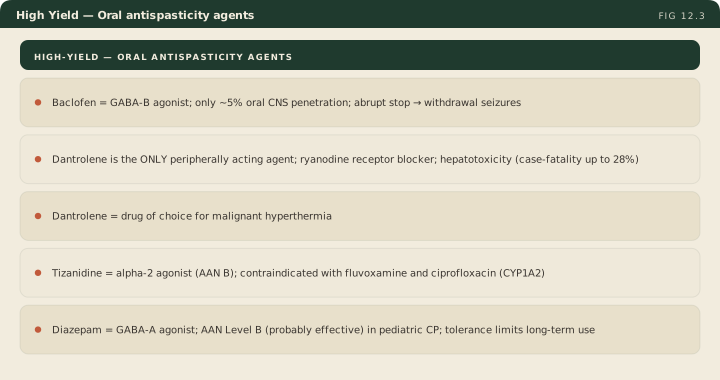
- Baclofen = GABA-B agonist; spinal cord; AAN U (insufficient evidence per Delgado 2010); oral CNS penetration ~5%; withdrawal seizures if abrupt stop.
- Dantrolene = ryanodine receptor blocker; only peripherally acting; AAN U; hepatotoxicity (case-fatality up to 28%); IV dantrolene is the life-saving malignant hyperthermia antidote via the same receptor mechanism — triggered by inhaled anesthetics/succinylcholine, cardinal triad of temp >40°C, rigidity, rhabdomyolysis.
- Tizanidine = alpha-2 agonist; CYP1A2 metabolism; contraindicated with fluvoxamine and ciprofloxacin; AAN C.
- Diazepam = GABA-A agonist; spinal + supraspinal; AAN Level B evidence (probably effective) in pediatric CP; tolerance/dependence limits long-term use.
Mnemonic — “B-D-T-D = GABA-B, Direct muscle, Two (alpha-2), Different GABA”
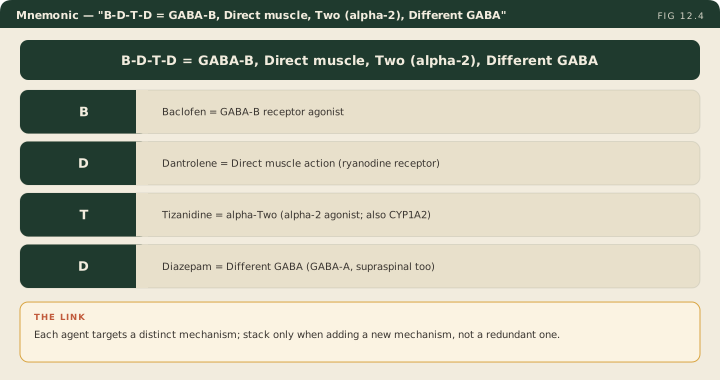
The four oral antispasticity agents map cleanly to four mechanisms. Baclofen = GABA-B. Dantrolene = Direct muscle (ryanodine). Tizanidine = alpha-Two (and CYP1A2). Diazepam = the Different GABA (GABA-A, supraspinal too). This separation matters because a child sedated on baclofen who needs more spasticity reduction does not want a second GABAergic agent (diazepam stacks the sedation); tizanidine adds an alpha-2 mechanism, dantrolene adds a peripheral mechanism, and the choice should be mechanism-driven.
The gate gets stuck wide open. The muscle cell just drowns in calcium. And it burns through all its energy stores trying to stay contracted and simultaneously trying to pump the calcium back.
— PEDS-12 podcast, ~12:29
Despite how universally it is prescribed, only 5% of an oral dose actually crosses the blood-brain barrier to reach the central nervous system.
— PEDS-12 podcast, ~10:05
Right, so in this case, subtracting R1 from R2 proves that the equinus is dynamic. It is completely reflex driven, not a fixed contracture.
— PEDS-12 podcast, ~2:24