Before You Listen
Episode Setup
- Topic in one line: the legal and service-delivery framework that supports children with disabilities from birth through adulthood, anchored by the Individuals with Disabilities Education Act (IDEA) Part C (early intervention, birth to 3, with the Individualized Family Service Plan (IFSP)) and Part B (special education, ages 3-21, with the Individualized Education Program (IEP)), Section 504 of the Rehabilitation Act, the Americans with Disabilities Act (ADA), the medical home model, the Got Transition six core elements of healthcare transition, the Workforce Innovation and Opportunity Act (WIOA) and pre-employment transition services, Supplemental Security Income (SSI) and Disabled Adult Child (DAC) benefits, the guardianship continuum and supported decision-making, and aging-related concerns in childhood-onset cerebral palsy, spina bifida, and Duchenne muscular dystrophy.
- Prerequisites: general familiarity with cerebral palsy, spina bifida, and Duchenne muscular dystrophy from PEDS-04, PEDS-05, and PEDS-06; the standardized outcome measures from PEDS-13.
- Runtime: 38 minutes.
Vignette. A 16-year-old young woman with spastic diplegic cerebral palsy at GMFCS level III is seen in your pediatric rehabilitation clinic for her annual visit. She is in tenth grade with an Individualized Education Program (IEP) under the Other Health Impairment category, ambulates with a posterior walker, and has cognition in the average range. Her current IEP includes physical therapy and occupational therapy as related services and accommodations for testing and class transitions. She has reliable bladder control with clean intermittent catheterization, depends on her mother for all medication management, and has expressed interest in attending community college and eventually working in early childhood education. Her mother asks what should be added to the IEP this year and how the family should begin healthcare transition planning.
Under IDEA, when must transition planning be added to the IEP and what four elements are required, what is the difference between an IEP and a Section 504 plan, what framework should guide healthcare transition planning and at what age should it begin, what vocational rehabilitation services are available to her under the Workforce Innovation and Opportunity Act, and what decision-making support continuum from supported decision-making through full guardianship should be considered as she approaches the age of majority?
(Answer at the end of this chapter)
Section 1: IDEA Part C and Part B
Bottom line: the Individuals with Disabilities Education Act (IDEA) is the cornerstone federal law for children with disabilities, with Part C providing family-centered early intervention birth to 3 through the Individualized Family Service Plan in natural environments, and Part B providing child-centered special education ages 3-21 through the Individualized Education Program in the Least Restrictive Environment, anchored by the Free Appropriate Public Education (FAPE) standard as interpreted by the Rowley (1982) and Endrew F. (2017) Supreme Court decisions.
The Individuals with Disabilities Education Act (IDEA) is the cornerstone federal law governing special education and early intervention services in the United States. IDEA traces its origins to the Education for All Handicapped Children Act of 1975 (PL 94-142), which first guaranteed a free appropriate public education to children with disabilities. The law was renamed IDEA in 1990 (PL 101-476) and was most recently reauthorized in 2004 (PL 108-446). IDEA has two main parts that bracket the developmental window.
Part C establishes the federal framework for early intervention services for infants and toddlers from birth through age 2 (up to the third birthday). The service plan is the Individualized Family Service Plan (IFSP). Services are family-centered, with the family as the unit of service. Delivery occurs in natural environments: the home, daycare, or community settings where the child and family naturally spend their time. Eligibility requires developmental delay (state-defined criteria), an established condition with high probability of delay, or, in some states, at-risk status. Services include physical therapy, occupational therapy, speech therapy, special instruction, audiology, vision services, nutrition, social work, and service coordination. A service coordinator is required as a single point of contact for the family. Evaluation must be completed within 45 days of referral, the IFSP is developed within 45 days, and review occurs every 6 months (interim) and annually (full). Transition planning to Part B is written into the IFSP at least 90 days, and at the parties’ discretion up to nine months, before the third birthday; age 2.5 is the usual operational target. Approximately 400,000-430,000 infants and toddlers receive Part C services annually, representing roughly 3.4% of the birth-to-three population.
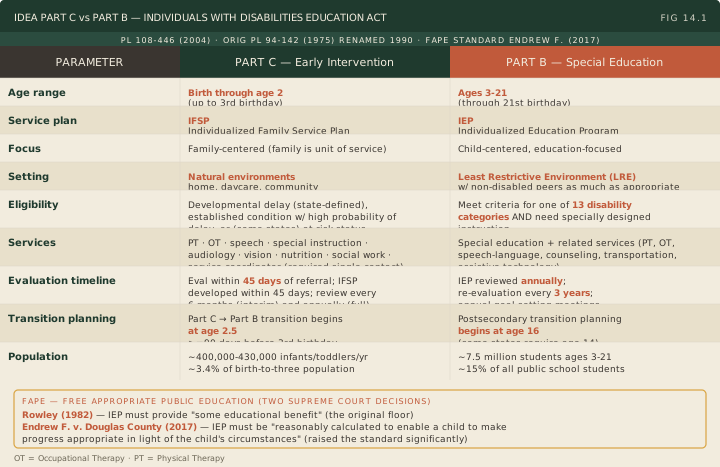
Part B governs special education for ages 3 through 21. The service plan is the Individualized Education Program (IEP). Services are child-centered and education-focused, delivered in the Least Restrictive Environment (LRE), with the child educated alongside non-disabled peers to the maximum extent appropriate. Eligibility requires meeting criteria for one of 13 disability categories AND requiring specially designed instruction. The 13 categories include Specific Learning Disability (about 33% of all eligible students), Speech or Language Impairment (19%), Other Health Impairment which includes attention-deficit hyperactivity disorder (ADHD) (15%), Autism (12%, rapidly increasing), Intellectual Disability (6%), Emotional Disturbance (5%), Multiple Disabilities (2%), Orthopedic Impairment (0.7%), and Traumatic Brain Injury (0.4%); a separate state-option category, Developmental Delay, covers ages 3 through 9 (7% of the same distribution). Approximately 7.5 million students ages 3-21 (roughly 15% of all public school students) receive special education services. Services include special education plus related services (physical therapy, occupational therapy, speech-language pathology, counseling, transportation, assistive technology). The IEP team includes the parent, regular education teacher, special education teacher, local education agency representative, evaluation specialist, and others as needed. Transition planning must begin by age 16 (some states require age 14). The IEP is reviewed annually, with re-evaluation every 3 years.
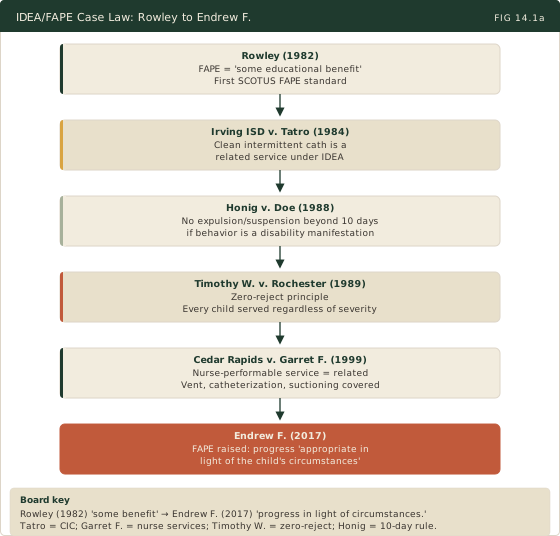
Free Appropriate Public Education (FAPE) is the legal standard that defines the educational entitlement under IDEA. Two Supreme Court decisions frame the interpretation. Board of Education v. Rowley (1982) established that FAPE requires educational services sufficient to provide “some educational benefit.” Endrew F. v. Douglas County School District (2017) raised the FAPE standard significantly: an IEP must be “reasonably calculated to enable a child to make progress appropriate in light of the child’s circumstances,” rejecting the prior “merely more than de minimis” standard. The Endrew F. decision is particularly important for children with severe disabilities, requiring the IEP team to develop challenging, individualized objectives even for children with the most significant impairments.
The LRE continuum runs from least to most restrictive: general education classroom with supports, general education with resource room services, self-contained special education classroom, separate school for students with disabilities, homebound instruction, and hospital or institutional setting. Related services must be educationally necessary, not medically necessary: a child who needs physical therapy to access the school environment qualifies; a child who needs physical therapy solely for community walking may not. Medical services under IDEA are limited to diagnostic and evaluation purposes; ongoing medical treatment is not a related service. Cedar Rapids v. Garret F. (1999) established that if a health service can be provided by a qualified nurse, it is a related service under IDEA, expanding school health services to include ventilator management, catheterization, and suctioning for medically fragile students. Irving ISD v. Tatro (1984) established that clean intermittent catheterization is a related service. Honig v. Doe (1988) prohibits expulsion or suspension for more than 10 days if the behavior is a manifestation of the disability. Timothy W. v. Rochester (1989) established the zero-reject principle: every child is entitled to education regardless of disability severity.
High Yield — IDEA Part C and Part B
- IDEA PL 108-446 (2004), originally PL 94-142 (1975) renamed (1990).
- Part C = birth-3, IFSP, family-centered, natural environments, 45-day evaluation, transition planning at age 2.5 (>=90 days before 3rd birthday).
- Part B = ages 3-21, IEP, child-centered, LRE, 13 disability categories, annual review, 3-year re-evaluation, transition by age 16.
- FAPE standard: Rowley (1982) “some educational benefit”; Endrew F. (2017) “progress appropriate in light of child’s circumstances.”
- Related services educationally necessary, not medically necessary.
- Cedar Rapids v. Garret F. = nurse-performable services are related services. Irving ISD v. Tatro = clean intermittent catheterization is a related service. Timothy W. v. Rochester = zero-reject principle.
The only discriminator is who must perform the service. If a physician must perform it, it is a medical service and the school does not have to pay. If a nurse or layperson can perform it, it is a related service and the school must provide it, period.
— PEDS-14 podcast, ~14:39
The law recognizes that pulling a one-year-old out of her home and putting her in a sterile fluorescent lit therapy clinic is significantly less effective than bringing the physical therapist to the living room and training the parents on how to incorporate therapy into daily play.
— PEDS-14 podcast, ~4:30