Before You Listen
- Prerequisites: basic lower-extremity musculoskeletal anatomy (hip, knee, ankle joints; the major muscle groups crossing each); the difference between concentric, eccentric, and isometric contraction; a working concept of joint moments and ground reaction forces; familiarity with peripheral neuropathies that affect the lower extremity (peroneal, femoral, sciatic, tibial).
- Runtime: 36 minutes.
- Topic in one line: the Rancho Los Amigos eight-phase gait cycle, the three rockers of the foot, the six determinants of gait, the M-shaped vertical GRF curve (peaks ~110% BW, midstance trough ~80%), the ankle A2 power burst as the largest power event, the energy-expenditure hierarchy by amputation level (Syme < unilateral TT traumatic < bilateral TT < unilateral TF traumatic < bilateral TF), the vascular-vs-traumatic premium, and the pathologic gait patterns (foot slap, foot drop, Trendelenburg, circumduction, vaulting, hip hiking, antalgic, scissor, crouch, ataxic, parkinsonian). Memorize cold.
Vignette. A 67-year-old woman is referred to your amputee clinic six weeks after a left transfemoral (TF) amputation for ischemic gangrene of the foot. She has type 2 diabetes mellitus, peripheral arterial disease (PAD), and a remote history of myocardial infarction. On observation gait in the parallel bars with her preparatory prosthesis, you note three deviations: (1) the prosthetic limb swings outward in a wide arc during swing rather than passing under her body, (2) she rises noticeably onto the toes of her sound right foot during left-prosthetic swing, and (3) her left pelvis drops as she stands on the right limb during the next step. She tires after two laps and asks to sit. Her self-selected walking speed in the laboratory is 28 meters per minute (normal ~80).
Name each gait deviation, identify the most likely prosthetic and patient causes for each, explain in mechanical terms why her self-selected speed is one third of normal, and state which assistive-device modification would reduce the abductor demand on the remaining hip.
(Answer at the end of this chapter)
Section 1: The Normal Gait Cycle — Phases, Rockers, and the Six Determinants
Bottom line: the gait cycle is one stride (initial contact of one foot to the next initial contact of the same foot), divided into a 60% stance phase and a 40% swing phase with two periods of double-limb support totaling ~20%; the Rancho Los Amigos system parses stance into five subphases (“I Like My Tea Presweetened”) and swing into three (“In My Teapot”), the foot rolls forward over three sequential rockers (heel, ankle, forefoot), and six determinants flatten center-of-gravity (COG) excursion to roughly 5 cm in each plane.
A gait cycle (stride) is the interval from initial contact of one foot to the next initial contact of the same foot, ~1.0 to 1.2 seconds in adults. A step is from initial contact of one foot to initial contact of the opposite foot (~0.5 to 0.6 seconds). One stride = two steps. Stride length (heel-to-heel of same foot) averages ~1.4 m; step length (heel-to-heel of opposite feet) averages ~0.7 m. Cadence is ~113 steps/min, self-selected walking velocity ~80 m/min (about 3 mph). Velocity equals cadence × step length. Base of support is roughly 5 to 10 cm.
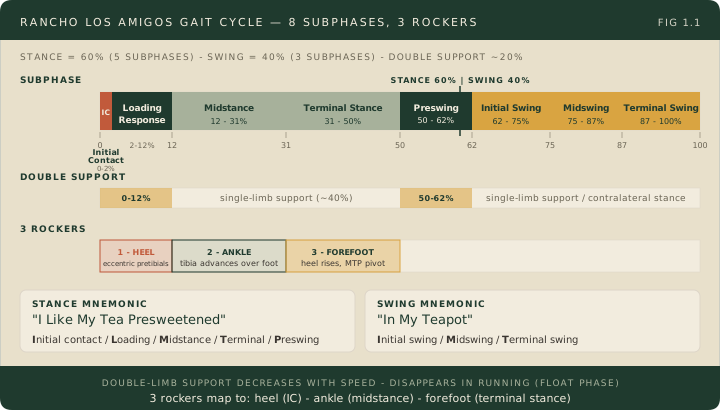
Stance phase occupies ~60% of the cycle (foot in contact with the ground); swing phase occupies the remaining 40%. Within stance there are two periods of double-limb support (each ~10%, combined ~20%) and one period of single-limb support (~40%, corresponding to the swing phase of the contralateral limb). Double-limb support decreases as walking speed increases and disappears entirely during running, replaced by a float phase. In pathologic gait, double-limb support increases as a stability strategy.
The Rancho Los Amigos system parses the cycle into eight subphases. Stance: initial contact (0–2%), loading response (2–12%), midstance (12–31%), terminal stance (31–50%), and preswing (50–62%), recalled as “I Like My Tea Presweetened.” Swing: initial swing (62–75%), midswing (75–87%), and terminal swing (87–100%), recalled as “In My Teapot.” At initial contact the heel strikes with the hip flexed about 30°, knee in 0–5° flexion, ankle in neutral. During loading response the knee flexes about 15° under eccentric quadriceps control for shock absorption, ankle plantarflexes under eccentric pretibial control. Midstance begins as the opposite foot lifts off; the gluteus medius prevents contralateral pelvic drop. Terminal stance brings the heel off the ground as ankle dorsiflexion peaks at about 10°. Preswing is the second period of double-limb support and the moment of explosive plantar-flexor concentric work producing the largest power burst. Initial swing accelerates the limb under iliopsoas pull, knee flexion peaks at about 60°. Terminal swing brings the limb to a stop as the hamstrings eccentrically decelerate the swinging shank.
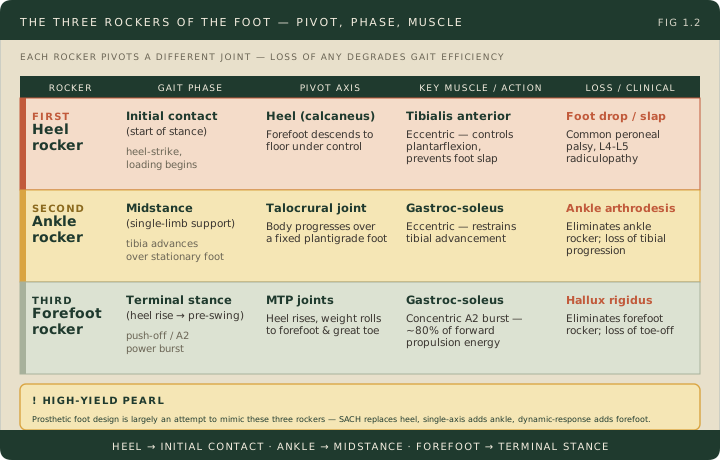
The foot rolls forward through three sequential rockers. The first rocker (heel rocker) pivots about the heel at initial contact; eccentric pretibial muscles control plantarflexion. The second rocker (ankle rocker) pivots about the talocrural joint during midstance and allows the tibia to advance under eccentric plantar-flexor control. The third rocker (forefoot rocker) pivots about the metatarsophalangeal joints during terminal stance as the heel rises. Loss of any rocker degrades efficiency. Ankle arthrodesis eliminates the second; hallux rigidus eliminates the third. Prosthetic foot design is largely an attempt to mimic these three rockers.
The body’s center of gravity (COG) sits approximately 5 cm anterior to S2 in standing. During gait it traces a smooth sinusoidal path with vertical excursion of roughly 5 cm and lateral excursion of about 5 cm. The COG is lowest during double-limb support (loading response) because both limbs are short and splayed; it is highest during single-limb support (midstance) because the stance limb acts as an inverted pendulum. Without active smoothing, vertical COG excursion would nearly double to 9.5 cm and metabolic cost would soar.
The six determinants of gait (Saunders, Inman, Eberhart 1953) flatten this arc. (1) Pelvic rotation of about 4° forward on the swing side raises the lowest COG point. (2) Pelvic tilt (list) of about 5° downward on the swing side, controlled by the stance-side hip abductors, lowers the highest COG point. (3) Knee flexion in stance of about 15° during loading response lowers the highest COG point and contributes shock absorption. (4) Foot mechanisms smooth the abrupt COG descent at initial contact. (5) Knee mechanisms smooth COG transitions. (6) Lateral pelvic displacement is reduced to about 5 cm by relative femoral adduction and the valgus angle at the knee. Knee arthrodesis eliminates determinant 3 and raises oxygen consumption by roughly 20–25%; transfemoral amputation disrupts determinants 3, 4, and 5 on the prosthetic side.
High Yield, Gait cycle, rockers, and determinants
- One stride = two steps; stride length is heel-to-heel of the same foot (~1.4 m), step length is heel-to-heel of opposite feet (~0.7 m).
- Stance = 60%, swing = 40%; double-limb support ~20% total (two periods of ~10% each); decreases with speed; disappears in running.
- Rancho Los Amigos stance mnemonic: “I Like My Tea Presweetened” (Initial contact, Loading response, Midstance, Terminal stance, Preswing). Swing mnemonic: “In My Teapot” (Initial swing, Midswing, Terminal swing).
- COG lowest at loading response (double support); highest at midstance (single support, inverted pendulum).
- Three rockers: heel (initial contact), ankle (midstance), forefoot (terminal stance).
- Six determinants (Saunders, Inman, Eberhart 1953): pelvic rotation, pelvic tilt, knee flexion in stance, foot mechanisms, knee mechanisms, lateral pelvic displacement.
- Knee arthrodesis eliminates determinant 3 → ~20–25% oxygen consumption increase.
- Transfemoral amputation disrupts determinants 3, 4, and 5 on the prosthetic side.
Mnemonic, “I Like My Tea Presweetened” / “In My Teapot”
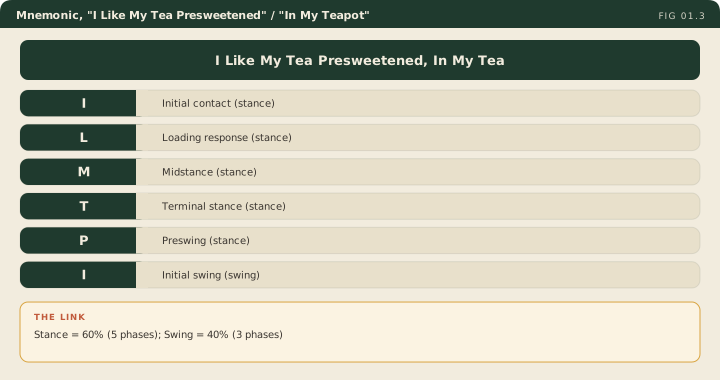
Stance (60%): Initial contact, Loading response, Midstance, Terminal stance, Preswing. Swing (40%): Initial swing, Midswing, Terminal swing. Memorize this verbatim, every subsequent prosthetic and orthotic chapter assumes you know the eight subphases by name and percentage range.
It’s like walking on a sheet of black ice. You instinctively take these short, wide, shuffling steps so both feet are always down.
— PO-01 podcast, ~5:41