Before You Listen
Before You Listen
- Topic in one line: the surgical principles that define residual limb quality (myodesis vs myoplasty; the Burgess long posterior flap; the Ertl osteomyoplastic with its higher complication profile); the nerve-management revolution (TMR with the Dumanian RCT for established pain, and RPNI with prophylactic zero percent neuroma); osseointegration as a socket alternative for eligible transfemoral amputees; the immediate postoperative work that prevents catastrophic contractures (RRD recommended by the VA/DoD CPG, figure-of-eight elastic wrapping, IPOP, and the no-pillow-under-the-knee rule); residual limb volume change and the prosthetic fitting timeline; the nine-phase rehabilitation continuum and the four highest-yield VA/DoD 2017 CPG recommendations (education, rigid dressings, microprocessor knees, annual transdisciplinary assessments); phantom limb pain across its peripheral, spinal, and central mechanisms and the failure of traditional pharmacotherapy; and the modern synthesis of osseointegration, IDEO with the Return to Run pathway, and the global burden of limb loss.
- Prerequisites: the amputation-level hierarchy and epidemiology from PO-02 (the dysvascular dominance, the knee-preservation rule, the K-level system); basic peripheral nerve anatomy of the lower extremity (sciatic, tibial, common peroneal, sural, saphenous); the difference between concentric, eccentric, and isometric contraction from PO-01; basic understanding of dressings, edema control, and contracture prevention; familiarity with the Medicare coverage framework for prosthetic components.
Vignette. A 31-year-old previously healthy man sustains a right traumatic transtibial amputation after a motorcycle collision. The orthopedic surgeon performs a Burgess long posterior flap amputation with a 13-cm tibial length, the fibula cut 1.5 cm shorter than the tibia, the anterior tibial crest beveled, and a myoplasty closure of the gastrosoleus complex to the anterior compartment. At the time of surgery the surgeon also performs a prophylactic Targeted Muscle Reinnervation (TMR) procedure on the tibial and common peroneal nerves. A rigid removable dressing (RRD) is applied in the operating room. On postoperative day 4 the patient is transferred to your inpatient rehabilitation service. He reports moderate residual limb pain controlled with scheduled acetaminophen and a low-dose oxycodone PRN, and intermittent shooting pain in the missing right foot. On examination he has a clean, well-perfused incision under the RRD, full passive hip and knee range of motion bilaterally, and 4/5 strength in his left lower extremity and right hip. His goal is to “get back to my construction job by next year.” He asks why he cannot just have a wheelchair and avoid all of this rehabilitation.
Identify the surgical decisions and the rationale (Burgess, myoplasty vs myodesis at transtibial, prophylactic TMR, RRD over shrinker). Locate the patient in the nine-phase rehabilitation continuum. State the three highest-priority contracture-prevention interventions over the next 14 days. Predict K-level and Medicare implications. Address his wheelchair-only question using the energy-expenditure framework.
(Answer at the end of this chapter)
Section 1: Surgical Principles — Muscle Management and the Burgess versus Ertl Decision
Bottom line: residual limb quality is set in the operating room, not in the rehabilitation gym. Two muscle-anchoring techniques manage severed muscles. Myodesis sutures muscles directly to bone through drill holes and produces the more structurally stable residual limb, resisting late muscle retraction; it is preferred whenever the limb is adequately perfused, and adductor myodesis is non-negotiable at the transfemoral level. Myoplasty sutures opposing muscles to each other over the cut bone end; it is faster and is the procedure of choice when perfusion is marginal, because myodesis is contraindicated in the severely dysvascular limb (drilling and anchoring to bone further compromises an already marginal periosteal blood supply). The choice is therefore scoped by perfusion, not by amputation level. The Burgess long posterior flap is the standard transtibial technique (12 to 15 cm tibial length, fibula 1 to 2 cm shorter, anterior crest beveled at roughly 45 degrees, gastrosoleus flap rotated anteriorly). The Ertl osteomyoplastic adds a tibiofibular synostosis for a broader weight-bearing distal surface but carries substantially higher complications (infection 34%, neuroma 18%, heterotopic ossification 15%, delayed union 11%). The TAOS multicenter RCT is the definitive comparison.
Surgery is not just the act of cutting a limb away. It is the act of reconstructing a functional, weight-bearing organ from severed muscles and shortened bones, and every decision under the surgical drape determines whether the patient ever walks comfortably on a prosthesis. Two muscle-anchoring techniques sit at the center of that reconstruction, and the board distinction between them is sharp.
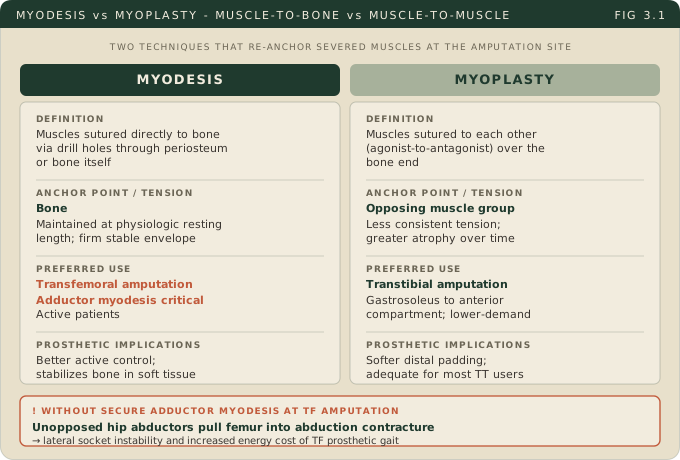
Myodesis sutures the severed muscle directly to bone, either through drilled cortical tunnels or through the dense periosteum that covers the bone. The anchor point is bone itself. Because the muscle is fixed to an immovable structure, it maintains its physiologic resting length and the tension on which contractile function depends. Muscle tissue lives by a strict use-it-or-lose-it rule: deprived of resistance, fibers retract proximally and undergo severe, often irreversible atrophy. A securely myodesed muscle, by contrast, keeps its bulk, keeps its leverage, and provides a stable padded envelope that does not slide around inside the eventual prosthetic socket.
Myodesis is the preferred technique at transfemoral amputation, and the reason is a biomechanical tug-of-war at the hip. The hip adductors (adductor magnus, longus, brevis, plus pectineus and gracilis) live on the medial thigh and pull the femur toward the midline. The hip abductors (gluteus medius, gluteus minimus) live laterally and pull it away. When the surgeon transects the femur, the distal attachments of the adductors are severed. If those medial muscles are not firmly anchored back to the residual femur, they retract and lose all their leverage. The intact lateral abductors continue to fire from their proximal pelvic origin, and with no opposing pull they yank the residual femur laterally into a fixed abduction contracture. The downstream prosthetic catastrophe is predictable: the prosthetist must build a socket around a laterally jutting femur, the patient cannot get the foot under the body, the trunk lurches sideways with every step, the metabolic cost soars, and the prosthesis is often abandoned. Adductor myodesis is therefore not an enhancement to transfemoral amputation; it is a structural requirement for functional walking.
Myoplasty sutures the severed muscles to each other (agonist to antagonist) over the cut end of the bone. The anchor point is the opposing muscle rather than bone, which means the anchor itself can shift under load. Muscle tension is less consistent, and atrophy over time tends to be greater than with myodesis. However, myoplasty creates a soft, pliable distal pad over the bone that is perfectly adequate for the lower mechanical demands of transtibial amputation. The classic transtibial myoplasty rotates the large gastrocsoleus flap anteriorly and sutures it to the anterior compartment muscles, deep fascia, and periosteum over the distal tibia. Some surgeons add a partial myodesis of the posterior flap to the tibial periosteum; full circumferential myodesis is reserved for the higher-tension transfemoral level.
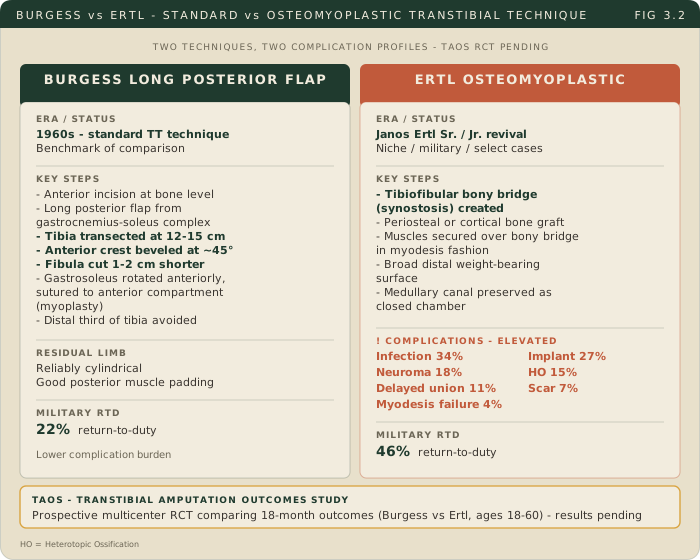
The Burgess long posterior flap, introduced in the 1960s, is the standard transtibial technique and remains the benchmark against which every newer approach is measured. The geometry is precise. The surgeon creates an anterior skin incision and brings up a long posterior flap from the gastrocnemius-soleus complex that is one to two centimeters longer than the anteroposterior diameter of the leg at the level of section, so that the meaty calf muscle can be swung fully forward and wrapped around the cut bone ends. The tibia is transected at a length of 12 to 15 cm below the knee joint, the anterior tibial crest is beveled at roughly 45 degrees to remove the sharp ninety-degree edge that would otherwise ulcerate through soft tissue under prosthetic load, and the fibula is cut 1 to 2 cm shorter than the tibia so that it never takes direct distal pressure (the fibula is not engineered to bear weight). The posterior flap is then rotated anteriorly and sutured to the anterior fascia. The result is a cylindrical residual limb with reliable posterior muscle padding.
The choice of 12 to 15 cm is the Goldilocks zone between lever arm and soft tissue coverage. A longer residuum drifts into the distal third of the leg, where muscle vanishes and only thin skin stretches over bone and tendon; weight bearing on that real estate produces relentless skin breakdown. A shorter residuum gives a poor mechanical lever for socket control. Twelve to fifteen centimeters gives strong control and keeps the cut bone end inside the well-padded muscular portion of the leg.
The Ertl osteomyoplastic procedure takes a more aggressive structural approach. The surgeon constructs a bony bridge (synostosis) between the cut ends of the tibia and the fibula, using a periosteal or cortical graft, and secures the muscles via formal myodesis. The architectural argument is seductive. A closed medullary canal restores normal intramedullary pressure (theoretically reducing residual limb pain), and the bony bridge creates a broad, flat distal surface that allows direct end-bearing rather than relying on proximal load distribution. Early military data appeared to support the approach: in some series the Ertl achieved a 46% return-to-active-duty rate compared with 22% for the standard Burgess, a difference large enough to drive widespread adoption in trauma centers.
The catch is the complication profile. The numbers reported in the literature are sobering: infection 34%, neuromas requiring secondary excision 18%, heterotopic ossification 15%, delayed or non-union of the bony bridge 11%, implant-related complications 27%, myodesis failure 4%, scar revision 7%. The return-to-duty advantage almost certainly reflects selection: young trauma patients were funneled into the Ertl while older vascular patients received the Burgess, confounding any clean comparison. To resolve the question, the TAOS (Transtibial Amputation Outcomes Study) is a multicenter, prospective, randomized controlled trial directly comparing the Ertl with the Burgess at 18 months in adults aged 18 to 60. Until those results read out, the standing board rule is straightforward: the Burgess remains the standard transtibial technique, and the Ertl is reserved for highly selected cases.
High Yield — Surgical principles and muscle management
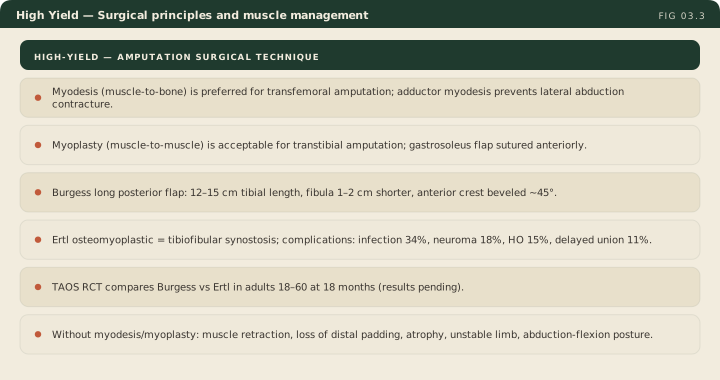
- Myodesis (muscle-to-bone) is preferred for transfemoral amputation; adductor myodesis is non-negotiable to prevent the lateral abduction contracture that destroys prosthetic alignment.
- Myodesis is the more stable construct and is preferred in a well-perfused limb at any level; myoplasty is chosen when perfusion is marginal (myodesis is contraindicated in severe dysvascularity). At transtibial the gastrosoleus flap is sutured anteriorly to the anterior compartment.
- Burgess long posterior flap = standard transtibial technique: 12 to 15 cm tibial length, fibula 1 to 2 cm shorter, anterior tibial crest beveled at roughly 45 degrees, distal third of the tibia avoided.
- Ertl osteomyoplastic = tibiofibular synostosis (bony bridge): broader distal weight-bearing surface but substantially higher complications (infection 34%, neuroma 18%, heterotopic ossification 15%, delayed union 11%).
- TAOS, the RCT comparing Burgess vs Ertl in adults 18 to 60 at 18 months, is published: operatively treated complications 42% with the synostosis vs 24% without, with no appreciable difference in mean functional scores, in a trial that missed its enrollment target.
- Without myodesis or myoplasty, severed muscles retract proximally and produce loss of distal padding, atrophy, an unstable limb, and at the transfemoral level a fixed abduction-flexion posture.
Mnemonic — “Myo-DE-sis = D for Diaphysis (bone); Myo-PLA-sty = P for Pair of opposing muscles”
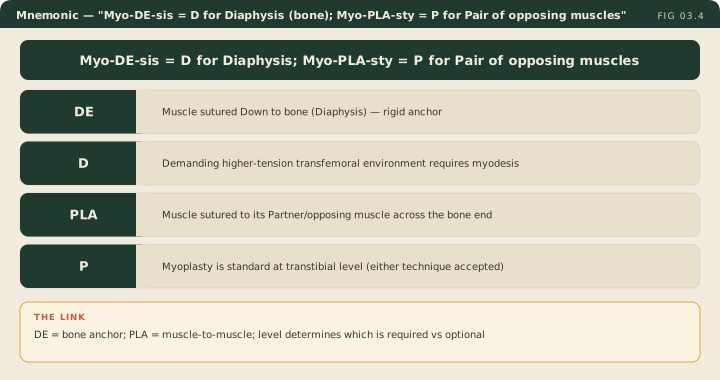
To remember which technique anchors to which structure: Myo-DE-sis = D = Diaphysis, the muscle is sutured Down to bone. Myo-PLA-sty = P = Pair of opposing muscles, the muscle is sutured to its Partner across the bone end. The transfemoral level demands myoDEsis (the D for the Demanding higher-tension transfemoral environment); the transtibial level accepts either, and perfusion decides: myoPLAsty when the limb is ischemic, because myoDEsis is contraindicated in severe dysvascularity.
That data was heavily skewed. The patients receiving the Ertl procedure were predominantly young, healthy service members with trauma-related amputations.
— PO-03 podcast, ~9:43
It’s like trying to tie a hammock to two other hammocks instead of tying it to a pair of trees. The tension is just constantly shifting.
— PO-03 podcast, ~3:24