Before You Listen
Before You Listen
- Prerequisites: the four-element prosthesis framework from Episode 4 (socket, liner, suspension, foot-ankle); myodesis vs myoplasty surgical concepts (adductor myodesis is critical at TF); proximal femur and pelvic anatomy (greater/lesser trochanter, ischial tuberosity, ischiopubic ramus); gait cycle subphases; the ground reaction force (GRF) vector and its relationship to a joint axis; Medicare functional levels K0-K4; Thomas test.
- Runtime: 46 minutes.
- Topic in one line: the four TF elements (socket, knee, suspension, foot-ankle); quadrilateral (ischium ON brim, femur abducted) vs ischial containment/MAS (ischium INSIDE, femur adducted); seven knee categories (polycentric for knee disarticulation; C-Leg as most-studied MPK); suspension hierarchy from suction (gold standard) to pelvic band (last resort), Silesian = rotation; GRF-vs-knee-axis as the key alignment principle (anterior = stable, posterior = buckling); high-yield gait deviations; hip disarticulation/hemipelvectomy with anterior hip joint; and the 85% vascular disease pearl shaping every adult prescription.
Vignette. A 68-year-old man with poorly controlled type 2 diabetes mellitus and peripheral vascular disease underwent a left transfemoral amputation eight months ago following a non-healing chronic foot ulcer that progressed to gangrene. The residual limb is conical and well-healed, with a documented adductor myodesis and approximately 60% of femoral length preserved. He was initially fit with a quadrilateral socket and a single-axis constant friction knee. He presents to clinic with two complaints. First, his daughter notices that his trunk leans dramatically toward the left during stance phase on the prosthetic side, despite the absence of pain. Second, he reports two falls in the last month while attempting to descend a ramp at his home; on each occasion he felt the knee suddenly “give way” under him. On exam, he has +4/5 hip extensor and +3/5 hip abductor strength on the amputated side, full hip range of motion with no flexion contracture, and the prosthesis appears 1 cm shorter than the contralateral limb on iliac crest measurement.
Which two specific gait deviations is this patient demonstrating, what are the most likely prosthetic and patient-related causes for each, what socket redesign would optimize gluteus medius leverage and reduce the trunk-bend pattern, and which microprocessor knee feature directly addresses the second complaint with documented fall reduction in the literature?
(Answer at the end of this chapter)
Section 1: The Vascular Reality, the Residual Limb, and the Two Foundational Sockets
Bottom line: ~85% of major lower-limb amputations are vascular (most often diabetic); energy cost per unit distance rises to ~55-65% (traumatic) or ~100-120% (vascular) above baseline at TF (vs 10-25% / ~40% at TT); ideal residual limb is conical with ≥5-7 cm distal to the lesser trochanter and a critical adductor myodesis; the two foundational sockets are the Radcliffe quadrilateral (narrow AP, wide ML, ischium ON brim, femur abducted) and the modern ischial containment / MAS (narrow ML, wider AP, ischium INSIDE, femur in anatomic adduction with optimized gluteus medius leverage).
Transfemoral (above-knee) amputation sacrifices the knee joint, eliminating the body’s most important energy-conserving mechanism and raising oxygen cost per unit distance to 55-65% (traumatic) or 100-120% (vascular) above baseline, vs 10-25% and about 40% at the transtibial level. The prescription involves four interdependent elements: socket, knee unit, suspension, and foot-ankle system.
Approximately 85% of major lower-limb amputations result from peripheral vascular disease, most commonly diabetes; the single most-tested transfemoral fact. The typical vascular TF amputee is 60-80 years old with cardiovascular comorbidities, an at-risk contralateral limb (~50% 5-year amputation risk), neuropathic skin, unstable limb volume from edema and dialysis, reduced dexterity, and possible diabetic retinopathy or cognitive impairment. Most are K1-K2 at best; many are K0 and never become functional users. The 100-120% above-baseline energy cost often exceeds cardiovascular capacity, driving wheelchair dependence and underscoring why knee preservation via transtibial amputation is so critical. Component selection must account for reduced dexterity (pin-lock often preferred over suction), impaired sensation (frequent skin checks), and volume instability (adjustable sockets or elevated vacuum). The contralateral limb requires aggressive prevention via foot exams, fitted footwear, glycemic and cardiovascular control.
Functional outcome is directly proportional to residual limb length, muscle strength, and soft tissue quality. Ideal shape is conical; the femur should be preserved ≥5-7 cm distal to the lesser trochanter, ideally 50-70% of original length. Myodesis (muscle and fascia anchored to bone through drilled channels) is preferred over myoplasty (opposing muscles sutured to each other over the cut bone end, which can raise a bursa and weaken the pull). Adductor myodesis is critical: without it, unopposed hip abductors create an abduction contracture and lateral socket instability. The exception matters in this population: bone fixation needs a limb that can heal it, so in a severely dysvascular or frail elderly limb the surgeon may take the muscle-to-muscle repair instead, and an absent myodesis there is a perfusion decision rather than a technical failure. Hip flexion contracture >20 degrees is very difficult to accommodate; abduction contracture is even more problematic for ML stability.
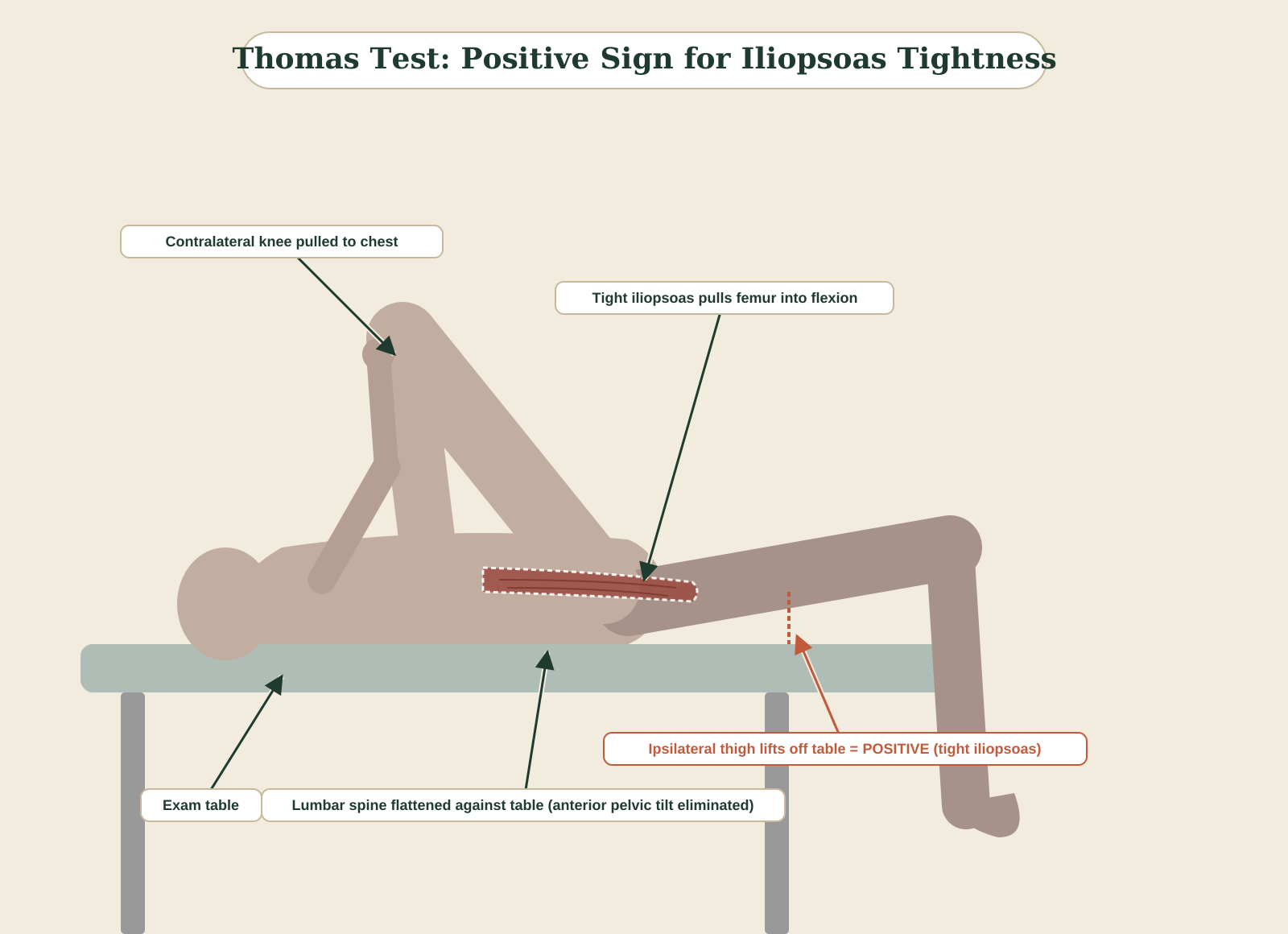
The Thomas test assesses hip flexion contracture: patient supine, contralateral hip flexed to flatten lordosis, and the angle the amputated limb rises is the contracture. 0-10 degrees: easily accommodated. 10-20 degrees: accommodated by matching socket flexion, with moderate energy cost and a shortened sound-side step (restricted prosthetic-side hip extension limits the opposite step). >20 degrees: dramatically impairs function; a 35-degree hip flexion contracture raises walking energy consumption by about 60%. Prevention via prone lying, avoiding prolonged sitting, no pillow under the limb, and hip extension stretching is far more effective than later accommodation.
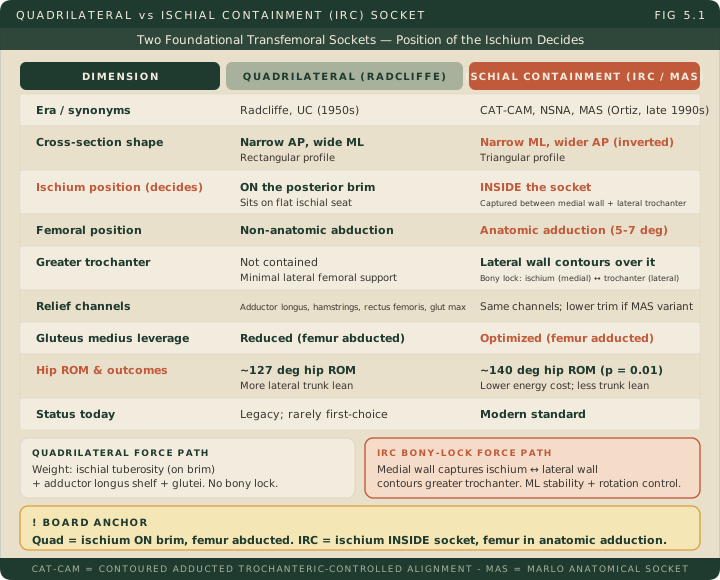
The quadrilateral socket (Radcliffe, UC, 1950s) has a rectangular cross-section with ML wider than AP. The ischial tuberosity sits ON the posterior brim (the “ischial seat”) and does not enter the socket; the flat posterior shelf bears weight. The anterior wall rises to the inguinal ligament with a Scarpa’s bulge for the femoral triangle. The lateral wall provides minimal femoral containment; the greater trochanter is not captured. Weight-bearing is across the ischial tuberosity, adductor longus region, and gluteal musculature. The narrow-AP/wide-ML shape forces the femur into non-anatomic abduction, reducing gluteus medius efficiency and producing the lateral trunk lean that defines quadrilateral gait.
The ischial containment (IRC) socket; also called CAT-CAM (Contoured Adducted Trochanteric-Controlled Alignment Method) or NSNA (Normal Shape Normal Alignment) — is the modern standard. The MAS (Marlo Anatomical Socket, Ortiz, late 1990s) is an evolution with low posterior and gluteal trim lines. The IRC cross-section inverts the quadrilateral: narrow ML, wider AP. The ischial tuberosity and ramus are contained INSIDE the socket; the medial wall captures the ischium and the lateral wall contours over the greater trochanter, creating a “bony lock” that resists rotation and provides ML stability. The femur is maintained in anatomic adduction, optimizing gluteus medius leverage. Socket flexion and adduction are each ~5-7 degrees. MAS adds a low posterior trim so the patient sits on gluteus maximus rather than the socket edge.
The critical board distinction: quadrilateral = ischium ON posterior brim, femur in abduction; IRC/MAS = ischium INSIDE socket, femur in anatomic adduction. IRC shows greater hip ROM (~140 vs ~127 degrees, p=0.01), lower energy cost, improved step length, less lateral trunk lean, better rotational control, and better seated comfort.
Flexible thermoplastic-within-rigid-frame sockets combine a thin thermoplastic inner socket with a rigid laminated outer frame. Advantages: sitting comfort, heat dissipation, proprioception, translucent inspection, volume-fluctuation accommodation, reduced weight.
Sub-ischial sockets place the proximal trim entirely below the ischial tuberosity, eliminating ischial containment for unrestricted hip motion. A systematic review of seven randomized or controlled trials (five comparing sub-ischial with ischial containment, with very low certainty for a comfort benefit and no established mobility advantage) and the HySS case series showed improvements in passive hip ROM, walking speed/distance, stride length, and reduced double-support time. Sub-ischial appears non-inferior to IRC and may offer better hip ROM and sitting comfort.
High Yield — Vascular reality, residual limb, foundational sockets
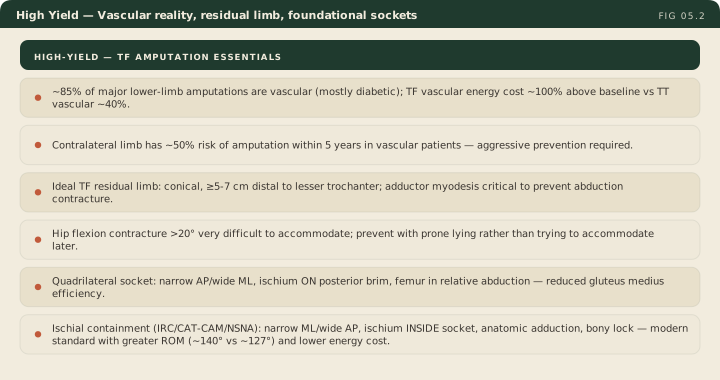
- ~85% of major lower-limb amputations are vascular (most often diabetic); shapes the entire transfemoral prescription.
- Energy cost (per unit distance, self-selected speed): TF traumatic ~55-65% above baseline; TF vascular ~100-120%; vs TT traumatic ~10-25% and TT vascular ~40%. Knee preservation is the highest-yield surgical principle.
- Contralateral limb at ~50% risk of amputation within 5 years in vascular patients; aggressive prevention required.
- Ideal TF residual limb: conical; ≥ 5-7 cm distal to the lesser trochanter; adductor myodesis critical (prevents abduction contracture).
- Hip flexion contracture > 20 degrees is very difficult to accommodate; prevention with prone lying is far more effective than later accommodation.
- Quadrilateral socket = narrow AP/wide ML; ischium ON the posterior brim; femur in relative abduction; reduced gluteus medius efficiency.
- Ischial containment (IRC/CAT-CAM/NSNA) socket = narrow ML/wider AP; ischium INSIDE the socket; femur in anatomic adduction; bony lock (ischium ↔︎ greater trochanter); modern standard.
- MAS (Marlo Anatomical Socket): IRC variant with low posterior/gluteal trim lines; the patient sits on gluteus maximus, not on the socket edge.
- IRC vs quadrilateral: greater hip ROM (~140 vs ~127 degrees), lower energy cost, less lateral trunk lean, more rotational control, better seated comfort.
Mnemonic — Quad sits ON the brim, IRC sits INSIDE the socket
Quadrilateral = ischium ON the brim, femur in abQuction (the “Q” reminds you of the non-anatomic ab-Q-ducted femur). IRC = ischium INSIDE the socket, femur in adduction. The bony lock of the IRC ties the ischium medially to the greater trochanter laterally, holding the femur in its anatomic adducted position and freeing the gluteus medius to do its frontal-plane job. When the stem describes lateral trunk lean in a transfemoral amputee, ask first whether the socket is a quadrilateral (because the ab-Q-ducted femur sabotages the gluteus medius from the start).
So the socket is wide side to side, which forces the femur into abduction, which shortens the gluteus medius, which weakens the pelvic stabilization, which causes the lateral trunk lean. It is a perfect cascade of mechanical failure.
— PO-05 podcast, ~13:19
You are taking a near doubling of metabolic demand and placing it squarely onto a patient whose cardiovascular system is already suffocated by systemic atherosclerosis.
— PO-05 podcast, ~5:30