Before You Listen
- Prerequisites: functional anatomy of the cervical, thoracic, and lumbar spine; three-column spine stability (anterior, middle, posterior); common spine fractures (Jefferson C1 burst, odontoid C2, anterior compression wedge, burst, fracture-dislocation); the Risser sign concept of iliac apophysis ossification as a marker of skeletal maturity; the Cobb angle method for measuring scoliotic curve magnitude.
- Runtime: 50 minutes.
- Topic in one line: the cervical orthosis hierarchy from soft collar to halo (gold standard, 96-99% in all planes); SOMI as best non-halo flexion (93%, worst extension 42%); Minerva as best non-halo extension (91%) and rotation (88%); halo construction with anterior pins above the lateral one-third of the orbital ridge, adult torque 6-8 inch-pounds, complications dominated by pin loosening (up to 36%) and pin-site infection (~20%); thoracolumbar orthoses split into three-point hyperextension devices (Jewett and CASH for stable T6-L1 wedge fractures, flexion only) versus custom-molded TLSO body jacket (multi-planar control for unstable burst fractures); the Williams flexion LSO as the unique orthosis limiting extension and allowing flexion for spondylolisthesis, lumbar spinal stenosis, facet arthropathy; scoliosis bracing with Milwaukee CTLSO (apex above T8) and Boston underarm TLSO (apex at or below T8), with nighttime-only options Charleston and Providence; the BrAIST trial 72% vs 48% success with 13+ hour dose-response producing 90-93%; Risser staging 0-5; Cobb thresholds of 25, 40-50, and 50 degrees; and the orthosis-by-fracture-level matching that is core board content.
Vignette. A 72-year-old woman with a 30-year history of postmenopausal osteoporosis on bisphosphonate therapy presents to the ED after a ground-level fall onto her back. Acute thoracic pain at T8. Imaging shows a T8 anterior compression (wedge) fracture with ~30% loss of anterior vertebral body height; middle and posterior columns intact on CT. Neurological exam normal. Alert, ambulatory with a single-point cane, independent in a single-story home. Very thin (BMI 18) with prominent sternal and pubic prominences. The trauma surgeon clears her for non-operative management and asks for orthotic recommendations.
Which orthosis is the textbook first-line answer for a stable T8 anterior compression fracture, what biomechanical principle does it use, what patient feature argues against the textbook answer in favor of an alternative, and what is the evidence basis for thoracolumbar bracing in osteoporotic compression fractures?
(Answer at the end of this chapter)
Section 1: Cervical Orthosis Hierarchy and the Motion Restriction Table
Bottom line: cervical orthoses range from the soft collar (essentially proprioceptive only) through the Philadelphia and Miami J rigid collars (~70 percent restriction of flexion and extension) to the cervicothoracic devices (SOMI, Yale, Minerva) and the halo vest (96-99 percent in all planes); the SOMI is the best non-halo device for flexion control (93 percent) but the worst for extension (42 percent); the Minerva is the best non-halo device for extension (91 percent) and rotation (88 percent); the halo is the gold standard and the only external device that adequately controls C1-C2.
Cervical orthoses range from soft collars providing minimal restriction to the halo vest providing near-complete immobilization. Selection depends on the level and stability of the cervical injury, the specific planes of motion requiring restriction, and patient tolerance. The cervical orthosis motion restriction table is one of the highest-yield reference tables on the ABPMR Part I examination. Rigid collars share a common limitation: they cannot effectively immobilize the lower cervical spine (C5-C7); adding a thoracic extension (poster-type CTO, SOMI, Minerva) is what improves lower cervical control, and poster-type CTOs treat stable middle and lower cervical fractures. Only the halo vest provides reliable control across the entire cervical spine.
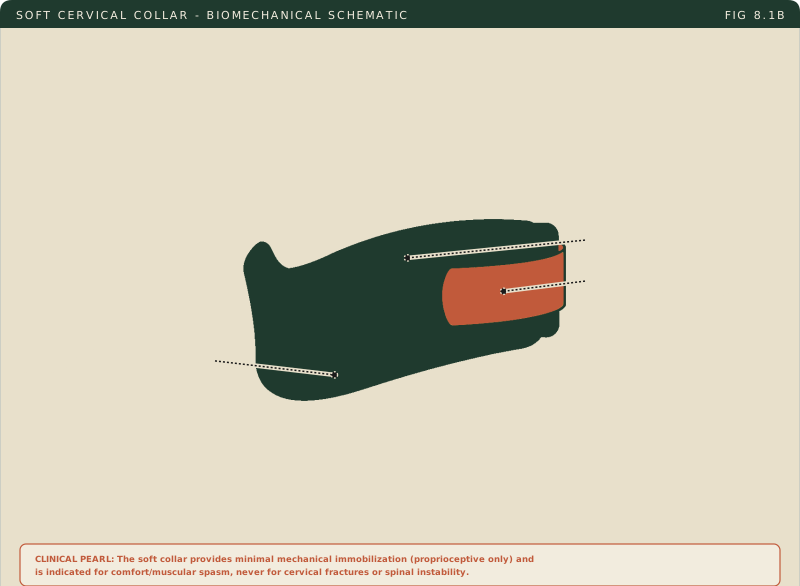
The soft collar is a flexible foam collar covered in fabric. It provides minimal restriction in all planes and does not provide meaningful immobilization. It should never be relied upon for cervical instability or fracture management. Its primary function is warmth, proprioceptive feedback, and psychological comfort. Indications: minor cervical strain or sprain, whiplash-associated disorder, post-collar weaning, comfort after minor procedures.
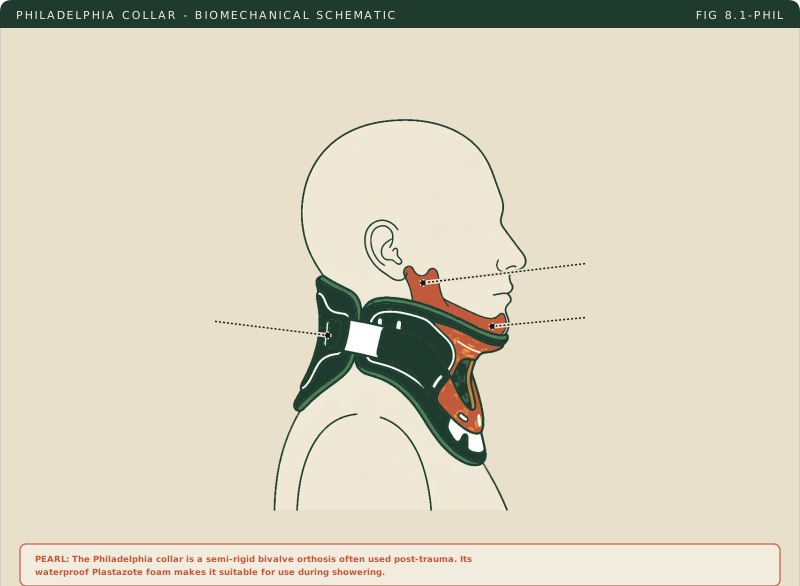
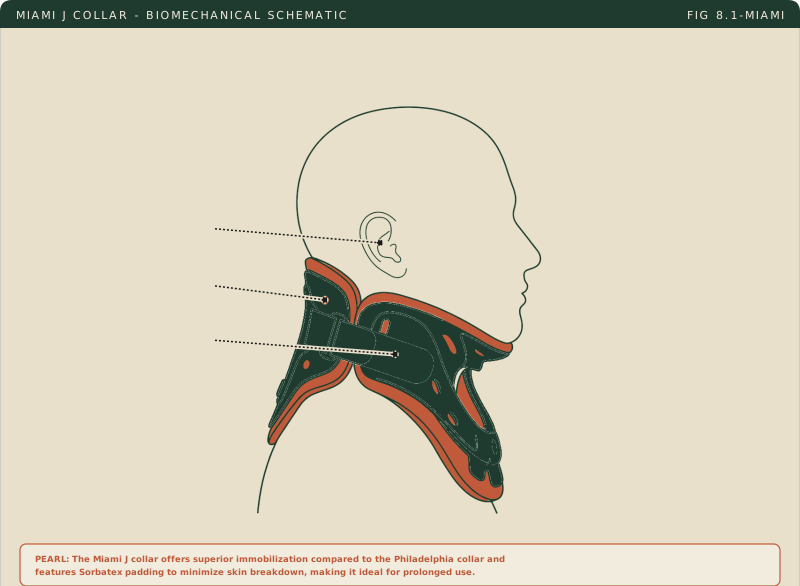
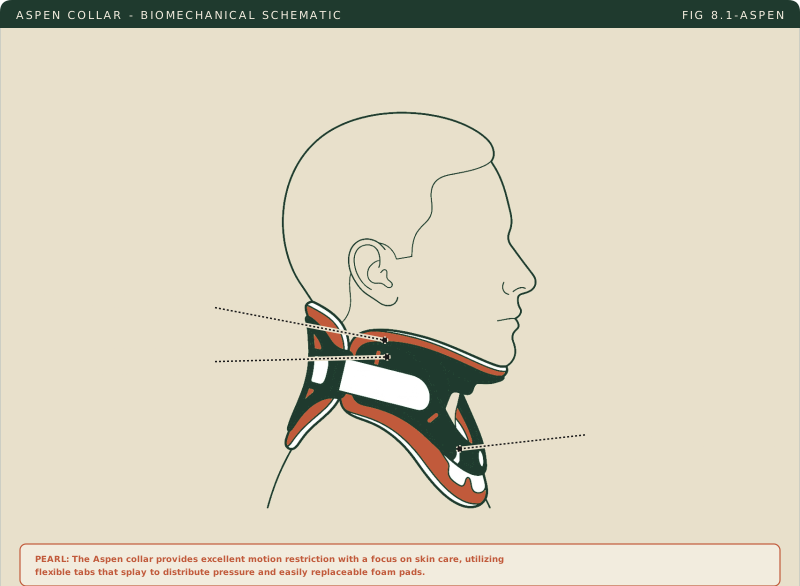
The Philadelphia collar is a two-piece rigid polyethylene foam orthosis connected by Velcro straps, restricting flexion ~71%, extension ~70%, lateral bending ~34%, and rotation ~56%. The anterior opening allows tracheostomy access. Indications: stable cervical fractures (C3-C7), post-surgical support, acute cervical injuries requiring moderate immobilization. It cannot adequately control upper cervical (C1-C2) injuries because it lacks thoracic extension. The Miami J collar is a similar two-piece rigid cervical orthosis with enhanced adjustability and ventilation, with adjustable height, perforated padding, and removable washable liners that help prevent skin breakdown. The Aspen collar has a four-piece padded liner system allowing individual pad replacement without removing the collar, particularly useful during prolonged collar use. Prolonged rigid-collar wear carries its own complications — pressure ulcers, aspiration and pneumonia, deep vein thrombosis, raised intracranial pressure, and a harder airway — arguing for prompt clearance and removal rather than leaving the collar on by default. More than 80% of adults require 1-5 cm of occipital padding to sit in neutral alignment relative to the torso; a collar applied without it holds the neck in unintended extension.
Board Trap — A rigid collar reduces motion at C5-C7, it does not immobilize it
This sounds like a contradiction with the composite Philadelphia figures above (71/70/34/56%) and is not. Segment-specific testing at C5-C7 tells a different story, because a rigid collar has no rigid anchor below C7 — nothing holds the bottom end, so the collar’s own rim becomes a fulcrum that concentrates residual motion at the cervicothoracic junction. At C5-C7 specifically, a rigid collar restricts flexion/extension only ~40%, lateral bending only ~30%, and rotation not at all in any meaningful sense — cadaveric testing cannot distinguish collared axial rotation from the normal physiologic range at any level except C1-C2. A halo tested at that same segment runs ~70%/75%/90% (F/E, LB, R), well below its own whole-spine 96/96/96/99 composite but still far beyond what a collar achieves at C5-C7. Both statements are true at once: adequate for a stable C3-C7 fracture, not an immobilizer for an unstable one — which is exactly why an unstable C3-C7 injury escalates past a collar to a device with a caudal thoracic anchor (CTO, Minerva) or a halo.
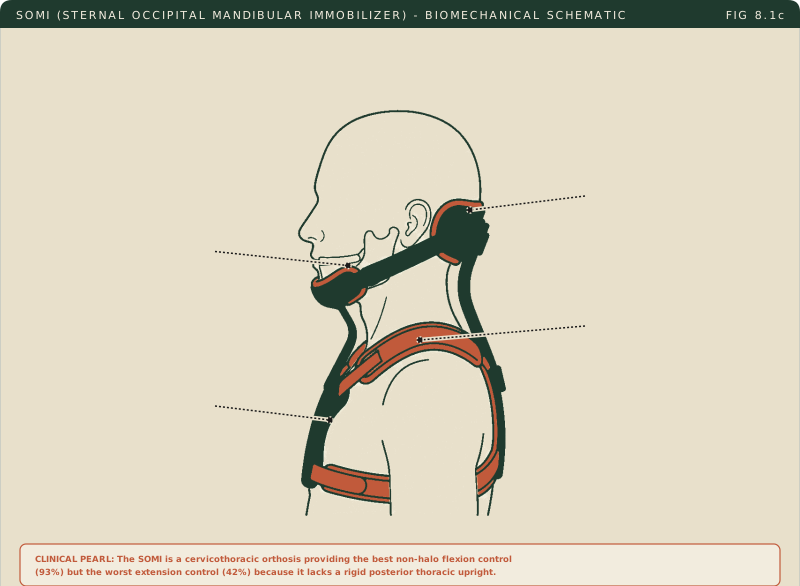
The SOMI (Sternal Occipital Mandibular Immobilizer) is a cervicothoracic device with a rigid sternal plate, occipital plate, and mandibular support connected by metal uprights. It restricts flexion 93% (BEST non-halo flexion control), extension only 42% (worst of any rigid cervical orthosis), lateral bending only 34%, and rotation 66%. The sternal plate provides robust anterior support, explaining the excellent flexion control. The mandibular piece can be removed for eating. The absence of a posterior thoracic component explains the poor extension control. The SOMI can be applied with the patient supine, advantageous for trauma patients. Indications: stable mid-to-lower cervical injuries where flexion control is the primary concern.
The four-poster brace has four adjustable metal uprights connecting anterior mandibular and posterior occipital plates to anterior and posterior thoracic plates, restricting flexion ~79%, extension ~73%, lateral bending ~53%, rotation ~56%. The posts are height-adjustable, so the head can be held in flexion or extension by changing anterior or posterior post length. Control is good in flexion and extension; lateral bending and rotation are the planes it does not hold. Indications: stable mid or low cervical fractures and cervical arthritis, not instability.
The Yale brace combines a rigid cervical collar with anterior and posterior thoracic extensions, restricting flexion ~87%, extension ~75%, lateral bending ~61%, rotation ~56%. It is more comfortable than the SOMI for ambulatory patients due to better weight distribution. Indications: mid-to-lower cervical injuries (C3-C7) requiring more control than a collar but less than a halo.
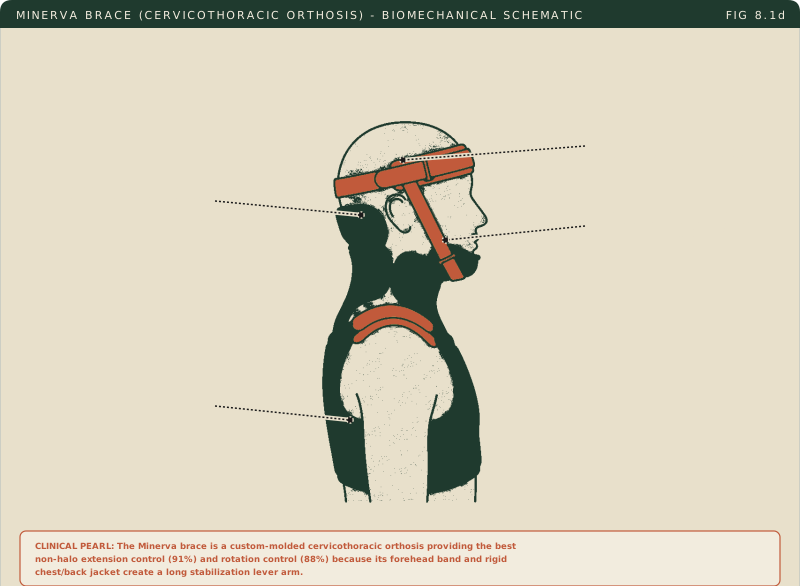
The Minerva body jacket is a custom-molded cervicothoracic orthosis with a circumferential forehead band and a rigid thermoplastic body jacket ending at the inferior costal margin (older jacket variants ran lower). Restrictions: flexion ~79%, extension 91% (BEST non-halo), and rotation 88% (BEST non-halo), and lateral bending ~51% (the Yale at 61% and the four-poster at 53% restrict lateral bending more). The circumferential forehead band controls every cervical plane, and the body jacket creates a long lever arm. Limitations: bulk and discomfort limiting compliance, and expensive custom fabrication.
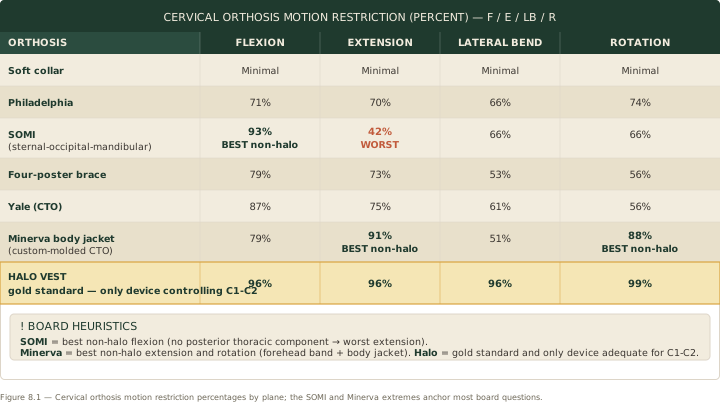
High Yield — Cervical orthosis motion restriction table
- Soft collar = proprioceptive; never for instability or fracture.
- Philadelphia = 71/70/34/56 (F/E/LB/R); two-piece rigid; tracheostomy opening; stable C3-C7.
- Miami J / Aspen = comparable to Philadelphia with better skin care features.
- SOMI = 93% flexion (BEST non-halo); only 42% extension (WORST, no posterior thoracic component); applies supine.
- Four-poster = 79/73/53/56 (F/E/LB/R); good sagittal control, poor lateral bending and rotation; adjustable upright height; for STABLE mid or low cervical fracture and arthritis.
- Yale (CTO) = 87/75/61/56 (F/E/LB/R); collar + thoracic vest; better tolerated than SOMI ambulatory.
- Minerva = 79/91/51/88 (F/E/LB/R); best non-halo extension and rotation; bulky, custom-molded.
- Halo vest = 96/96/96/99 (F/E/LB/R); only device with adequate C1-C2 control.
Mnemonic — SOMI Stops forward Motion (flexIon); Minerva masters Motion in extension and rotation
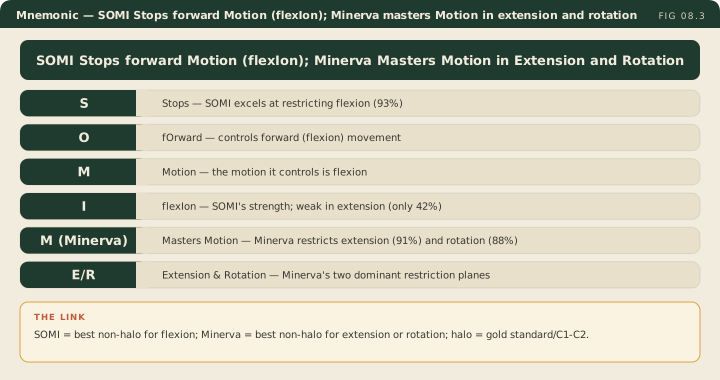
The SOMI Stops forward motion (flexIon, 93%); without a posterior thoracic strut, extension is its failure point at 42%. The Minerva has a circumferential forehead band that locks the head against rotation and posterior tilt; think Minerva as Master of Motion in extension (91%) and rotation (88%). Best non-halo flexion = SOMI; best non-halo extension or rotation = Minerva; gold standard or C1-C2 fracture = halo.
Because the SOMI lacks a posterior thoracic piece, it has the worst extension control of any rigid cervical orthosis at only about 42%.
— PO-08 podcast, ~11:01