Before You Listen
Episode Setup
- Topic in one line: the three mechanical classes of upper limb orthoses (static, dynamic, static-progressive) and the joint-naming convention (WHO, EWHO, SEWHO); the wrist-hand orthosis short list (resting hand, functional position, cock-up, thumb spica), the intrinsic-plus (safe) position that the resting hand splint and the acute burn hand splint share, and the position of function that contrasts with it; the dynamic wrist-finger extension orthosis for radial nerve palsy and the Kleinert and modified Duran tendon repair protocols; the wrist-driven flexor hinge orthosis (WDFHO) that converts active wrist extension into mechanical pinch in C6 tetraplegia, together with the SCI orthosis-by-cervical-level matrix (C4 sip-and-puff, C5 balanced forearm orthosis, C6 tenodesis splint, C7 triceps for transfers, C8 finger flexors with an intrinsic-minus claw, T1 intrinsics and near-normal hand); the master peripheral nerve injury–deformity–splint table (radial = wrist drop, cock-up; ulnar = claw hand, anti-claw; median = ape hand or hand of benediction, opponens) and the ulnar paradox explaining why low (distal) ulnar lesions claw worse than high (proximal) ones; the hinged elbow orthosis and the turnbuckle static-progressive splint; the airplane splint at 80 to 90 degrees versus the gunslinger at 15 to 20 degrees; the Sarmiento humeral functional brace, whose companion humeral shaft fracture carries the radial nerve palsy risk from the spiral groove while nonunion is the brace’s own main complication; and the rheumatoid arthritis and burn splinting positions that protect the joints most at risk in each disease.
- Prerequisites: functional anatomy of the brachial plexus and the three major peripheral nerves of the upper limb (radial, median, ulnar) with the muscles each innervates and the cutaneous distributions; the concept of tenodesis as passive finger flexion driven by wrist extension via the long flexor tendons; the segmental motor levels of the cervical spinal cord (C5 deltoid/biceps, C6 wrist extensors, C7 triceps, C8 finger flexors, T1 intrinsics); the viscoelastic properties of connective tissue (creep and stress relaxation) that underpin the static-progressive splinting principle.
- Runtime: 41 minutes.
Vignette. A 19-year-old man sustains a complete C6 spinal cord injury (American Spinal Injury Association Impairment Scale [AIS] grade A) in a diving accident. Six weeks into inpatient rehabilitation, manual muscle testing shows full strength of the deltoid, biceps, brachialis, and rotator cuff bilaterally; both wrist extensors (extensor carpi radialis longus [ECRL] and extensor carpi radialis brevis [ECRB]) test 4/5; triceps and all finger flexors and intrinsic hand muscles test 0/5. He has been working with the occupational therapist on transfer mechanics and beginning to use a manual wheelchair with rim modifications. The therapist reports that he has been performing aggressive passive finger flexor stretching during evening wash-out routines and that his finger flexors now feel “loose” on passive ranging. He is highly motivated and has a supportive family. He asks what orthosis would maximize his independence in feeding, grooming, and writing.
Which upper extremity orthosis is the device of choice at this neurological level, what muscles must be intact for the orthosis to function, what specific rehabilitation behavior described in the vignette could undermine the orthosis even if it is appropriately fitted, and what is the approximate pinch force this orthosis generates and what category of activities does that force support?
(Answer at the end of this chapter)
Section 1: The Three Splint Classes and the Wrist-Hand Orthosis Family
Bottom line: upper extremity orthoses are classified by mechanical function as static (no movable parts, immobilize), dynamic (springs/rubber bands/outriggers, apply constant mobilizing force), or static-progressive (turnbuckle/ratchet, hold at end-range with non-elastic incremental adjustment); the wrist-hand orthosis family includes the resting hand splint, the functional position splint with the thumb in opposition, the cock-up splint set in extension for radial nerve palsy and set at neutral for a carpal tunnel night splint, and the thumb spica for de Quervain, scaphoid fracture, and gamekeeper’s thumb; the resting hand splint and the acute burn hand splint are the same device in the same intrinsic-plus (safe, anti-deformity) position, with the wrist in 20 to 30 degrees of extension, the MCPs in 70 to 90 degrees of flexion, the IPs in full extension, and the thumb in palmar abduction, which stands in contrast to the position of function used when the goal is usefulness rather than contracture prevention.
Upper extremity orthoses serve four overlapping functions: immobilization, mobilization, restriction, and functional substitution. The choice of strategy depends on the underlying pathology, the phase of tissue healing, and the patient’s functional goals. Before naming a specific device, the prescriber commits to one of three mechanical categories, because the category determines the indication.
Static orthoses have no movable components. They rigidly hold a joint or chain of joints in a fixed position. Their roles are to protect healing structures, prevent unwanted motion, maintain joint alignment, and prevent contracture. The principle is complete rest of the target tissue. Indications include acute inflammation, post-surgical immobilization, fracture management, and nighttime positioning during nerve recovery. Dynamic orthoses contain movable elements (rubber bands, springs, outrigger systems) that apply a controlled mobilizing force, allowing or assisting joint motion in a therapeutic direction. Indications include tendon repair protocols, nerve palsy substitution, and contracture management following the low-load prolonged stretch (LLPS) principle. Static-progressive orthoses are hybrids: like static splints they have no elastic components, but they incorporate an adjustable mechanism (turnbuckle, serial cast, ratchet) that the clinician or patient incrementally advances to progressively stretch a contracted joint. Tissue is held at its current end-range without elastic recoil and undergoes creep (gradual deformation under sustained load) and stress relaxation (decreasing resistance at a maintained length).
The dynamic versus static-progressive distinction is heavily tested. Dynamic equals constant mobilizing force via elastic elements. Static-progressive equals end-range hold via a non-elastic, incrementally adjustable mechanism. Both target range of motion. Dynamic recoils as the joint approaches end-range; static-progressive does not recoil at all, so the tissue creeps at the new length.
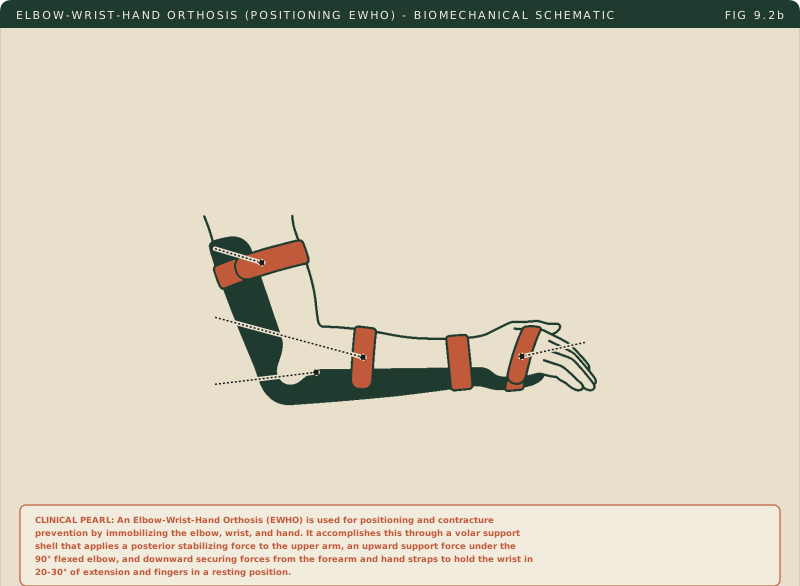
Upper extremity orthoses are named by the joints they cross: WHO (wrist-hand), EWHO (elbow-wrist-hand), and SEWHO (shoulder-elbow-wrist-hand).
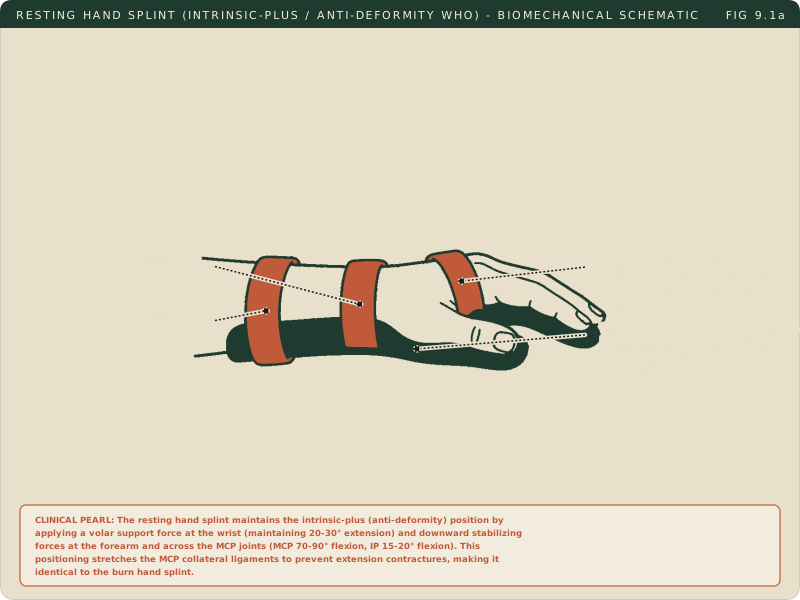
The resting hand splint is the workhorse static WHO, a wrist-hand-finger orthosis that runs from the fingertips to the proximal two-thirds of the forearm and is usually applied to the volar surface. It positions the hand in the intrinsic-plus position, also called the safe or anti-deformity position: wrist in 20-30 degrees of extension, MCP joints in 70-90 degrees of flexion, IP joints in full extension, and the thumb in palmar abduction with its MCP and IP joints extended. Every one of those choices serves a single goal, which is to hold both sets of collateral ligaments at their longest so the joint capsules cannot contract. The MCP collateral ligaments are lax in extension and taut in flexion, so the MCPs are flexed to 70-90 degrees to prevent the MCP extension contracture that develops in the edematous or immobilized hand. The IP collateral ligaments and volar plate shorten in flexion, so the IPs are held straight. The thumb sits in palmar abduction to keep the first web space open, which also leaves it positioned for opposition and three-jaw-chuck pinch. Indications include rheumatoid arthritis flares, post-surgical immobilization, acute inflammation, general hand burns, and overnight positioning during nerve recovery.
The acute burn hand splint is this same splint in this same position. The resting hand splint is the device used for anti-deformity positioning of the general hand burn, and the intrinsic-plus position is exactly what the burned hand needs, because the burned, edematous hand collapses into a predictable position of deformity: MCP extension, IP flexion, thumb adduction into the palm, and wrist flexion. The intrinsic-plus splint reverses each of those tendencies at the joint where it occurs. At the IPs, a flexed posture lets the volar plate scar and lock the finger into a flexion contracture, and a dorsal burn over the PIP threatens the central slip of the extensor mechanism, which is exactly the setup for a boutonnière deformity; holding the IPs at zero protects both. At the thumb, palmar abduction keeps the first web space open, because a web space that scars closed abolishes pinch and grasp. The burn-specific modifications are two: the hand with exposed extensor tendons, where the tendons are deliberately put on slack to prevent central slip failure and a resulting boutonnière, and the palmar burn, splinted with the MCPs and IPs extended and the fingers and thumb abducted so the palm is held open against contracture. Section 5 gives the full joint-by-joint burn protocol.
The functional position splint holds the hand in the position of function, which is a genuinely different posture from the intrinsic-plus position and differs from it at the MCPs, the IPs, and the thumb: wrist in about 20 degrees of extension, MCPs in roughly 45 degrees of flexion, PIPs in about 30 degrees and DIPs in about 20 degrees of flexion, and the thumb in opposition with the pad facing the fingertips. The trade is deliberate. The intrinsic-plus position is the best posture for preventing contracture; the position of function is the best posture for using the hand, and it is chosen when usefulness rather than contracture prevention is the goal. It is used when motor recovery is anticipated (post-stroke, post-nerve injury) so the patient can resume functional grasp the moment recovery occurs, and it is the orthosis of choice for combined high median-ulnar nerve palsy, where every intrinsic is lost and the hand needs to be parked in the most useful possible static posture.
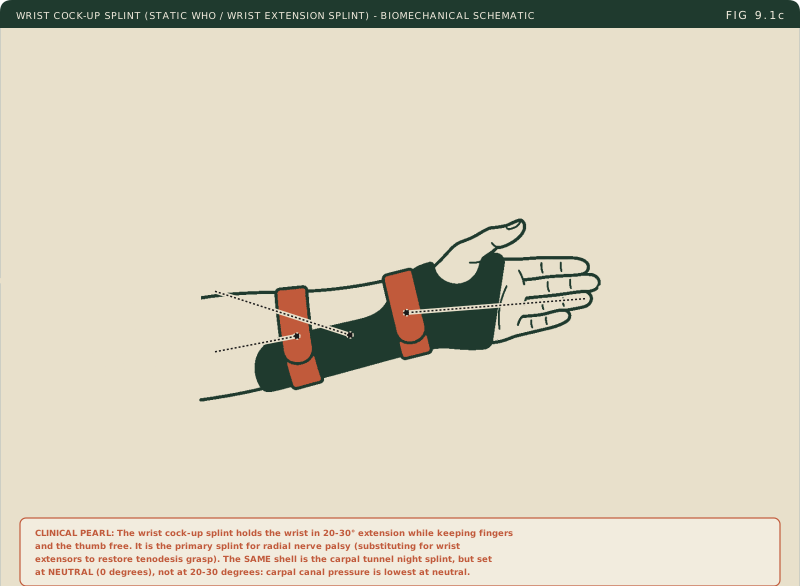
The cock-up splint, also called the wrist extension splint, is a static WHO that maintains the wrist in 20-30 degrees of extension while leaving the fingers and thumb completely free. Volar (palmar) cock-up designs lie on the palmar surface (excellent wrist support, partially blocks palmar sensation and grip). Dorsal cock-up designs lie dorsally and free the palm, which is preferred when palmar clearance for grip and sensation matters. The most-tested indication is radial nerve palsy (wrist drop): the splint substitutes for paralyzed wrist extensors and restores the tenodesis effect for grip. Other indications for the 20-30 degree setting are wrist extensor tendinitis, de Quervain tenosynovitis (with a thumb component), and general wrist pain.
The carpal tunnel night splint is the same shell set at NEUTRAL, 0 degrees, with a practical tolerance of about 5 degrees either side, and it is the one indication that does not take the 20-30 degree setting. Carpal canal pressure measured directly inside the canal is lowest within a couple of degrees of neutral, sonographic measures of median nerve flattening are lowest at neutral, and the one randomised comparison of splint angles found neutral relieved symptoms better than 20 degrees of extension. Be precise about the harm: extension at 20-30 degrees does not injure the median nerve overnight. What it does is move the wrist off the measured pressure minimum in a canal that is already hypertensive at neutral in this disease, so the conservative trial underperforms and the patient escalates to injection or surgery sooner than they needed to.
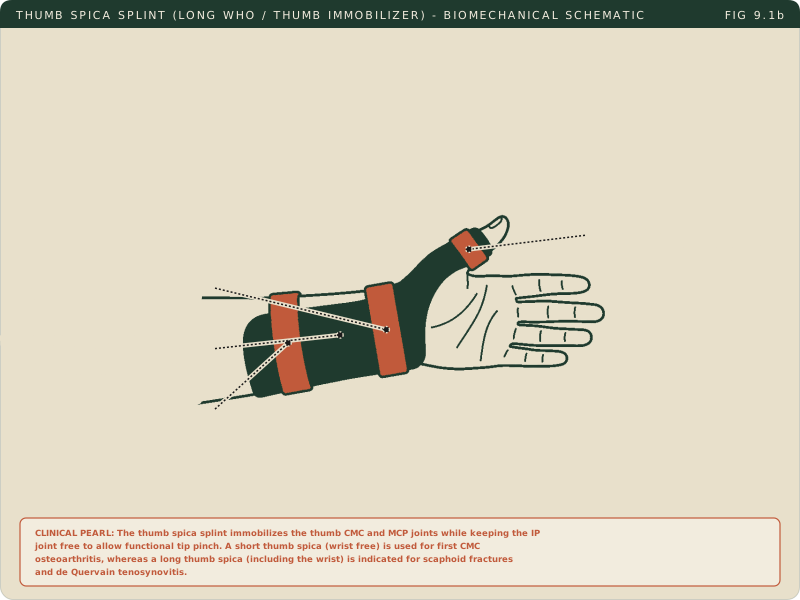
The thumb spica splint immobilizes the thumb carpometacarpal (CMC) and MCP joints, with the IP joint typically free to preserve tip pinch. Short thumb spica immobilizes the thumb only with the wrist free (first CMC osteoarthritis). Long thumb spica includes wrist immobilization (scaphoid fracture, because the scaphoid sits at the base of the thumb ray). Indications include de Quervain tenosynovitis (APL and EPB tendinitis at the first dorsal compartment), gamekeeper’s or skier’s thumb (UCL injury at thumb MCP), scaphoid fracture (long), first CMC OA, Bennett fracture, and thumb MCP or CMC sprains. The IP joint is left free to preserve tip pinch.
Source: Mikael Granberg, “Full hand orthose backside” — CC BY-SA 4.0. https://commons.wikimedia.org/wiki/File:Full_hand_orthose_backside.jpg
High Yield — Mechanical classification and the wrist-hand orthosis family
- Static orthoses = no movable parts; immobilize and protect (post-surgical, RA flare, nerve recovery overnight).
- Dynamic orthoses = springs, rubber bands, outriggers; apply CONSTANT mobilizing force; for nerve palsy substitution, tendon repair protocols, and contracture stretch (LLPS).
- Static-progressive orthoses = turnbuckle or ratchet; NON-elastic incremental adjustment to end-range; exploits creep and stress relaxation.
- Naming: WHO (wrist-hand), EWHO (elbow-wrist-hand), SEWHO (shoulder-elbow-wrist-hand).
- Resting hand splint = intrinsic-plus (“safe”, anti-deformity) position: wrist 20-30 deg extension, MCP 70-90 deg flexion, IPs in FULL extension, thumb in palmar abduction.
- Acute burn hand splint = the resting hand splint. Same device, same intrinsic-plus position. The burn-specific modifications are two: exposed extensor tendons go on slack to prevent central slip failure, and a palmar burn is splinted with MCPs and IPs extended and the fingers and thumb abducted.
- Functional position splint = the position of function, a different posture: wrist ~20 deg extension, MCP ~45 deg flexion, PIP ~30 deg and DIP ~20 deg flexion, thumb in opposition; choice for combined high median-ulnar palsy and for anticipated motor recovery.
- Cock-up splint = one shell, two settings. Wrist 20-30 deg extension, fingers free, for radial nerve palsy (restores tenodesis) and wrist extensor tendinitis. Wrist at NEUTRAL (0 deg) for the carpal tunnel night splint, because carpal canal pressure and median nerve deformation are both lowest at neutral.
- Thumb spica = CMC + MCP immobilized, IP free; SHORT (thumb only) for first CMC OA; LONG (includes wrist) for scaphoid fracture; also de Quervain and gamekeeper’s thumb.
Board Trap — Intrinsic-plus (safe) position versus the position of function
The confusable pair in hand splinting is not resting-versus-burn. The resting hand splint is the burn hand splint: it is the device used for anti-deformity positioning of the general hand burn, and resting, intrinsic-plus, safe, and anti-deformity are four names for one position. The real contrast is between that position and the position of function, and the two differ at the MCPs, the IPs, and the thumb.
| Joint | Intrinsic-plus (resting / safe / anti-deformity) | Position of function |
|---|---|---|
| Wrist | 20-30 degrees extension | About 20 degrees extension |
| MCP | 70-90 degrees flexion | About 45 degrees flexion |
| PIP / DIP | Full extension (0 degrees) | PIP ~30 degrees, DIP ~20 degrees flexion |
| Thumb | Palmar abduction, MCP and IP extended | Opposition |
The intrinsic-plus position is chosen whenever the goal is to prevent contracture, because it is the one posture that holds both sets of collateral ligaments at their longest at the same time. The MCP collaterals are lax in extension and taut in flexion, so the MCPs are flexed; the IP collaterals and volar plate shorten in flexion, so the IPs are held straight. That is why it is the position for a burned, edematous, or immobilized hand. The position of function is chosen when the goal is usefulness rather than contracture prevention: a hand parked in its most functional static posture during anticipated motor recovery, or one that has lost every intrinsic to combined high median-ulnar palsy.
There is no “15 to 20 degrees” anywhere in the hand here. A stem that offers “IP joints in 15 to 20 degrees of flexion” as the resting, safe, or anti-deformity hand position is wrong: in that position the IPs go to full extension. The IPs are softly flexed only in the position of function, and there the PIP sits nearer 30 degrees.
Mnemonic — “Intrinsic-plus protects; the position of function performs”
Two hand positions, two different jobs.
- Intrinsic-plus (the resting hand splint, the burn hand splint, the safe position, the anti-deformity position, all one thing): bent knuckles, straight fingers. MCPs 70-90 degrees flexed, IPs at zero, thumb in palmar abduction. Its job is to keep every collateral ligament long so nothing contracts.
- Position of function (the functional position splint): everything softly curled, thumb opposed, as though holding a can. Wrist about 20 degrees extension, MCPs about 45 degrees flexion, PIPs about 30 degrees, DIPs about 20 degrees, thumb in opposition. Its job is to make the hand useful.
One sentence: bent knuckles with straight fingers protect the hand; a softly curled hand with an opposed thumb uses it.
If you yank a piece of cold taffy quickly, it just snaps in half. The tissue fails. But if you hold a steady, locked, gentle pull on it, it slowly and smoothly elongates without breaking.
— PO-09 podcast, ~5:47