Before You Listen
- Prerequisites: lower extremity (LE) amputation levels (Syme, transtibial [TT], transfemoral [TF]), Medicare Functional Classification Levels (K0-K4), socket and suspension basics from PO-04/PO-05, and the diabetic foot exam (protective sensation, monofilament, pulses).
- Runtime: 53 minutes.
- Topic in one line: the dysvascular triad (82%/55%/50%), the ankle-brachial index (ABI) with the falsely elevated diabetic value rescued by toe-brachial index (TBI), total contact casting (TCC) for neuropathic plantar ulcers, Eichenholtz staging of Charcot foot with the prodromal Stage 0 seen on MRI after normal radiographs, the Medicare Therapeutic Shoe Program (two unlettered baskets), bilateral TT versus bilateral TF energy hierarchy with stubbies for TF training, geriatric predictors (cognition over age), the J-shaped Cheetah running blade, and the Intrepid Dynamic Exoskeletal Orthosis (IDEO) with OEF/OIF return-to-duty (RTD) data.
Vignette. A 68-year-old woman with type 2 diabetes mellitus, hypertension, and chronic kidney disease presents eight weeks after a right transtibial amputation for a non-healing plantar ulcer. Hospital records list a left ankle-brachial index (ABI) of 1.45, which the discharging surgeon documented as “normal vascular status.” She uses a wheelchair full-time and asks when she can walk again. Her left foot has dense protective-sensation loss, a healed callus over the second metatarsal head, and a warm, swollen midfoot with intact pulses; plain radiographs show fragmentation at the tarsometatarsal joints. Mini-Mental State Examination (MMSE) is 27 of 30 and motivation is high.
How should the left ABI be interpreted, what alternative vascular study should you order, what is the diagnosis at the left midfoot and which Eichenholtz stage applies, what is the immediate offloading prescription, and what factors most strongly determine her prosthetic prognosis on the right?
(Answer at the end of this chapter)
Section 1: Dysvascular Amputees — ABI Interpretation — and the Diabetic Vascular Trap
Bottom line: dysvascular disease accounts for 82% of lower extremity (LE) amputations, with diabetes contributing roughly two-thirds of all LE amputations; 55% of diabetic amputees lose the contralateral limb within 2 to 3 years and nearly 50% die within 5 years; the ankle-brachial index (ABI) is the primary screening test, but values greater than 1.40 in diabetic or renal patients are falsely elevated from medial calcification and require toe pressures (TBI) for accurate assessment.
Dysvascular disease, encompassing peripheral arterial disease (PAD) and diabetic vasculopathy, is by far the leading cause of lower extremity amputation. Three statistics anchor this section and appear repeatedly on the board: 82% of LE amputations are dysvascular, 55% of diabetic amputees require a contralateral amputation within 2 to 3 years, and nearly 50% of dysvascular amputees die within 5 years of the index amputation. Diabetes contributes roughly two-thirds of all lower-extremity amputations. The majority of LE amputations occur in patients over age 60, and modifiable risk factors include smoking, uncontrolled diabetes, hypertension, hyperlipidemia, and renal disease. These numbers reflect a systemic vascular process, not a local limb problem, and coronary heart disease is the leading cause of death in long-term follow-up; the contralateral limb demands aggressive surveillance, and rehabilitation goals must account for shortened life expectancy when prescribing high-technology prosthetic systems.
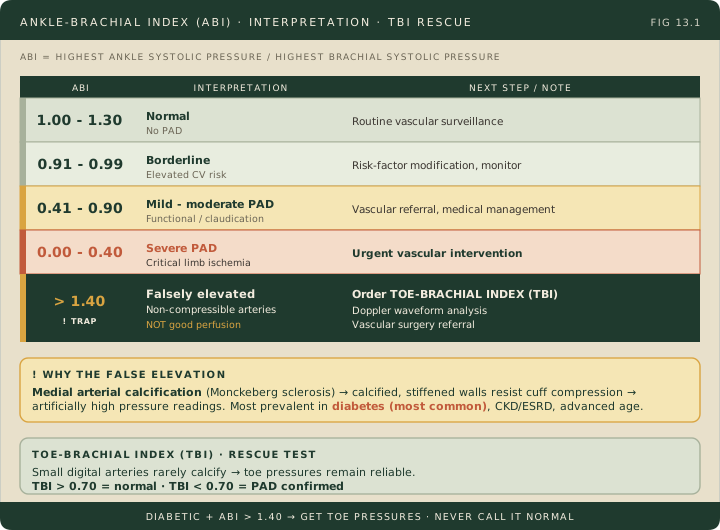
The ankle-brachial index (ABI) is the primary non-invasive screening tool for PAD. It is calculated by dividing the highest ankle systolic pressure (dorsalis pedis or posterior tibial) by the highest brachial systolic pressure. The 2024 ACC/AHA lower extremity PAD guideline reports the resting ABI in four categories: normal 1.00-1.40, borderline 0.91-0.99, abnormal (diagnostic of PAD) 0.90 or less, and non-compressible above 1.40. Normal runs all the way to 1.40, not to 1.30, so a value of 1.35 is normal and does not by itself call for a toe-brachial index. Older texts cut the top of normal at 1.30 and call anything above it non-compressible; that convention comes from the 2005 guideline and was replaced in 2011, so recognize the legacy number without answering from it. Below 0.90 the guideline stops at “abnormal,” and the familiar severity split (0.41-0.90 mild to moderate, 0.40 or less severe; critical limb ischemia is the clinical syndrome of rest pain, non-healing wound or gangrene with PAD, not an ABI value alone) is a vascular-laboratory descriptive convention rather than guideline content. Values greater than 1.40 do not indicate excellent perfusion; they indicate non-compressible arteries.
The falsely elevated ABI is the most testable concept in the dysvascular section. In diabetic patients, the ABI frequently produces values greater than 1.40 because of medial arterial calcification, also known as Monckeberg sclerosis. The calcified, stiffened arterial walls resist compression by the blood pressure cuff, generating artificially high pressure readings that mask underlying arterial insufficiency. The phenomenon is most prevalent in diabetes (most common cause), chronic kidney disease and end-stage renal disease, and advanced age. The rescue test is the toe-brachial index (TBI). The small digital arteries of the toes rarely undergo medial calcification, so toe pressure measurements remain reliable even when ankle pressures are non-compressible. Normal TBI is greater than 0.70; a TBI of 0.70 or less confirms PAD. When a stem describes a diabetic or renal patient with an ABI greater than 1.40, the correct next step is to obtain toe pressures or a TBI.
Dysvascular amputees demand a different prosthetic prescription than traumatic amputees. Component selection should favor lighter components (reducing already-elevated energy demand from combined amputation and cardiovascular disease), simplified suspension systems because peripheral neuropathy and arthritis impair the dexterity needed for suction donning, and supracondylar or sleeve systems for the patient who cannot see or feel a pin into its lock (a pin-and-lock still needs the pin aligned). Gel liners protect fragile, poorly healing skin and distribute pressure across wide socket margins to reduce shear. Rehabilitation should set conservative gait-training goals, prescribe frequent skin checks because insensate skin tolerates pressure poorly, perform aggressive contralateral limb surveillance given the 55% contralateral amputation rate, and teach energy conservation strategies.
High Yield — Dysvascular statistics, ABI, and TBI
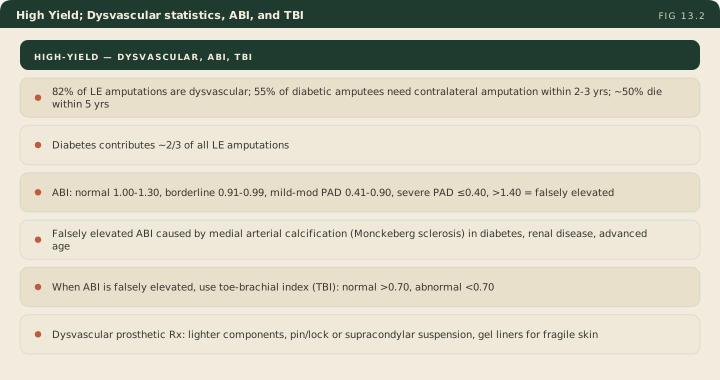
- Triad to memorize: 82% of LE amputations are dysvascular; 55% of diabetic amputees require contralateral amputation within 2-3 years; ~50% of dysvascular amputees die within 5 years.
- Diabetes contributes ~2/3 of all LE amputations.
- ABI bands (2024 ACC/AHA): 1.00-1.40 normal, 0.91-0.99 borderline, ≤0.90 abnormal (PAD), >1.40 non-compressible (falsely elevated). The severity split below 0.90 (0.41-0.90 mild-moderate, ≤0.40 severe/critical limb ischemia) is a vascular-lab convention, not guideline content; the 1.30 top-of-normal is the superseded 2005 cutoff.
- Falsely elevated ABI in diabetes/renal disease/advanced age = medial arterial calcification (Monckeberg sclerosis); vessels are non-compressible.
- Rescue test = toe-brachial index (TBI). Normal TBI >0.70; abnormal ≤0.70.
- Dysvascular prosthetic prescription: lighter components, simplified suspension (pin/lock, or supracondylar/sleeve when the pin cannot be seen or felt into its lock), gel liners for fragile skin, contralateral limb surveillance.
Board Trap — A diabetic ABI of 1.45 is NOT a normal vascular exam
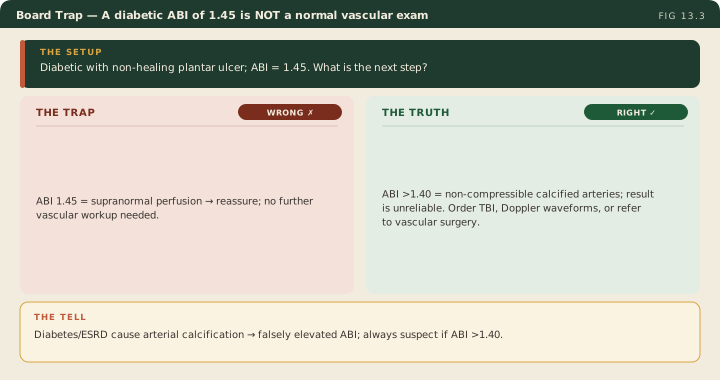
A vignette describes a diabetic with a non-healing plantar ulcer and an ABI of 1.45 and asks for the next step. The trap is to interpret 1.45 as “normal or supranormal perfusion” and pick reassurance. The discriminator: ABI greater than 1.40 means non-compressible arteries, not good flow. Vessels are calcified, so the cuff cannot occlude them. Correct next step: toe pressures (TBI), Doppler waveform analysis, or vascular surgery referral. The same trap applies to ESRD and the very elderly.
The intuitive but completely wrong clinical instinct is to think that a higher number means robust, excellent blood flow. But an ABI greater than 1.40 does not mean excellent blood flow.
— PO-13 podcast, ~6:55