Before You Listen
Before You Listen
- Prerequisites: lower extremity amputation level vocabulary (Syme, transtibial [TT], transfemoral [TF], hip disarticulation), Medicare Functional Classification Levels (K0-K4) and their component templates from earlier episodes, and a working understanding of basic exercise physiology (oxygen consumption, walking speed, heart rate).
- Runtime: 38 minutes.
- Topic in one line: the energy expenditure hierarchy from Syme to bilateral TF and the vascular-versus-traumatic premium at every level, the rate-versus-cost distinction with self-selected walking speed as the compensatory mechanism, the K-level system with its 2024 K2 microprocessor knee (MPK) coverage expansion and five well-defined limitations, the Amputee Mobility Predictor (AMP) with its uniquely high reliability and pre-prosthetic predictive value, the patient-reported outcome batteries (PLUS-M, ABC, OPUS, Houghton, SCS, PEQ, TAPES) with the COMPASS recommended set, and the functional prognosis grid that anchors prosthetic prescription and counseling.
Vignette. A 54-year-old man underwent a left transfemoral amputation 6 months ago after a motorcycle crash. He has no diabetes, no peripheral arterial disease, and a strong premorbid activity history. His current Amputee Mobility Predictor with prosthesis (AMPPRO) score is in the upper third of published norms, his Six-Minute Walk Test (6MWT) distance is 432 meters, and his Activities-specific Balance Confidence (ABC) Scale score is 78%. His Socket Comfort Score (SCS) on the most recent visit was 4 of 10. He is requesting a microprocessor knee (MPK) and asks how oxygen cost compares to his pre-amputation baseline. His Medicare K-level was assigned as K2 by his prosthetist on the basis of “limited community ambulation.”
How should you interpret his AMPPRO and 6MWT in the context of K-level assignment, what does an ABC score of 78% indicate about fall risk, why is the SCS less reliable than the other measures, and what changed in September 2024 that affects his MPK candidacy?
(Answer at the end of this chapter)
Section 1: The Energy Expenditure Hierarchy and the Rate-Versus-Cost Trap
Bottom line: walking energy cost rises with more proximal amputation level and is higher in vascular than traumatic amputees at every level; the hierarchy from least to most demanding is Syme < unilateral TT < bilateral TT < unilateral TF < bilateral TF, with hip disarticulation and hemipelvectomy together in the 80-125% range; amputees self-select a slower walking speed to keep oxygen consumption rate near normal, but oxygen cost per meter is elevated.
The metabolic cost of walking with a prosthesis increases with more proximal amputation levels and with vascular versus traumatic etiology. This relationship, originally established by Waters and colleagues (1970s-1990s) and confirmed by modern meta-analyses, has direct implications for prosthetic prescription, rehabilitation goals, and prognosis. Two energy measures are clinically important and often confused. Oxygen consumption rate (mL O2/kg/min) measures metabolic demand per unit time. Oxygen cost (mL O2/kg/m) measures metabolic expense per unit distance traveled and accounts for walking speed; higher values mean it takes more energy to cover each meter.
The board concept tested repeatedly: amputees self-select a walking speed that keeps oxygen consumption rate near comfortable levels. As amputation level increases, patients walk more slowly to keep RATE within tolerable limits, but because they cover less distance per unit of energy, oxygen COST per meter increases. This compensatory mechanism explains why oxygen consumption rate may appear near-normal while oxygen cost per meter is clearly elevated; cost per meter is rate divided by speed, and because rate also falls at slower speeds the relationship is U-shaped, so slowing from above the optimum can lower cost while slowing below it raises cost again. A vignette describing a TF amputee’s near-normal oxygen consumption rate during walking is not asking whether the patient walks efficiently; it is asking whether the test-taker recognizes that the slower self-selected speed has artificially preserved the rate measure while cost per meter remains elevated.
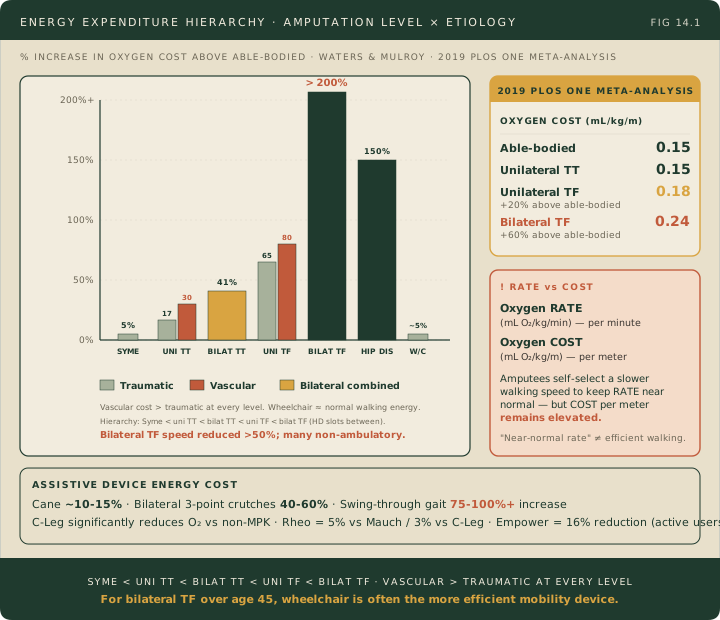
The energy expenditure hierarchy is among the most-tested facts in the prosthetic domain, and every number in it is oxygen cost per unit distance at self-selected speed. Syme amputation produces a minimal increase, about 15 percent in the board table. Unilateral TT traumatic raises walking energy 10-25% with 10-15% speed reduction; unilateral TT vascular raises it about 40%. Bilateral TT raises it approximately 41% with speed decreased 20-30%. Unilateral TF traumatic raises oxygen cost per metre roughly 55-65%, with self-selected speed falling to about two-thirds of normal (a 30-35% reduction); unilateral TF vascular raises it 100-120%, with speed falling to about half. Bilateral TF raises energy greater than 200% above normal with speed reduced more than 50%, often making patients non-ambulatory. Hip disarticulation and hemipelvectomy raise cost per unit distance 80-125% with comfortable speed at 51-61% of controls (Nowroozi F, Salvanelli ML, Gerber LH. Arch Phys Med Rehabil. 1983;64(7):300-303; PMID 6860105). Read that range as covering the two levels together: it is not a hip-disarticulation-only figure, and the study is n=8 hip disarticulation plus n=10 hemipelvectomy and has never been replicated. Vascular amputees consistently demonstrate higher metabolic costs than traumatic at the same level.
Two modern datasets sit underneath the classic table, and both are lower. The meta-analysis to cite is Ettema S, Kal E, Houdijk H (Prosthet Orthot Int. 2021;45(5):417-427; PMID 34538817), which pooled gross oxygen cost per metre at self-selected speed and found non-vascular TT +12%, vascular TT +36%, non-vascular TF +41% and vascular TF +102%; the authors attribute the gap to Waters’ small subgroups and a possibly unrepresentative sample. In a highly rehabilitated cohort of severely injured military personnel, unilateral TF cost 0.18 vs 0.15 mL/kg/m, a 20% increase, unilateral TT was indistinguishable from able-bodied, and bilateral TF was 0.24, a 60% increase (Jarvis HL, Bennett AN, Twiste M, Phillip RD, Etherington J, Baker R. Arch Phys Med Rehabil. 2017;98(7):1389-1399; PMID 27865845). Answer the classic table on the exam and know the modern values are lower. Note the vascular estimates rest on three study subgroups each and are the weakest cells in the modern table.
One further band has to be kept out of that column. A frequently quoted 30-60% for transfemoral amputees is not a competing cost-per-distance figure: it is net energy expenditure rate measured at speeds matched to controls (Genin JJ, Bastien GJ, Franck B, Detrembleur C, Willems PA. Eur J Appl Physiol. 2008;103(6):655-663; PMID 18478251), so the slowing that the classic table folds in has been deliberately controlled out. The two are different measures on different conditions, not two opinions about one quantity.
Board answer vs. current evidence — Bilateral transfemoral amputation increases the energy cost of walking by greater than 200% above normal — this is likely the board-tested answer, but more recent evidence indicates in young, fit bilateral transfemoral amputees with modern prosthetics, this increase can be as low as roughly 60%, as the actual magnitude varies widely with age, etiology, and prosthetic technology. Answer the board-canonical version on the test.
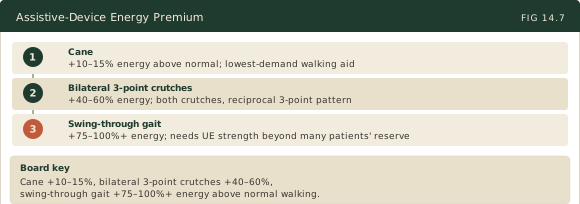
For higher-level amputations, particularly bilateral TF, wheelchair mobility may be more energy-efficient than prosthetic ambulation. Wheelchair propulsion on level ground costs only about 9% more energy than normal walking — roughly comparable to normal walking as a moment-to-moment rate at self-selected speed — though the cost per unit distance runs higher, making it the more practical primary mobility device when bilateral TF demands (>200% above normal) exceed cardiovascular capacity. Cane use increases energy expenditure approximately 10-15% above normal. Bilateral 3-point crutch walking increases it 40-60%. Swing-through gait can increase it 75-100% or more, requiring upper extremity strength that exceeds many patients’ reserve.
Advanced prosthetic technology reduces metabolic demand. The C-Leg significantly reduces oxygen consumption at typical and fast speeds versus non-microprocessor knees. The Rheo Knee produces a 5% metabolic reduction versus the Mauch Knee and 3% versus C-Leg. MPK users demonstrate significantly increased physical activity in free-living environments, indicating that reduced per-step energy cost translates to greater daily activity. Reduced cognitive demand during ambulation is another MPK benefit. Powered ankle-foot systems (BiOM/Empower) reduce metabolic rate by 16% in highly active users with a 15% faster self-selected speed, though not all patients benefit equally.
High Yield; Energy expenditure hierarchy
- Hierarchy (least → most): Syme < unilateral TT < bilateral TT < unilateral TF < bilateral TF.
- Hip disarticulation and hemipelvectomy sit between unilateral TF traumatic and bilateral TF (80-125% increase, reported for the two levels together; Nowroozi 1983, PMID 6860105).
- Vascular > traumatic at every level.
- Bilateral TF: >200% above normal; walking speed cut by more than half; often non-ambulatory.
- Oxygen consumption RATE (mL/kg/min) = per minute; oxygen COST (mL/kg/m) = per meter.
- Self-selected slower speed keeps RATE near normal; COST per meter is elevated.
- Able-bodied O2 cost = 0.15 mL/kg/m; unilateral TF 0.18; bilateral TF 0.24 (2017 highly rehabilitated military cohort).
- Wheelchair propulsion: ~9% above normal walking (comparable by rate; higher cost per unit distance) vs >200% for bilateral TF prosthetic ambulation — the 9% vs >200% comparison is why bilateral TF patients are appropriately wheelchair users.
- Cane ~10-15% energy increase; bilateral crutches 3-point ~40-60%; swing-through 75-100%+.
- C-Leg reduces O2 consumption; Rheo = 5% reduction vs Mauch, 3% vs C-Leg; Empower = 16% reduction in active users with 15% faster speed.
Board Trap — Near-normal oxygen consumption RATE does not mean efficient walking
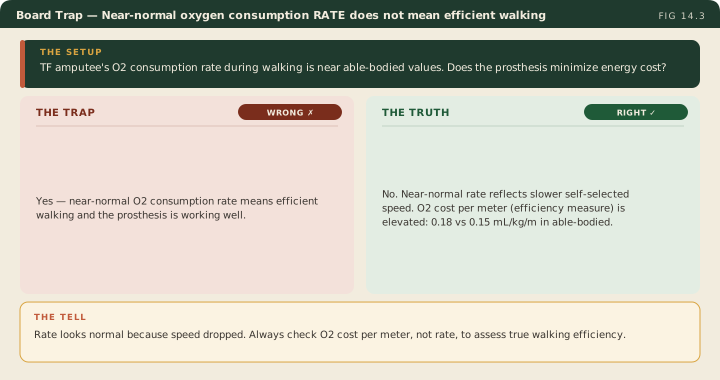
A vignette gives a TF amputee whose oxygen consumption rate during walking is near able-bodied values and asks whether the prosthesis “minimizes energy cost.” The trap is to pick yes. The discriminator: the near-normal rate reflects a slower self-selected speed, not improved efficiency. Oxygen cost per meter is the efficiency measure and is clearly elevated in TF amputees (0.18 vs 0.15 mL/kg/m for able-bodied). The patient is offsetting the metabolic penalty by walking more slowly. The same logic applies to bilateral TF patients whose heart rate and oxygen consumption rate may seem manageable on a treadmill at slow speed but whose per-meter cost remains greater than 200% above normal.
Slowing down cannot lower the oxygen cost per meter. It is mathematically and physiologically impossible in this context.
— PO-14 podcast, ~9:32
The knee is an incredibly expensive joint to replace metabolically. During the stance phase of normal gait, the knee acts as your primary shock absorber.
— PO-14 podcast, ~5:21